?
On revolutionary waves since the 16th century
P. 389–411.
Authors distinguished 12 waves in European countries from the sixteenth to twentieth century. We agree with seven of them (namely, the Calvinist I/Second Reformation from 1566; the Revolutions of 1830; the Revolutions of 1848; the Democratic/Constitutional revolutions of the beginning of the twentieth century; the revolutions following World War I; the revolutions following World War II; and the revolutions of 1989 and the collapse of communism) and disagree with the other waves (namely, the Calvinist II/Thirty Years’ War from 1618; the Atlantic Revolutions from 1773; the Greek War of Independence of 1821–1831; the Balkan Crisis of 1875; and the wave of Fascism in 1926–1939). Let us consider which of them we reject and why.
Publication based on the results of:
In book
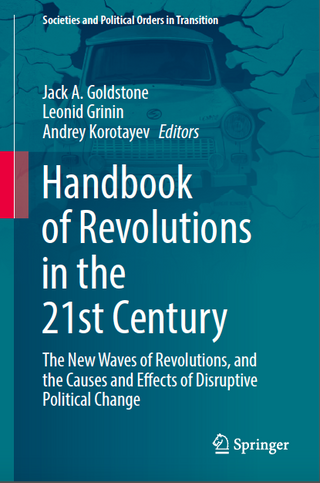
Grinin L. E., Korotayev A., Karasev D., Rozov N., Grinin A., Selbin E., Mitchell L., Goldstone J. Springer, 2022.
Ustyuzhanin V., Zinkina J. V., Korotayev A., / Series "SocArXiv". 2026.
“Leaderlessness” is widely held to be a defining feature of contemporary mass mobilization, yet the claim rests on a handful of recent cases. We offer the first systematic cross-national analysis of this phenomenon from 1791 to 2019. We show that the absence of leadership is real but older and more modest than claimed: the share ...
Added: August 29, 2026
Korotayev A., Guseinov R., Ustyuzhanin V., Political Studies Review 2026 P. 1–22
In recent years, a kind of “Berlin Wall” has emerged between the study of “revolutions” and “maximalist campaigns.” Although scholars in these two traditions analyze closely related phenomena, they use different terminology, bodies of literature, and empirical conventions. We argue that this separation is analytically costly and prevents fruitful dialogue. On one hand, this leads ...
Added: August 8, 2026
Talking about the [same] revolution? A comparative analysis of main datasets of revolutionary events
Guseinov R., Ustyuzhanin V., Korotayev A., Defence and peace economics 2026 P. 1–31
We conduct a comparative analysis of the main datasets on revolutionary events, including The Nonviolent and Violent Campaigns and Outcomes (NAVCO, versions 1.3 and 2.1), Cross-National Time-Series (CNTS), Revolutionary Episodes Dataset by Mark Beissinger, Revolutionary Database by HSE University (CSRA), and Historical Regime Data (HRD). To compare these sources systematically, we develop several complementary empirical instruments designed to identify and interpret differences across datasets. We ...
Added: July 17, 2026
Гусейнов Р. И., Ustyuzhanin V., Korotayev A., Вестник Пермского университета. Серия: Политология 2026 Т. 20 № 2 С. 15–27
This paper investigates the relationship between fiscal stability and revolutionary onsets. Classic researchers of revolutions, such as Jack Goldstone, have provided theoretical arguments for the importance of fiscal factors, but any substantial quantitative cross-national large-n research has not been conducted yet. Logistic regression analysis with an interaction term that we have performed confirms our main ...
Added: July 2, 2026
Chernomorchenko I., Ilya Medvedev, Korotayev A., Cross-Cultural Research 2026 Vol. 60 No. 4 P. 375–423
This study investigates which structural factors most strongly predict armed and unarmed revolutionary destabilization across Sub-Saharan Africa (SSA), the Middle East and North Africa (MENA), as well as Asia using country–year data for 1950–2022 and a set of economic, demographic, political, and climatic indicators. It employs an interpretable machine learning framework (CatBoost with SHAP values ...
Added: June 1, 2026
Ustyuzhanin V., Fain E., Korotayev A., Conflict Management and Peace Science 2026 P. 1–23
In the field of civil war studies, there is a consensus that the risk of war decreases as income increases. Nevertheless, such consensus has not been reached in the field of civil resistance and unarmed revolutions. This paper proposes a curvilinear framework positing two opposite trends in economic development. On the one hand, it increases ...
Added: April 21, 2026
Вадим Устюжанин, Дмитрий Семичев, Леонид Гринин et al., Социологическое обозрение 2026 Т. 25 № 1 С. 9–61
The revolutionary process in the 21st century has undergone significant changes, and with the destabilization of democracy and the transformation of the world order, the number of revolutionary episodes has only increased, acquiring new goals and forms. In the countries of the Global South, as the population grew, millions of people began to come out ...
Added: March 25, 2026
Andrey Korotayev, Andrey Zhdanov, Julia Zinkina et al., Comparative Sociology 2025 Vol. 24 No. 6 P. 801–842
Revolutionary events are increasingly likely to take unarmed forms. This trend has been observed over the past 120 years as a result of the World System transformation, wherein most societies increased their GDP per capita, experienced the spread of modern formal education, and moved from predominantly rural and very young populations to mostly urban and older ...
Added: November 21, 2025
Ustyuzhanin V., Медведев И. А., Ufimtsev A. et al., Социологическое обозрение 2025 Т. 24 № 1 С. 71–105
One of the most important trends noted by researchers in the revolutionary events of recent decades is the rapid increase in the share of unarmed revolutionary uprisings and, accordingly, a decrease in the share of armed revolutionary insurgencies. The study of this trend is of great importance. This work continues previous research on unarmed revolutionary ...
Added: November 13, 2025
Korotayev A., Egor Fain, Ustyuzhanin V. et al., Critical Sociology 2025 Vol. 51 No. 4-5 P. 659–677
This article is the final part of our systematic review of the substantive findings of fifth-generation revolution studies, building on the examination of the emergence and characteristics of this generation contained in the first article in the series. Our systematic review is divided into two parts. In this second and final part, the following areas ...
Added: January 30, 2025
Ustyuzhanin V., Fain E., Korotayev A., Экономическая социология 2025 Т. 26 № 1 С. 52–89
The article tests several hypotheses about the impact of wealth and income inequality, as well as inequality in human capital, on the risks of armed and unarmed revolutions. Using the revolutionary destabilization database from the Center for Stability and Risk Analysis (CSRA) at HSE University, along with data collected by Mark Beissinger, the study analyzes ...
Added: January 29, 2025
Издательство "Учитель", 2021.
Revolutions have always played a significant role in the life of societies, but this role has become especially important since the XVI century. In other words, since the early Modern period, the role of revolutions as a driving force of progress has increased dramatically. However, in the following centuries, their role in the transformation of ...
Added: October 8, 2024
Korotayev A., Ustyuzhanin V., Grinin L. E. et al., / Series " ". 2024.
There are grounds for stating that in the 21st century a new ("fifth") generation of revolution studies has emerged. It can be noted that the characteristics of this generation are: a tendency towards a macro approach (both in the historical and geographical sense) together with a systemic approach; the research of separate important types of ...
Added: September 15, 2024
Ustyuzhanin V., / NRU Higher School of Economics. Series PS "Political Science". 2024.
In the field of civil war studies, there is now a consensus that the risk of war decreases as average income increases. Nevertheless, such consensus has not been reached in the field of unarmed revolutions, which dominate the revolutionary process of our time. This can be explained by the fact that the researchers assumed a ...
Added: June 10, 2024
Leonid Grinin, Korotayev A., Critical Sociology 2024 Vol. 50 No. 6 P. 1109–1141
First of all, we would like to sincerely thank our critics for their work, for being able to find the opportunity to read our voluminous books, especially the Handbook of Revolutions (Goldstone et al., 2022b), which indeed came out much larger than we had planned, although unfortunately many topics and problems were left ‘off the ...
Added: May 20, 2024
Maksim Kostin, Korotayev A., Comparative Sociology 2024 Vol. 23 No. 2 P. 240–278
USAID democracy promotion programs might not only influence the democracy levels, but also increase the likelihood of revolutionary uprisings in the recipient states. Democracy promotion can strengthen political opponents of the incumbent regime via support for alternative media, civil society groups and political parties, on one hand, and, on the other, support democratic institutions that ...
Added: May 7, 2024
Leonid Grinin, Korotayev A., Critical Sociology 2024 Vol. 50 No. 6 P. 1039–1067
Recently, several significant studies have been published on revolutions, various aspects of the theory of revolution, and revolutions of recent times—the 21st century. Some of these studies will be discussed in this review essay. These studies deserve the most careful reading and analysis, consideration of their strengths and weaknesses in relation to the aspect of ...
Added: April 10, 2024
Korotayev A., Elena Voronina, , in: Terrorism and Political Contention. New Perspectives on North Africa and the Sahel Region.: Springer, 2024. P. 349–400.
Added: April 8, 2024
Korotayev A., Andrew Zhdanov, Gleb Krivenko, Comparative Sociology 2024 Vol. 23 No. 1 P. 98–126
This analysis finds that the impact of elections on risks of armed insurrections is not statistically significant, whereas unarmed uprisings/nonviolent revolutions are more likely to occur in the election year. It is also shown that the influence of elections on unarmed revolutionary destabilization had tended to grow with time. The election
year became a significant factor ...
Added: February 26, 2024
Atanasiu M., Besenyő J., Denisova T. et al., Springer, 2024.
Against the backdrop of terrorist activity and the emergence of new conflicts in the MENA region, this book identifies factors of political contestation and analyzes organizational forms and dynamics of terrorism and conflict in North Africa and the Sahel. Written by an international selection of authors from different fields, the book covers topics such as ...
Added: November 15, 2023
Korotayev A., Zhdanov A., Полития: Анализ. Хроника. Прогноз 2023 Т. 110 № 3 С. 149–171
The article presents a systematic review of the results of testing the political factors of revolutionary destabilization in the works attributed by the authors to the fifth generation of studies of revolutions. It is shown that, according to quantitative cross-national studies conducted to date, the same political factors can have different effects on the likelihood ...
Added: November 13, 2023
Ustyuzhanin V., Жодзишская П. А., Korotayev A., Социологический журнал 2022 Т. 28 № 4 С. 34–59
Although there are plenty of quantitative cross-national analyses on the influence of population age structure on revolutionary risks, there are currently not enough studies that examine its impact on the risks of armed and unarmed revolutions taken separately. Assuming that the dependence of potential political destabilization on the median age will suffer for armed and ...
Added: November 23, 2022
Korotayev A., Shishkina A., Khokhlova A., , in: Handbook of Revolutions in the 21st Century. The New Waves of Revolutions, and the Causes and Effects of Disruptive Political Change.: Springer, 2022. P. 813–849.
The Arab Spring acted as a trigger for a global wave of socio-political destabilization that significantly exceeded the scale of the Arab Spring itself and affected absolutely all the World System zones. From 2011 to 2015 explosive global growth has been observed for the vast majority of indicators of socio-political destabilization: anti-government demonstrations, riots, general ...
Added: November 23, 2022