• A
  • A
  • A
  • АБВ
  • АБВ
  • АБВ
  • A
  • A
  • A
  • A
  • A
Обычная версия сайта
  • RU
  • EN
  • HSE University
  • Publications
  • Book chapter
  • Global Echo of the Arab Spring
  • RU
  • EN
Расширенный поиск
Высшая школа экономики
Национальный исследовательский университет
Priority areas
  • business informatics
  • economics
  • engineering science
  • humanitarian
  • IT and mathematics
  • law
  • management
  • mathematics
  • sociology
  • state and public administration
by year
  • 2027
  • 2026
  • 2025
  • 2024
  • 2023
  • 2022
  • 2021
  • 2020
  • 2019
  • 2018
  • 2017
  • 2016
  • 2015
  • 2014
  • 2013
  • 2012
  • 2011
  • 2010
  • 2009
  • 2008
  • 2007
  • 2006
  • 2005
  • 2004
  • 2003
  • 2002
  • 2001
  • 2000
  • 1999
  • 1998
  • 1997
  • 1996
  • 1995
  • 1994
  • 1993
  • 1992
  • 1991
  • 1990
  • 1989
  • 1988
  • 1987
  • 1986
  • 1985
  • 1984
  • 1983
  • 1982
  • 1981
  • 1980
  • 1979
  • 1978
  • 1977
  • 1976
  • 1975
  • 1974
  • 1973
  • 1972
  • 1971
  • 1970
  • 1969
  • 1968
  • 1967
  • 1966
  • 1965
  • 1964
  • 1963
  • 1958
  • More
Subject
News
July 24, 2026
'Physics Is What the World Is Literally Built On'
Physicist Nina Dzhanayeva, recipient of a Vladimir Potanin Foundation scholarship, focuses her research on nanophotonics. In this interview for the HSE Young Scientists project, she discusses nanowells, scientific intuition, and how physics can help in making frangipane cream puffs.
July 20, 2026
Scientists Create Open Dataset for Studying Concentration
A team of Russian researchers, including scientists from HSE University–St Petersburg, has developed the first open multimodal dataset containing recordings of brain activity, heart function, and video observations to help researchers understand what happens in the human brain during deep concentration. In the future, the dataset could accelerate the development of neural interfaces, rehabilitation technologies, and AI systems. The article has been published in Scientific Data.
July 20, 2026
‘Science Is Universal-It Knows No Borders
Fuad Aleskerov, Tenured Professor and Director of the International Centre of Decision Choice and Analysis at HSE University, together with his colleagues, has developed methods of network analysis in bibliometrics that have made it possible to identify patterns in the appearance and citation of publications in academic journals, as well as their influence on each other. When one or a number of studies are frequently cited by a wide range of journals, this is an indicator that the research is of high quality. By contrast, extensive cross-citation within a limited group of journals increases the likelihood of identifying a network of predatory publications.


Have you spotted a typo?
Highlight it, click Ctrl+Enter and send us a message. Thank you for your help!

Publications
  • Books
  • Articles
  • Chapters of books
  • Working papers
  • Report a publication
  • Research at HSE

?

Global Echo of the Arab Spring

P. 813–849.
Korotayev A., Shishkina A., Khokhlova A.

The Arab Spring acted as a trigger for a global wave of socio-political destabilization that significantly exceeded the scale of the Arab Spring itself and affected absolutely all the World System zones. From 2011 to 2015 explosive global growth has been observed for the vast majority of indicators of socio-political destabilization: anti-government demonstrations, riots, general strikes, terrorist/guerrilla attacks and political repressions/purges. However, this global destabilization wave manifested itself in different World System zones in different ways and not quite synchronously. In 2011, a particularly strong increase in the number of demonstrations, riots and strikes was observed in the Arab World and Western countries (although one could observe a substantial increase in the number of anti-government demonstrations and riots in Sub-Saharan Africa, Asia and Eastern Europe, it was not as powerful as in the Arab World and Western countries). After 2011, the number of demonstrations, riots and strikes in the Arab countries decreased significantly, but against this background in the Arab World (and adjacent regions of Tropical Africa and Middle Asia, that is, in the Afrasian macrozone of instability) in 2012–2014 there was an explosive growth in the number of major terrorist attacks/guerilla warfare (the metastases of which began to gradually penetrate into some other World System zones). Moreover, in 2012–2015, against the background of a very noticeable decrease in the number of demonstrations, riots and strikes in the Arab World, there was a significant increase in their number in Western countries, Latin America (practically unaffected by the global destabilization wave in 2011), Sub-Saharan Africa, Asia and Eastern Europe. This increase has more than offset the decline in the number of demonstrations, riots and strikes in the Arab World; and in 2014–2015 the global number of demonstrations, riots and strikes significantly exceeded the previously record levels of 2011.

Language: English
Full text
DOI
Text on another site
Keywords: Арабская веснаволны революцийrevolutionsRevolutionary WaveреволюцииArab Spring
Publication based on the results of:
New revolution wave at the Afrasian instability zone (2022)

In book

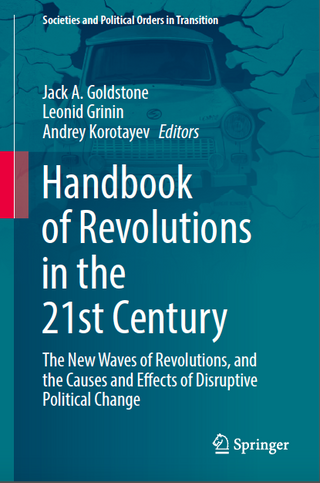
Handbook of Revolutions in the 21st Century. The New Waves of Revolutions, and the Causes and Effects of Disruptive Political Change
Grinin L. E., Korotayev A., Karasev D., Rozov N., Grinin A., Selbin E., Mitchell L., Goldstone J. Springer, 2022.
Similar publications
Talking about the [same] revolution? A comparative analysis of main datasets of revolutionary events
Guseinov R., Ustyuzhanin V., Korotayev A., Defence and peace economics 2026 P. 1–31
We conduct a comparative analysis of the main datasets on revolutionary events, including The Nonviolent and Violent Campaigns and Outcomes (NAVCO, versions 1.3 and 2.1), Cross-National Time-Series (CNTS), Revolutionary Episodes Dataset by Mark Beissinger, Revolutionary Database by HSE University (CSRA), and Historical Regime Data (HRD). To compare these sources systematically, we develop several complementary empirical instruments designed to identify and interpret differences across datasets. We ...
Added: July 17, 2026
Фискальная устойчивость и вероятность революционной дестабилизации. Опыт количественного анализа
Гусейнов Р. И., Ustyuzhanin V., Korotayev A., Вестник Пермского университета. Серия: Политология 2026 Т. 20 № 2 С. 15–27
This paper investigates the relationship between fiscal stability and revolutionary onsets. Classic researchers of revolutions, such as Jack Goldstone, have provided theoretical arguments for the importance of fiscal factors, but any substantial quantitative cross-national large-n research has not been conducted yet. Logistic regression analysis with an interaction term that we have performed confirms our main ...
Added: July 2, 2026
Факторы революционной дестабилизации в режимном контексте. Опыт количественного анализа
Zhdanov A., Korotayev A., Социология власти 2026 Т. 38 № 2 С. 118–167
Imagining a cosmic future touches on many topics — but typically avoids the topic of death, burial, and attitudes toward deceased ancestors. Most of these developments concern life-support systems. This article analyzes the debate between American anthropologist Elizabeth Povinelli and Russian cosmists. The subject of this debate is immortality and attitudes toward ancestors in the ...
Added: June 29, 2026
Towards the Ranking of the Importance of Revolutionary Destabilization Factors in Asian and African Countries Using Machine Learning Methods
Chernomorchenko I., Ilya Medvedev, Korotayev A., Cross-Cultural Research 2026 P. 1–49
This study investigates which structural factors most strongly predict armed and unarmed revolutionary destabilization across Sub-Saharan Africa (SSA), the Middle East and North Africa (MENA), as well as Asia using country–year data for 1950–2022 and a set of economic, demographic, political, and climatic indicators. It employs an interpretable machine learning framework (CatBoost with SHAP values ...
Added: June 1, 2026
Economic development and revolutions. A cross-national investigation
Ustyuzhanin V., Fain E., Korotayev A., Conflict Management and Peace Science 2026 P. 1–23
In the field of civil war studies, there is a consensus that the risk of war decreases as income increases. Nevertheless, such consensus has not been reached in the field of civil resistance and unarmed revolutions. This paper proposes a curvilinear framework positing two opposite trends in economic development. On the one hand, it increases ...
Added: April 21, 2026
Саудовская Аравия и Объединенные Арабские Эмираты: тактическое или стратегическое партнерство?
Korotayev A., Хайруллин Т. Р., Shelkovnikov A., Восток. Афро-азиатские общества: история и современность 2025 № 1 С. 195–207
The article analyzes the Saudi-Emirati alliance formed after the events of the Arab Spring as a reaction to the strengthening of the Turkish-Qatari alliance. The common point of contact in the process of rapprochement between Saudi Arabia and the UAE was the fear and suspicion of the transnational organization Muslim Brotherhood supported by Qatar and ...
Added: April 20, 2026
Новые возможности анализа революций: представление базы данных революций XXI века
Вадим Устюжанин, Дмитрий Семичев, Леонид Гринин et al., Социологическое обозрение 2026 Т. 25 № 1 С. 9–61
The revolutionary process in the 21st century has undergone significant changes, and with the destabilization of democracy and the transformation of the world order, the number of revolutionary episodes has only increased, acquiring new goals and forms. In the countries of the Global South, as the population grew, millions of people began to come out ...
Added: March 25, 2026
Why Do Revolutions Tend to Become Less Violent? Some Explanations of the Global Trend
Andrey Korotayev, Andrey Zhdanov, Julia Zinkina et al., Comparative Sociology 2025 Vol. 24 No. 6 P. 801–842
Revolutionary events are increasingly likely to take unarmed forms. This trend has been observed over the past 120 years as a result of the World System transformation, wherein most societies increased their GDP per capita, experienced the spread of modern formal education, and moved from predominantly rural and very young populations to mostly urban and older ...
Added: November 21, 2025
Факторы начала невооруженных революционных выступлений: опыт комплексного анализа
Ustyuzhanin V., Медведев И. А., Ufimtsev A. et al., Социологическое обозрение 2025 Т. 24 № 1 С. 71–105
One of the most important trends noted by researchers in the revolutionary events of recent decades is the rapid increase in the share of unarmed revolutionary uprisings and, accordingly, a decrease in the share of armed revolutionary insurgencies. The study of this trend is of great importance. This work continues previous research on unarmed revolutionary ...
Added: November 13, 2025
Влияние раскола элит на успех невооруженных революционных выступлений начала XXI века
Ижогин А. А., Korotayev A., Социология власти 2025 Т. 37 № 3 С. 177–213
Existing data on elite splits suggest their significance for revolutionary success, as well as the significance of the defection of primarily security elites to the side of the revolutionary opposition for the success of a revolutionary uprising. The authors, relying on modern political science concepts and qualitative comparative analysis (QCA), tested the corresponding hypotheses. The ...
Added: November 1, 2025
Пятое поколение исследователей революционных событий и революции XXI века
Л.Е. Гринин, А.В. Коротаев, Полис. Политические исследования 2025 № 6 С. 160–172
In 2001, after the publication of the article by J. According to Goldstone's “Towards the fourth generation of revolutionary theory”, a lot of new things have appeared in the approaches of researchers of revolutions in the 1990s, which means that we can talk about the formation of a new - fourth – generation of researchers, ...
Added: October 24, 2025
Short-Term Shocks, Long-Term Shifts: Nonviolent Political Movements and Economic Activity
Ustyuzhanin V., Fain E., / NRU Higher School of Economics. Series PS "Political Science". 2025. No. 1.
This article aims to shed light on the economic consequences of the nonviolent campaigns (NVCs) across the  world. The current era is shaped with various political transformations that are often driven by political movements  that engage in NVCs. Some of them are successful and result in regime change while others fail and are unable to ...
Added: September 12, 2025
Islamic Monarchies, Youth Bulges, and Socio-political Destabilization. A Cross-National Investigation
Andrey V. Korotayev, Alina A. Khokhlova, Comparative Sociology 2025 Vol. 24 No. 3 P. 327–350
During the Arab Spring, it has already been well-observed that the Arab monarchies possess stabilization capacity. This article identifies it as not only a regional, but also a confessional factor that all Islamic monarchies have a stabilizing effect on the socio-political dynamics. Moreover, in Islamic monarchies, the share of the young comes out more as ...
Added: July 1, 2025
Never Ending Revolutions
Fain, Egor, Cliodynamics: The Journal of Quantitative History and Cultural Evolution UC Riverside 2024 Vol. 15 P. 106–120
A Review Essay on Handbook of Revolutions in the 21st Century. The New Waves of Revolutions, and the Causes and Effects of Disruptive Political Change edited by Jack A. Goldstone, Leonid Grinin and Andrey Korotayev (Springer International Publishing, 2022)& New Wave of Revolutions in the MENA Region: A Comparative Perspective edited by Leonid Issaev and ...
Added: January 31, 2025
The Fifth Generation of Revolution Studies. Part III: A Systematic Review of Substantive Findings (Repression, Success, and Outcomes of Revolutions)
Korotayev A., Egor Fain, Ustyuzhanin V. et al., Critical Sociology 2025 Vol. 51 No. 4-5 P. 659–677
This article is the final part of our systematic review of the substantive findings of fifth-generation revolution studies, building on the examination of the emergence and characteristics of this generation contained in the first article in the series. Our systematic review is divided into two parts. In this second and final part, the following areas ...
Added: January 30, 2025
Влияние экономического неравенства на вероятность революционных событий: международный опыт 1995–2021 гг.
Ustyuzhanin V., Fain E., Korotayev A., Экономическая социология 2025 Т. 26 № 1 С. 52–89
The article tests several hypotheses about the impact of wealth and income inequality, as well as inequality in human capital, on the risks of armed and unarmed revolutions. Using the revolutionary destabilization database from the Center for Stability and Risk Analysis (CSRA) at HSE University, along with data collected by Mark Beissinger, the study analyzes ...
Added: January 29, 2025
  • About
  • About
  • Key Figures & Facts
  • Sustainability at HSE University
  • Faculties & Departments
  • International Partnerships
  • Faculty & Staff
  • HSE Buildings
  • HSE University for Persons with Disabilities
  • Public Enquiries
  • Studies
  • Admissions
  • Programme Catalogue
  • Undergraduate
  • Graduate
  • Exchange Programmes
  • Summer University
  • Summer Schools
  • Semester in Moscow
  • Business Internship
  • Research
  • International Laboratories
  • Research Centres
  • Research Projects
  • Monitoring Studies
  • Conferences & Seminars
  • Academic Jobs
  • Yasin (April) International Academic Conference on Economic and Social Development
  • Media & Resources
  • Publications by staff
  • HSE Journals
  • Publishing House
  • iq.hse.ru: commentary by HSE experts
  • Library
  • Economic & Social Data Archive
  • Video
  • HSE Repository of Socio-Economic Information
  • HSE1993–2026
  • Contacts
  • Copyright
  • Privacy Policy
  • Site Map
Edit