?
Conclusion. How Many Revolutions Will We See in the Twenty-First Century?
P. 1037–1061.
Publication based on the results of:
In book
Grinin L. E., Korotayev A., Karasev D., Rozov N., Grinin A., Selbin E., Mitchell L., Goldstone J. Springer, 2022.
Korotayev A., Grinin L. E., Ustyuzhanin V. et al., Логос 2025 Т. 35 № 1 С. 191–316
In the 21st century, a fifth generation of revolution studies has emerged, characterized
by several key features. It is distinguished by macro and systemic approaches to
analyzing revolutionary processes, the study of specific trends (such as urban civic
revolutions) and contemporary factors, including the role of information technologies.
Researchers of this generation pay special attention to revolutionary waves and
their ...
Added: November 13, 2025
Rutkevich A. M., Тетради по консерватизму 2024 № 3 С. 15–72
The subject of the present article is the relationship between fascism and the monarchic conservatism, existing in the period between two World wars in continental European countries. As the case studies are taken the states, which are usually described as “Fascist regimes” of the 20th century: Italy, Germany, Portugal and Spain. Added to them are ...
Added: December 10, 2024
Solovyov K., В кн.: Зигзаги и тупики российской модернизации (кон. XIX – нач. XXI вв.): Коллективная монография в честь 85-летия доктора исторических наук, профессора, лауреата Государственной премии РФ в области науки и техники Валерия Васильевича Журавлева.: БукЭксперт, 2023. Гл. 1 С. 28–54.
Added: August 27, 2023
Rutkevich A. M., Studies in East European Thought 2024 Vol. 76 No. 1 P. 25–39
When discussing the French Revolution and Napoleon in his lectures from 1933 to 1939, Alexandre Kojève had in mind events in Russia. The clash between the “old order,” with its Masters, and the worker Slaves corresponded for him more with the images of pre-revolutionary Russian journalism than with the wigged aristocrats and French bourgeoisie of ...
Added: June 28, 2023
Ustyuzhanin V., Korotayev A., Comparative Sociology 2023 Vol. 22 No. 1 P. 95–137
In recent years, the question of what form a revolutionary uprising will take – armed or unarmed – has been raised more often. This is because, as shown by numerous studies, revolutionary nonviolence can explain why an uprising fails or succeeds to lead to democracy. In the recent decades the likelihood of revolution being nonviolent appears to ...
Added: March 7, 2023
Solovyov K., М.: РОССПЭН, 2022.
The collective monograph is devoted to the history of political parties of the Russian Empire for the entire period of their existence ‒ from the appearance of the first proto-party organizations in the early 1900s to the complete disappearance of party structures during the Great Russian Revolution and the Civil War. The book examines the ...
Added: January 10, 2023
Korotayev A., Shishkina A., Khokhlova A., , in: Handbook of Revolutions in the 21st Century. The New Waves of Revolutions, and the Causes and Effects of Disruptive Political Change.: Springer, 2022. P. 813–849.
The Arab Spring acted as a trigger for a global wave of socio-political destabilization that significantly exceeded the scale of the Arab Spring itself and affected absolutely all the World System zones. From 2011 to 2015 explosive global growth has been observed for the vast majority of indicators of socio-political destabilization: anti-government demonstrations, riots, general ...
Added: November 23, 2022
Ustyuzhanin V., Sumernikov E., Grinin L. E. et al., Социологические исследования 2022 № 10 С. 85–95
Developing countries are now at a stage of accelerated modernization and its crucial part – the urbanization transition. In classical papers on this topic, authors mentioned that revolutions are an integral part of modernization. In this article authors presents a study of how urbanization affects the risks of different revolutionary events – armed and unarmed. ...
Added: October 29, 2022
Rutkevich A. M., , in: Alexandre Kojève: A Man of Influence.: L.: Lexington Books, 2022. Ch. 7 P. 141–159.
Added: October 25, 2022
L.: Lexington Books, 2022.
This edited volume addresses Alexandre Kojève's work from different perspectives, emphasizing the continuity between his early reception of a set of non-philosophical and philosophical influences and that which he might have sought himself to exercise in a pedagogical and practical manner. The first part of the book comprises six essays in which their authors explore ...
Added: October 25, 2022
Goldstone J., Leonid Grinin, Korotayev A., , in: Handbook of Revolutions in the 21st Century. The New Waves of Revolutions, and the Causes and Effects of Disruptive Political Change.: Springer, 2022. P. 37–68.
Added: August 3, 2022
Grinin L. E., , in: Handbook of Revolutions in the 21st Century. The New Waves of Revolutions, and the Causes and Effects of Disruptive Political Change.: Springer, 2022. P. 389–411.
Authors distinguished 12 waves in European countries from the sixteenth to twentieth century. We agree with seven of them (namely, the Calvinist I/Second Reformation from 1566; the Revolutions of 1830; the Revolutions of 1848; the Democratic/Constitutional revolutions of the beginning of the twentieth century; the revolutions following World War I; the revolutions following World War ...
Added: August 3, 2022
Korotayev A., Issaev L., Malkov S. et al., , in: Handbook of Revolutions in the 21st Century. The New Waves of Revolutions, and the Causes and Effects of Disruptive Political Change.: Springer, 2022. P. 781–810.
Added: May 29, 2022
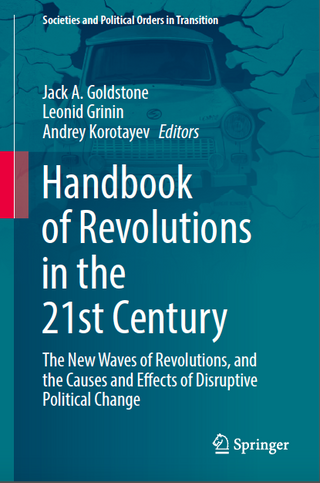
Grinin L. E., Korotayev A., Karasev D. et al., Springer, 2022.
The 21st century has witnessed a considerable and increasing number of political revolutions around the world. This contradicts the popular belief of many experts in the 1970s that revolutions occurred mainly in monarchies and empires. Instead, the revolutions of this century have several new characteristics, which call for a renewed analysis of the subject.
This handbook ...
Added: May 29, 2022
Grinin L. E., Grinin A., Korotayev A., Humanities and Social Sciences Communications 2022 Vol. 9 Article 124
The 20th century revolutionary process had a big impact on the World System and significantly changed its entire configuration. However, there are essential gaps in terms of theoretical approaches, in particular, in terms of the typology of revolutions. Moreover, there is clearly insufficient research related to qualitative and quantitative analysis and consideration of the revolutions ...
Added: April 13, 2022
NY, Abingdon: Routledge, 2021.
This book focuses upon significant aspects of Stalinism as a system in the USSR. It sheds new light on established questions and addresses issues that have never before been raised in the study of Stalinism.
Stalinism constitutes one of the most striking and contentious phenomena of the twentieth century. It not only transformed the Soviet Union ...
Added: April 29, 2021
Rutkevich A. M., Вопросы философии 2019 № 12 С. 118–131
The article holds the idea that for A. Kojève during his lecture course «Introduction
to Hegel's Reading» the central figure of the course was «Gestalt
» of the Intellectual. The author of the article emphasizes: the beginning
of the transition from Master–Slave relationship to the bourgeois
world, Kojève sees in times of the late Roman Empire, and with the ...
Added: December 18, 2019
Issaev L., Korotayev A., Zinkina J. V., Cross-Cultural Research 2015 No. 4 P. 461–488
Jack Goldstone proposes three predictors for acute social and political destabilization during the revolutionary wave of 2013-2014: 1) an intermediate level of per capita GDP; 2) a high level of corruption; 3) a transitional type of political regime. After testing this theory on a broader sample, this study suggests and finds support for another predictor--"center-periphery ...
Added: June 8, 2015