?
How to hintikkize a Frege
.
Schang F.
The aim of the present paper is twofold. On the basis of Frege's "Sense and Denotation", to compare two competing theories of meaning, namely: a one-sorted semantics à la Frege, where every sign symbolizes uniformly; a two-sorted semantics à la Kripke, where a distinction can be made between two modes of functioning among these entities. Then to depict Hintikka's epistemic logic as an internalization of sense, that is, a calculus by means of the operations leading to Frege's theory of meaning.
In book
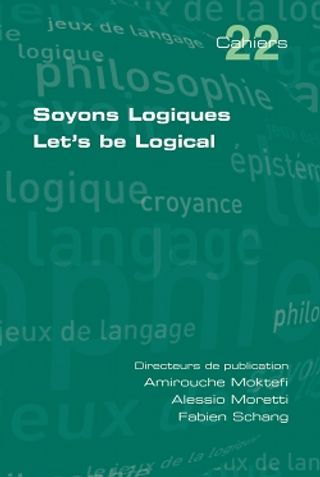
Vol. 22: Cahiers de Logique et d'Epistémologie. , College Publications, 2016.
Fedyanin D., , in: 17th International Conference, SCSM 2025, Held as Part of the 27th HCI International Conference, HCII 2025, Gothenburg, Sweden, June 22–27, 2025, Proceedings, Part II. Social Computing and Social Media. LNCS, volume 15787Vol. 2.: Switzerland: Springer, 2025. P. 247–256.
The paper proposes a formal model for describing opinions and higher-order opinions (e.g., opinions about opinions) using classical epistemic logic, such as the Kripke structure. Traditionally employed for analyzing knowledge and beliefs, this model is adapted to interpret opinions as beliefs, which is particularly promising for describing human-computer interaction due to its high level of formalization. The study is ...
Added: December 13, 2025
Fedyanin D., Switzerland: Springer, 2025.
The 17th International Conference on Social Computing and Social Media (SCSM 2025)
was an affiliated conference of the HCI International (HCII) conference. It provided an
established international forum for the exchange and dissemination of scientific information related to social computing and social media, addressing a broad spectrum of
issues expanding our understanding of current and future issues in ...
Added: December 3, 2025
Ayupov R., История философии 2025 Т. 30 № 1 С. 101–114
The purpose of this article is to acquaint Russian-speaking readers with one of important works in analytic philosophy of language, dedicated to the semantics of proper names, namely with the article “Proper Names” by the American philosopher John Searle, published in 1958. Searle defends the so-called descriptivism view, according to which proper names possess not ...
Added: April 8, 2025
M. A. Smirnov, Логико-философские штудии 2024 Vol. 21 No. 4 P. 195–197
Works of Twardowski in the early XX century contain an outline of general semantic framework for natural languages. This framework, proposed within Twardowski’s theory of actions and ‘products’, provides a drastic alternative to Frege’s semantic framework based on the notion of proposition (Gedanke in Frege). The latter has to a great extent shaped the following development ...
Added: November 21, 2024
Dolgorukov V., Popova E., , in: Logic Colloquium 2023, European Summer Meeting of the Association for Symbolic Logic, University of Milan, Italy 5—9 June 2023, Book of Abstracts.: Milan: University of Milan, 2023. P. 90–90.
We present a multi-agent logic for reasoning about knowledge in time which involves delays in the agent’s awareness. Awareness framework divides a common epistemic concept of knowledge into explicit and implicit ones. This division helps to avoid the problem of logical omniscience and proposes new instruments for analysis of resourcebounded agents reasoning. ...
Added: November 26, 2023
Dolgorukov V., Gladyshev M., , in: SCAN 2023 Semantical and Computational Aspects of Non-Classical Logics: Moscow + Online, June 13–17, 2023. Abstracts.: M.: ., 2023. P. 20–23.
This abstract is based on recent work in [6]. We present a static (ELbc) and dynamic (DELbc) epistemic logic for budget-constrained agents. ELbc extends a standard multi-agent epistemic logic with expressions concerning agent’s budgets and formulas’ costs. DELbc extends ELbc with dynamic modality “[?iA]φ” which reads as “φ holds after i’s question whether a propositional ...
Added: November 26, 2023
Popova E., Логико-философские штудии 2022 Vol. 20 No. 1 P. 1–7
There are two approaches to merging temporal and epistemic models. The first one consists in starting with a temporal model and enriching it with epistemic dimension (as temporal epistemic logic), while the second one is supposed to start with an epistemic model introducing temporal dimension (dynamic epistemic logic, epistemic temporal logic). The proposed evolutionary epistemic ...
Added: August 1, 2022
Dolgorukov V., Maksim Gladyshev, , in: Dynamic Logic. New Trends and Applications. 4th International Workshop, DaLí 2022, Haifa, Israel, July 31–August 1, 2022, Revised Selected PapersVol. 13780.: Cham: Springer, 2023. P. 56–72.
We present a static (ELbc) and dynamic (DELbc) epistemic logic for budget-constrained agents, in which an agent can obtain some information in exchange for budget resources. ELbc extends a standard multi-agent epistemic logic with expressions concerning agent’s budgets and formulas’ costs. DELbc extends ELbc with dynamic modality “[?iA]φ” which reads as “φ holds after i’s ...
Added: July 31, 2022
В.В. Долгоруков, Логические исследования 2022 Т. 28 № 1 С. 9–26
Implicit group knowledge (or distributive knowledge) is the sum of the knowledge in a group. In this paper, two approaches to group implicit knowledge are compared. According to the first approach, group implicit knowledge is defined as a logical consequence of individual agents’ knowledge sets. According to the second approach, group implicit knowledge is characterized ...
Added: May 16, 2022
Тимошина Е. В., Васильева Н. С., Кондуров В. Е. et al., Вестник Российского фонда фундаментальных исследований. Гуманитарные и общественные науки 2021 № 3 С. 93–104
Notions of validity and efficacy of law have long been in the spotlight of jurisprudence, but the discussion on the respective issues is of a circular nature. We propose to systematize the existing approaches to legal validity on the basis of two criteria: 1) foundation of validity and 2) relation between validity and efficacy. This ...
Added: November 9, 2021
Dolgorukov V., В кн.: Двенадцатые Смирновские чтения: материалы Международной научной конференции, Москва, 24–26 июня 2021 г.: М.: Русское общество истории и философии науки, 2021. С. 86–89.
The paper shows that the concept of distributive knowledge and the concept of implicit knowledge are equivalent in the class of finite distinguishable Kripke models. Some modifications of implicit knowledge are considered. It is demonstrated that these modifications are equivalent in the class of finite distinguishable Kripke models. ...
Added: June 28, 2021
Popova E., , in: Двенадцатые Смирновские чтения: материалы Международной научной конференции, Москва, 24–26 июня 2021 г.: М.: Русское общество истории и философии науки, 2021. P. 134–137.
This paper is concerned with the formalization problem of a wide range of scenarios of how knowledge evolves over time. We focus on combinations of temporal and epistemic modalities reflecting various properties of rational agents’ deliberation. For this purpose, we introduce the model EEM – evolutionary epistemic model. ...
Added: June 28, 2021
Bronzo S., Synthese 2021 Vol. 198 P. 3099–3130
It is almost universally accepted that the Frege-Geach Point is necessary for explaining the inferential relations and compositional structure of truth-functionally complex propositions. I argue that this claim rests on a disputable view of propositional structure, which models truth-functionally complex propositions on atomic propositions. I propose an alternative view of propositional structure, based on a ...
Added: May 31, 2019
Ma M., Pietarinen A., Synthese 2017 Vol. 195 No. 8 P. 3621–3650
We describe Peirce’s 1903 system of modal gamma graphs, its transformation rules of inference, and the interpretation of the broken-cut modal operator. We show that Peirce proposed the normality rule in his gamma system. We then show how various normal modal logics arise from Peirce’s assumptions concerning the broken-cut notation. By developing an algebraic semantics ...
Added: September 16, 2018
Bellucci F., Chiffi D., Pietarinen A., Journal of Applied Non-Classical Logics 2018 Vol. 28 No. 1 P. 72–91
Peirce and Frege both distinguished between the propositio
nal content of an assertion and
the assertion of a propositional content, but with different
notational means. We present a
modification of Peirce’s graphical method of logic that can b
e used to reason about assertions
in a manner similar to Peirce’s original method. We propose a
new system of Assertive
Graphs (AGs), which unlike ...
Added: September 16, 2018
Gladyshev M., В кн.: Десятые Смирновские чтения: материалы Междунар. науч. конф., Москва, 15–17 июня 2017 г.: М.: Современные тетради, 2017. С. 67–68.
В предлагаемой работе предпринята попытка формализации феномена лжи с помощью инструментов современной динамической эпистемической логики. Предлагается к рассмотрению две модели доксатической логики: модель, описывающая ложь со стороны стороннего наблюдателя и модель для описания лжи одного из агентов остальным ...
Added: November 5, 2017
Dolgorukov V., В кн.: Десятые Смирновские чтения: материалы Междунар. науч. конф., Москва, 15–17 июня 2017 г.: М.: Современные тетради, 2017. С. 74–76.
Доклад посвящен описанию модели социального влияния для эпистемических агентов. Наша задача состоит в том, чтобы продемонстрировать возможность расширения стандартной версии доксатической и эпистемической логики (в правдоподобной версии) за счет модели социального влияния М. Дегроота. ...
Added: June 9, 2017
Bronzo S., British Journal for the History of Philosophy 2017 Vol. 25 No. 4 P. 750–771
This paper identifies a tension in Frege’s philosophy and offers a diagnosis of its origins.Frege’s Context Principle can be used to dissolve the problem of propositional unity. However, Frege’s official response to the problem does not invoke the Context Principle, but the distinction between “saturated” and “unsaturated” propositional constituents. I argue that such a response ...
Added: January 23, 2017
Bronzo S., Journal for the History of Analytic Philosophy 2014 Vol. 2 No. 8 P. 1–42
This paper (i) offers an interpretation of some central aspects of Jeremy Bentham’s philosophy of language, (ii) challenges the received view of its relation to analytic philosophy, and (iii) seeks to show that this investigation into the prehistory of analytic philosophy sheds light on its history proper. It has been often maintained, most notably by ...
Added: October 5, 2016
Dolgorukov V., Эпистемология и философия науки 2017 Т. 51 № 1 С. 92–105
The paper proposes an epistemic taxonomy of assertives based on a concept of epistemic presuppositions. Epistemic presuppositions are a special kind of pragmatic presuppositions, which describe the structure of hearer’s and speaker’s meta-reasoning. The epistemic taxonomy of assertives is based on the operator of strong common belief (𝐶𝐵). It is argued that the properties of a strong ...
Added: September 25, 2016