• A
  • A
  • A
  • АБВ
  • АБВ
  • АБВ
  • A
  • A
  • A
  • A
  • A
Обычная версия сайта
  • RU
  • EN
  • HSE University
  • Publications
  • Book chapter
  • Sociopolitical Transformations: A Difficult Path to Cybernetic Society
  • RU
  • EN
Расширенный поиск
Высшая школа экономики
Национальный исследовательский университет
Priority areas
  • business informatics
  • economics
  • engineering science
  • humanitarian
  • IT and mathematics
  • law
  • management
  • mathematics
  • sociology
  • state and public administration
by year
  • 2027
  • 2026
  • 2025
  • 2024
  • 2023
  • 2022
  • 2021
  • 2020
  • 2019
  • 2018
  • 2017
  • 2016
  • 2015
  • 2014
  • 2013
  • 2012
  • 2011
  • 2010
  • 2009
  • 2008
  • 2007
  • 2006
  • 2005
  • 2004
  • 2003
  • 2002
  • 2001
  • 2000
  • 1999
  • 1998
  • 1997
  • 1996
  • 1995
  • 1994
  • 1993
  • 1992
  • 1991
  • 1990
  • 1989
  • 1988
  • 1987
  • 1986
  • 1985
  • 1984
  • 1983
  • 1982
  • 1981
  • 1980
  • 1979
  • 1978
  • 1977
  • 1976
  • 1975
  • 1974
  • 1973
  • 1972
  • 1971
  • 1970
  • 1969
  • 1968
  • 1967
  • 1966
  • 1965
  • 1964
  • 1963
  • 1958
  • More
Subject
News
June 19, 2026
HSE Researchers Determine Which Internet Users Are More Likely to Fact-Check
Researchers at HSE University examined the strategies employed by Russian internet users to verify unreliable information and the factors that motivate them to do so. The study found that more than half of users who encounter potentially false information online attempt to verify it by locating the original source. The likelihood of fact-checking is influenced by several factors, including age, place of residence, social status, information literacy skills, and the use of AI. The findings have been published in Monitoring of Public Opinion: Economic and Social Changes.
June 5, 2026
'Im Used to Producing Distilled Knowledge'
Ivan Rubachev works in a HSE University laboratory established jointly with Yandex Research, where he focuses on machine learning with tabular data. In this interview with the HSE Young Scientists project, he discusses why following a vibe can be better than goal-setting, explains the concept of the Neural Turing Machine, and argues why withholding scientific knowledge is counterproductive.
June 17, 2026
Population Lifespan Is Governed by Mathematical Laws
Researchers at HSE University and MSU have established a universal law governing the time to extinction of a population in a random environment. Their analysis of the evolution of branching processes—complex probabilistic systems—shows that, regardless of the initial population size, extinction follows strict mathematical laws. The results have been published in the Journal of Applied Probability.


Have you spotted a typo?
Highlight it, click Ctrl+Enter and send us a message. Thank you for your help!

Publications
  • Books
  • Articles
  • Chapters of books
  • Working papers
  • Report a publication
  • Research at HSE

?

Sociopolitical Transformations: A Difficult Path to Cybernetic Society

P. 169–189.
Leonid Grinin, Anton Grinin, Malkov S.

Since the second half of the twentieth century, there have been radical changes in all spheres of life, which qualitatively distinguish the new phase of development from the previous ones. The chapter is devoted to the ongoing transformations in the social and political sphere, which include: the increasing digitalization of all spheres of life together with their positive and negative consequences, the change in the demographic structure of the population (including global aging), the development of global interactions, the increasing interdependence of the countries of the world, etc. The most important factor in these transformations is technological development, the Cybernetic Revolution unfolding before our eyes. These transformations lead to a serious restructuring of the social structure and sociopolitical changes. Grinin et al. consider the shape of future society, which they call “Cybernetic W-society” in different areas: technological, demographic, economic, political and administrative, international relations, social, and environmental. They also consider different scenarios of future Cybernetic W-society. According to them, as a result of the completion of the Cybernetic Revolution and the achievement by the global aging of an advanced phase, a new society will be formed–Cybernetic W-society. It will be an elderly society, with the institutionalization of age differences, relying almost entirely on smart (cybernetic) technologies and AI-based self-regulating systems. Grinin et al. also consider other scenarios and aspects of this society. They analyze two extreme alternatives which are not likely to be implemented in their pure forms but rather indicate the limits within which the actual trajectory of global evolution will proceed: (1) “new feudalism,” (2) “World-Organism.” The former alternative essentially involves the reincarnation of a totalitarian-type system in the cybernetic era, whereas the latter alternative is a society where, in the presence of a deep professional specialization of the population, there is no discrimination, management is carried out on the basis of network technologies (network technologies are used to “synchronize” collective action and to exercise direct democracy). The second variant of development—“World-Organism”—is considered as favorable because it assumes cooperation, instead of competition, as a fundamental principle in development. Grinin et al. also note that ideology, which is of a universal nature, is of great importance in an effective transition to the second developmental option, which allows overcoming the confrontation between representatives of different faiths, nationalities, and civilizations. Grinin et al. point out that it would be preferable if we could move to a future society that is based on cooperation rather than competition and, at the same time, preserves the privacy, individuality, and initiative of its citizens.

Language: English
Full text
DOI
Text on another site
Keywords: technological development global agingthe increasing digitalizationthe Cybernetic Revolution

In book

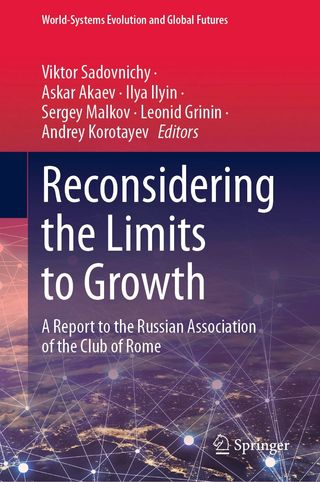
Reconsidering the Limits to Growth. A Report to the Russian Association of the Club of Rome
Springer, 2023.
Similar publications
Российские разработчики о создании и востребованности отечественного индустриального ПО: результаты пилотного обследования
Shashnov S. A., Bogdanov T., Abdrakhmanova G., Вопросы статистики 2026 Т. 33 № 2 С. 58–68
The article presents the results of a study of the Russian industrial software market. The relevance of the topic stems from the significance of this segment for technological sovereignty and the comprehensive digitalization of industrial sectors and the economy as a whole. The aim of the study was to collect and analyze primary data refiecting the ...
Added: May 8, 2026
Global aging and demographic policies: a reconsideration
Ustyuzhanin V., Zinkina J. V., Korotayev A., Journal of Globalization Studies 2025 Vol. 16 No. 1 P. 47–60
Population aging is expected to affect large parts of the world in the coming decades, leading to profound changes in various social, economic and financial institutions and infrastructure networks. Raising the old-age retirement (pension) age has been the most common response of the affected countries to this challenge, but it has proven neither sufficient nor popular ...
Added: July 8, 2025
Global Aging and the Medicine of the Future
Leonid Grinin, Anton Grinin, Korotayev A., World Futures 2025 Vol. 81 No. 1 P. 35–62
Aging is one of the most powerful processes of the 21st century which is accelerating, which is influencing and will influence much more during many forthcoming decades all aspects of life. The percentage of elderly in developed countries will surpass a share of young people within decades. So we will live in gray society where ...
Added: January 24, 2025
Directions of development of digitalization of the oil industry in the Russian Federation
Kulyasov N.S., Shipkova O. T., Zavialov A. E. et al., , in: International Scientific Conference CAMSTech-2020: Advances in Material Science and Technology 31 July 2020, Krasnoyarsk, Russia. IOP Conference Series: Materials Science and Engineering Vol. 919.: Institute of Physics Publishing (IOP), 2020. Ch. 6.
Added: September 27, 2024
Искусственный интеллект в глобальной экономике: вызовы для России
Filosofova T. G., В кн.: Вестник ученого совета: №6Вып. 6: Влияние технологий искусственного интеллекта на геополитическую расстановку сил. : М.: РИСИ, 2020. С. 130–146.
It is shown that the global nature of the economy is being disrupted and inequality is increasing. At the same time, scientific, technological, and innovative factors in strengthening the competitiveness of an individual country come to the fore, primarily as one of the aspects of ensuring national security and the possibility of global influence. It ...
Added: June 24, 2024
The Global Encyclopaedia of Informality, Volume 3: A hitchhiker’s guide to informal problem-solving in human life
L.: UCL Press, 2024.
For a post-human hitchhiker, human life – with its anxiety, ageing, illness and constant need for problem-solving – may look unviable. Yet, for humans, the life struggle is softened by human touch, human emotion and human cooperation. The Global Encyclopaedia of Informality, Volume 3 continues the journey of the two previous volumes into the world’s open secrets, ...
Added: April 12, 2024
Will Global Aging Change the Rate of Technological Progress and Form a New Consumption Model?
Leonid Grinin, Anton Grinin, Andrey Korotayev, World Futures 2024 Vol. 80 No. 3 P. 199–222
The article discusses how the pace of technological progress and economic model of society will change under the influence of global aging process. It tries to answer the following questions: What could be the driver of an acceleration of technological growth in the forthcoming decades? Is slowdown of technological growth likely to be observed afterwards? ...
Added: April 5, 2024
К вопросу о приоритетах стратегии развития общества и экономики в условиях формирования многополярного мира
Filosofova T. G., В кн.: Стратегии развития общества и экономики в новой реальности: Сборник трудов пятой международной научно-практической конференции «SOCIAL SCIENCE» (Общественные науки) ч. I, 26-27 октября 2023 г.: Изд-во ЮРИУ РАНХиГС, 2023. Гл. 1, 6 С. 54–61.
In the current conditions of sanctions pressure on Russia and the associated transformations of the Russian economy, new scientifically based approaches to the formation of a sustainable development strategy that can withstand modern challenges and contribute to the further development of society and the country's economy are becoming necessary. It is shown that in the ...
Added: February 25, 2024
Complex patterns of ICTs' effect on sustainable development at the national level: The triple bottom line perspective
Tekic Z., Tekic A., Technological Forecasting and Social Change 2024 Vol. 198 Article 122969
Building upon the complexity theory, we explore the interaction effects of the development of key digital information and communication technologies (ICTs) at the national level on a country's sustainability performance. By the means of the fuzzy-set Qualitative Comparative Analysis on a sample of 77 countries, we show that 1) a country's ICT profile matters for ...
Added: November 23, 2023
Modeling Social Self-Organization and Historical Dynamics. Industrial Society
Akaev A., Malkov S., Davydova O. et al., , in: Reconsidering the Limits to Growth. A Report to the Russian Association of the Club of Rome.: Springer, 2023. P. 337–385.
This chapter presents the results of using the set of basic models described in the chapter “Modeling Social Self-Organization and Historical Dynamics. A General Approach” to model the dynamics of an industrial society. Both interactions in the “society–nature” system and social interactions within society between the main social groups (including economic and political interactions) are ...
Added: October 5, 2023
The Future Society and the Transition to It
Sadovnichy V., Akaev A., Ilyin I. et al., , in: Reconsidering the Limits to Growth. A Report to the Russian Association of the Club of Rome.: Springer, 2023. P. 35–50.
This chapter analyzes the current historical situation and the prospects for its further development. It is evident that drastic changes are currently taking place in the world, reflecting a phase transition in historical development, namely, the transition from the late industrial phase to the cybernetic phase, features of which are largely determined by the ongoing ...
Added: September 28, 2023
Глобальное старение как интегральная проблема будущего
Grinin L. E., Гринин А. Л., Korotayev A., Социологический журнал 2023 Т. 29 № 2 С. 110–131
В статье анализируется процесс глобального старения населения, оказывающий существенное влияние на все сферы общественной жизни в XXI в. Влияние этого процесса на различные сферы общественной деятельности будет определяться его масштабами и глубиной, то есть возможной демографической структурой будущего общества. В то же время проблематична способность современного общества справляться с возрастающими рисками, связанными с этим процессом. ...
Added: August 1, 2023
Развитие российских биотехнологий для скотоводства (оценка на основе патентного анализа)
Dezhina I., Арутюнян А. Г., ЭКО 2023 Т. 53 № 7 С. 149–171
Biotechnologies are increasingly being used in animal husbandry, but in Russia today they are 80% imported. This poses a threat to food security and actualizes the task of highlighting those areas of biotechnology, the development of which is critical for the industry. Based on a patent analysis and a comparison of the global dynamics of ...
Added: July 5, 2023
Designing a Framework to Develop a Flipped CEPHEI Course in Innovation Systems and Technological Development
Pavlova I., Narimanova G., Larioshina I. et al., , in: Digital Teaching and Learning in Higher Education. Developing and Disseminating Skills for Blended Learning.: Cham: Palgrave Macmillan, 2022. P. 313–330.
The study explores the transformative potential of the blended course development in the context of the university processes implementation. The chapter discusses seven pillars for the course design and implementation on the example of the flipped master level course “Innovation Systems and Technological Development.” The course was developed under the framework of the CEPHEI Industrial ...
Added: January 29, 2023
Management of Technological Development of the Region: Ecosystem Approach
Evseeva M., , in: Proceedings of the Second Conference on Sustainable Development: Industrial Future of Territories (IFT 2021)Issue 195.: Atlantis Press, 2021. P. 577–580.
The current stage of technological development is characterized by several important trends. First, the current level of technology limits the ability of companies to develop and apply them independently. Companies unite in business networks, forming stable dynamic network structures, where the emergence and diffusion of technologies occurs in the inter-company space. Secondly, the network nature ...
Added: November 14, 2022
Стратегические детерминанты технологического развития промышленного предприятия
Evseeva M., Стариков Е. Н., Ткаченко И. Н., Journal of New Economy 2021 Т. 22 № 4 С. 139–155
The pace of technological changes requires certain flexibility of industrial enterprises’ business models. The paper aims to uncover and explore the importance and interaction of the determinants of technological development strategies. Methodological basis of the research rests on the tripod strategy perspective and the theory of technological development. The authors apply general scientific and sociometric ...
Added: October 27, 2022
  • About
  • About
  • Key Figures & Facts
  • Sustainability at HSE University
  • Faculties & Departments
  • International Partnerships
  • Faculty & Staff
  • HSE Buildings
  • HSE University for Persons with Disabilities
  • Public Enquiries
  • Studies
  • Admissions
  • Programme Catalogue
  • Undergraduate
  • Graduate
  • Exchange Programmes
  • Summer University
  • Summer Schools
  • Semester in Moscow
  • Business Internship
  • Research
  • International Laboratories
  • Research Centres
  • Research Projects
  • Monitoring Studies
  • Conferences & Seminars
  • Academic Jobs
  • Yasin (April) International Academic Conference on Economic and Social Development
  • Media & Resources
  • Publications by staff
  • HSE Journals
  • Publishing House
  • iq.hse.ru: commentary by HSE experts
  • Library
  • Economic & Social Data Archive
  • Video
  • HSE Repository of Socio-Economic Information
  • HSE1993–2026
  • Contacts
  • Copyright
  • Privacy Policy
  • Site Map
Edit