• A
  • A
  • A
  • АБВ
  • АБВ
  • АБВ
  • A
  • A
  • A
  • A
  • A
Обычная версия сайта
  • RU
  • EN
  • HSE University
  • Publications
  • Book chapter
  • Постсоветские страны между ЕС и Россией
  • RU
  • EN
Расширенный поиск
Высшая школа экономики
Национальный исследовательский университет
Priority areas
  • business informatics
  • economics
  • engineering science
  • humanitarian
  • IT and mathematics
  • law
  • management
  • mathematics
  • sociology
  • state and public administration
by year
  • 2027
  • 2026
  • 2025
  • 2024
  • 2023
  • 2022
  • 2021
  • 2020
  • 2019
  • 2018
  • 2017
  • 2016
  • 2015
  • 2014
  • 2013
  • 2012
  • 2011
  • 2010
  • 2009
  • 2008
  • 2007
  • 2006
  • 2005
  • 2004
  • 2003
  • 2002
  • 2001
  • 2000
  • 1999
  • 1998
  • 1997
  • 1996
  • 1995
  • 1994
  • 1993
  • 1992
  • 1991
  • 1990
  • 1989
  • 1988
  • 1987
  • 1986
  • 1985
  • 1984
  • 1983
  • 1982
  • 1981
  • 1980
  • 1979
  • 1978
  • 1977
  • 1976
  • 1975
  • 1974
  • 1973
  • 1972
  • 1971
  • 1970
  • 1969
  • 1968
  • 1967
  • 1966
  • 1965
  • 1964
  • 1963
  • 1958
  • More
Subject
News
May 15, 2026
Preserving Rationality in a Period of Turbulence
The HSE International Laboratory for Logic, Linguistics and Formal Philosophy studies logic and rationality in a transformed world characterised by a diversity of logical systems and rational agents. The laboratory supports and develops academic ties with Russian and international partners. The HSE News Service spoke with the head of the laboratory, Prof. Elena Dragalina-Chernaya, about its work.
May 15, 2026
‘All My Time Is Devoted to My Dissertation
Ilya Venediktov graduated from the Master’s programme at the HSE Tikhonov Moscow Institute of Electronics and Mathematics through the combined Master’s–PhD track and is currently studying at the HSE Doctoral School of Engineering Sciences. At present, he is undertaking a long-term research internship at the University of Science and Technology of China in Hefei, where he is preparing his dissertation. In this interview, he explains how an internship differs from an academic mobility programme, discusses his research topic, and describes the daily life of a Russian doctoral student in China.
May 15, 2026
‘What Matters Is Not What You Study, but Who You Study with
Katerina Koloskova began studying Arabic expecting to give it up after a year—now she cannot imagine her life without it. In an interview for the Young Scientists of HSE University project, she spoke about two translated books, an expedition to Socotra, and her love for Bethlehem.


Have you spotted a typo?
Highlight it, click Ctrl+Enter and send us a message. Thank you for your help!

Publications
  • Books
  • Articles
  • Chapters of books
  • Working papers
  • Report a publication
  • Research at HSE

?

Постсоветские страны между ЕС и Россией

С. 313–335.
Skriba A., Bodishteanu N.

Conclusions about the influence of the geopolitical contradictions between Russia and the EU on foreign and integration policies seem extremely important in terms of the development of conflicts between the regional central forces themselves, as well as in assessing promising integration blocs and the “choice” of the interacting post-Soviet countries themselves. The instability of their behavior is a direct consequence of the emerging "integration dilemma". Although, one should not forget that the “integration dilemma” itself is needed for each country. In such circumstances, the politics of post-Soviet countries will gravitate towards instability and variability. All these countries have been and remain interested in expanding trade and economic relations simultaneously with Russia and the EU, as well as in obtaining assistance and attracting investment from both sides. “One-way” integration, obviously, was not able to provide the necessary and quicker opportunities for faster economic or political statements. The relationship between the two civilizational (in our case, integration) centers is called limitrophic or political balancing. Its strength is to belong to a particular center of power or community of states. Cooperation policies between countries can become volatile and sometimes speculative. In foreign literature, it should be noted the work of R. Schwedler, who pointed to the tendency of small and medium-sized countries to “bandwagon" to more powerful countries in order to achieve economic advantages. Such examples can be found among all five post-Soviet countries. It is on the example of the post-Soviet space that this article broadens the understanding of the behavior of such countries that are used in the context of the "dilemma of integration". The conflict between relations between Russia and the EU. If we are talking about a military confrontation, it would be logical to use the theoretical achievements of the Cold War by authors such as S. Walt and S. David. However, it is increasingly developing without the use of military forces. In this case, when planning integration strategies, everyone should also correspond to the results.

Language: Russian
Full text
Keywords: внешняя политика РоссииRussian foreign policyCommonwealth of independent StatesEurasiaБольшая Евразиявосточная Европа и страны СНГ

In book

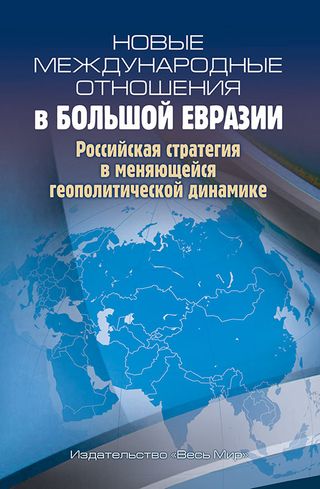
Новые международные отношения в Большой Евразии. Российская стратегия в меняющейся геополитической динамике
Lukin A., Novikov D., Kutyrev G., Karaganov S. A., Bratersky M., Puzanova O., Bordachev T., Suslov D., Kanaev E., Ryzhkov V. A., Kovalev I. G., Bodishteanu N., Suzdaltsev A. М.: Весь мир, 2019.
Similar publications
Doroshenko, G., Shelkovnikov, A. Russia’s Policy Towards the Gulf: A Factor in Promoting ‘Global Majority’ Organisations // Asian Journal of Middle Eastern and Islamic Studies. 2025. Vol. 19 №3, P. 272–284.
Shelkovnikov A., Дорошенко Г. А., Asian Journal of Middle Eastern and Islamic Studies 2025 Vol. 19 No. 3 P. 272–284
The study analyzes one of the most important elements of Russia’s foreign policy at the present stage. The stated topic is explored on the basis of three components: a study of the Russian Federation’s policy on promoting BRICS and the SCO among the Gulf countries, an analysis of the positions and degree of practical participation ...
Added: April 20, 2026
Environment, space, and identity in the Eurasian region
Di Puppo L., Roy Chowdhury A., Globalizations 2026 Vol. 23 No. 1 P. 1–9
In this special issue, we bring together the post-colonial and post-socialist conditions of the post-Soviet space and the Indian subcontinent through the study of human–nature relationships. Not only are these two regions entangled through the Eurasian geography, but they also both represent hybrid modernization trajectories characterized by varying socio-political responses to Western modernity and the ...
Added: March 27, 2026
Край, которого нет, или Неверленд
Asatryan G., Trenin D., Россия в глобальной политике 2025 Т. 23 № 6 С. 191–205
The armed confrontation between the Russian Federation and the collective West requires focusing its attention and resources on Ukraine. Under extreme circumstances, it is more difficult for Russia to expand or even maintain its position in other neighboring countries. Moscow has lost its position as the main mediator in the Armenian-Azerbaijani conflict. Its peacekeeping mission in ...
Added: March 20, 2026
Коридоры возможностей и рисков. МТК «Север – Юг» в контексте геополитики транспорта Большой Евразии
Efremenko D., Karaganov S. A., Kozylov I., Россия в глобальной политике 2026 Т. 24 № 2 С. 162–176
The article examines the International North–South Transport Corridor (INSTC) in the context of shaping the Eurasian transport framework and Russia’s spatial development geostrategy. It explores the historical and contemporary foundations of meridional connectivity as a basis for the long-term stability of the Eurasian space. The study argues that the INSTC can become a key element ...
Added: March 2, 2026
Mirroring and Metanarrative: Understanding Russia’s Information Influence Strategy in Latin America and the Caribbean
Kosevich E., Demokratizatsiya: The Journal of Post-Soviet Democratization 2025 Vol. 33 No. 2 P. 107–138
With the blurring of the boundaries between peace and war in their classical sense, confrontation is moving into the information space. This study traces the logic and main stages of the formation of the Russian information influence strategy in Latin America and the Caribbean (LAC). Russia uses various methods to wage its information wars in ...
Added: December 24, 2025
A Global South 2.0? Evaluating the Concept of World Majority in Russian Foreign Policy
Kapoor N., Journal of Eurasian Studies 2025
The idea of world majority, floated by Russian experts after 2022, seeks to simultaneously offer a foreign policy direction for the country while also building a meta-category to define the non-western world. As an emerging concept, this article seeks to be one of the first systematic approaches towards understanding what the world majority stands for ...
Added: December 23, 2025
Сидящие «по-восточному» фигуры в наскальном искусстве Минусинской котловины (атрибуция, аналогии)
Советова О. С., Ермоленко Л. Н., Zinchenko S., СибСкрипт 2024 Т. 26 № 6 С. 904–918
The rock art of the Minusinsk Basin has a long academic history; however, it still brings about new fascinating discoveries. Some petroglyphs of the Tesin period show people sitting cross-legged on the floor in the so-called Oriental fashion. These images have not yet received special scientific attention. Such images are most often single; they are to be found ...
Added: December 4, 2025
Деятельность Совета государств Балтийского моря по защите прав национальных меньшинств в 1990-е годы
Паникар М. М., Соколова Ф. Х., Белошицкая Н. Н., Балтийский регион 2025 Т. 17 № 3 С. 23–41
The article explores the activity of the Council of the Baltic Sea States on promoting the rights of the national minorities throughout the period from 1994 to 2000. The research is based on the detailed analysis of the documents from the Foreign Policy Archive of the Russian Federation and represents the first time these documents ...
Added: September 29, 2025
Mechanisms of Formation of Migrant Residential Concentration Areas in the Context of a Postsocialist City: Evidence from Russia’s 15 Largest Cities
Varshaver E., Rocheva A., Ivanova N. et al., Nationalities Papers: The Journal of Nationalism and Ethnicity 2025 Vol. 53 No. 2 P. 426–448
Migrant residential concentration areas have been a significant focus for research, but academic attention has primarily centered on their effects rather than how they form. There is some research considering the discrete factors of such areas’ emergence, but these factors are rarely fused into a comprehensive explanation with a description of specific mechanisms in operation. ...
Added: September 22, 2025
Reimagining the Silk Roads: Interactions and Perceptions Across Eurasia
L.: Routledge, 2025.
The book is devoted to various aspects of the study of the Great Silk Road and its influence on the history and archeology of Eurasia. ...
Added: July 1, 2025
Империи древних — грубое орудие истории
Grigoryev L. M., Вестник Московского университета. Серия 6: Экономика 2024 Т. 59 № 6 С. 125–160
In the world of different tribes, languages and slightly cultivated landscapes, empires through crude violence extended rent concentration scale, with the focus on infrastructure (roads, dumbs, canals), fortifications, cult centers and palaces. Investment concentration of a leading nation was achieved through robbery of other nations or through levying taxes on the periphery of the empire. ...
Added: May 16, 2025
Без «тени войны», но в тени ответственности. Россия и Центральная Азия перед общими вызовами безопасности
Bordachev T., Тебин П. Ю., Россия в глобальной политике 2025 Т. 23 № 3 С. 164–180
Период совместного развития России и народов Центральной Азии сначала в составе Российской империи, а затем СССР уходит всё дальше в историю. Задачей российской политики в регионе становится выстраивание полноценных межгосударственных отношений. Вопрос не в формальном взаимном признании независимости и уважении национальных интересов, а в осознании друг друга самостоятельными участниками международной политики, что накладывает на обе ...
Added: May 5, 2025
Перестройка? Бис!
Lukyanov F., Россия в глобальной политике 2025 Т. 23 № 2 С. 5–8
American politics has taken a dizzying turn since Donald Trump's return to the presidency. A suspicion arose: isn't this another turning point in the course of history, no less decisive than in the second half of the eighties of the last century? A reverse fracture. Gorbachev, with his new political thinking, willingly or unwittingly opened ...
Added: April 23, 2025
Ведущие вниз
Lukyanov F., Россия в глобальной политике 2025 Т. 23 № 1 С. 5–8
The relatively uniform globalization that it was at the turn of the century has ended, but the world has not fragmented. It has remained interconnected, although often in a whimsical way – through informal mechanisms and gray-black schemes. Centralized management by certain rules is being replaced by self–organization for survival - a special one, from ...
Added: April 23, 2025
Триумф воль
Lukyanov F., Россия в глобальной политике 2024 Т. 22 № 6 С. 5–8
2024 was immediately declared the year of big elections – half of the world's population voted in almost all significant countries and regions. And it's not just that the entire world politics depends on the results of the expression of will in some states. During periods of drastic change, as now, societies move. Elections serve ...
Added: April 23, 2025
Не по порядку
Lukyanov F., Россия в глобальной политике 2024 Т. 22 № 5 С. 5–10
The chain of conflicts with the armed component will continue, and many of the contradictions that were under control will enter an active phase. This is natural in the context of the general crisis of the restriction system. Hence the increased role of military force, which is certain today and inevitable tomorrow. But, as extensive ...
Added: April 23, 2025
Вероятное – неочевидное
Lukyanov F., Россия в глобальной политике 2024 Т. 22 № 2 С. 5–8
The events of two years have changed the perception of both war and peace. It would be an exaggeration to say that everything turned upside down overnight – international processes have long and consistently deviated from how they were usually described. The divergence of feelings, words, and deeds became more and more striking. Looking back, ...
Added: April 23, 2025
  • About
  • About
  • Key Figures & Facts
  • Sustainability at HSE University
  • Faculties & Departments
  • International Partnerships
  • Faculty & Staff
  • HSE Buildings
  • HSE University for Persons with Disabilities
  • Public Enquiries
  • Studies
  • Admissions
  • Programme Catalogue
  • Undergraduate
  • Graduate
  • Exchange Programmes
  • Summer University
  • Summer Schools
  • Semester in Moscow
  • Business Internship
  • Research
  • International Laboratories
  • Research Centres
  • Research Projects
  • Monitoring Studies
  • Conferences & Seminars
  • Academic Jobs
  • Yasin (April) International Academic Conference on Economic and Social Development
  • Media & Resources
  • Publications by staff
  • HSE Journals
  • Publishing House
  • iq.hse.ru: commentary by HSE experts
  • Library
  • Economic & Social Data Archive
  • Video
  • HSE Repository of Socio-Economic Information
  • HSE1993–2026
  • Contacts
  • Copyright
  • Privacy Policy
  • Site Map
Edit