• A
  • A
  • A
  • АБВ
  • АБВ
  • АБВ
  • A
  • A
  • A
  • A
  • A
Обычная версия сайта
  • RU
  • EN
  • HSE University
  • Publications
  • Book chapter
  • Побудительные реплики и их компоненты в русском устном диалоге: количественное описание
  • RU
  • EN
Расширенный поиск
Высшая школа экономики
Национальный исследовательский университет
Priority areas
  • business informatics
  • economics
  • engineering science
  • humanitarian
  • IT and mathematics
  • law
  • management
  • mathematics
  • sociology
  • state and public administration
by year
  • 2027
  • 2026
  • 2025
  • 2024
  • 2023
  • 2022
  • 2021
  • 2020
  • 2019
  • 2018
  • 2017
  • 2016
  • 2015
  • 2014
  • 2013
  • 2012
  • 2011
  • 2010
  • 2009
  • 2008
  • 2007
  • 2006
  • 2005
  • 2004
  • 2003
  • 2002
  • 2001
  • 2000
  • 1999
  • 1998
  • 1997
  • 1996
  • 1995
  • 1994
  • 1993
  • 1992
  • 1991
  • 1990
  • 1989
  • 1988
  • 1987
  • 1986
  • 1985
  • 1984
  • 1983
  • 1982
  • 1981
  • 1980
  • 1979
  • 1978
  • 1977
  • 1976
  • 1975
  • 1974
  • 1973
  • 1972
  • 1971
  • 1970
  • 1969
  • 1968
  • 1967
  • 1966
  • 1965
  • 1964
  • 1963
  • 1958
  • More
Subject
News
April 30, 2026
HSE Researchers Compile Scientific Database for Studying Childrens Eating Habits
The database created at HSE University can serve as a foundation for studying children’s eating habits. This is outlined in the study ‘The Influence of Age, Gender, and Social-Role Factors on Children’s Compliance with Age-Based Nutritional Norms: An Experimental Study Using the Dish-I-Wish Web Application.’ The work has been carried out as part of the HSE Basic Research Programme and was presented at the XXVI April International Academic Conference named after Evgeny Yasin.
April 30, 2026
New Foresight Centre Study Identifies the Most Destructive Global Trends for Humankind
A team of researchers from the HSE International Research and Educational Foresight Centre has examined how global trends affect the quality of human life—from life expectancy to professional fulfilment. The findings of the study titled ‘Human Capital Transformation under the Influence of Global Trends’ were published in Foresight.
April 28, 2026
Scientists Develop Algorithm for Accurate Financial Time Series Forecasting
Researchers at the HSE Faculty of Computer Science benchmarked more than 200,000 model configurations for predicting financial asset prices and realised volatility, showing that performance can be improved by filtering out noise at specific frequencies in advance. This technique increased accuracy in 65% of cases. The authors also developed their own algorithm, which achieves accuracy comparable to that of the best models while requiring less computational power. The study has been published in Applied Soft Computing.


Have you spotted a typo?
Highlight it, click Ctrl+Enter and send us a message. Thank you for your help!

Publications
  • Books
  • Articles
  • Chapters of books
  • Working papers
  • Report a publication
  • Research at HSE

?

Побудительные реплики и их компоненты в русском устном диалоге: количественное описание

С. 95–124.
Blinova O. V.

The paper analyses imperative utterances using a subcorpus of 239500 words from the “One Day of Speech” corpus (further referred to as ORD). The article covers only utterances with the 2 nd person Sg and Pl forms of the verb in the
imperative mood. There are 2353 verb forms of this kind and 2025 utterances that contain them. Each imperative utterance is viewed as a sequence of components that consists of a core component (an imperative or an imperative construction) and “meaningful components,” i.e., components that are regularly used in imperative utterances and often shift the utterance along the politeness/impoliteness scale and categoricity/non-categoricity scale.

Among meaningful components the following are common:

  • forms of address;
  • personal pronouns;
  • particles davaj, davajte [let’s], nu, -ka, že, na, a, da, vot, prosto and their combinations;
  • politeness formulae, explicit request markers such as prošu tebja [I ask you];
  • various verbal modifiers, including downgraders nemnožko [a bit], tichonečko [slowly, carefully]) and intensifiers bystro [quickly], sročno [urgently], objazatel’no [necessarily], sejčas že [now], uže [already], nakonec [at last] and others;
  • emotive interjections;
  • imperative interjections.

According to the ORD data, there are 10 verbs most frequently used in the imperative mood (2 nd person Sg or Pl): slušat’ [listen] (ipm 1048,20), smotret’ [look] (ipm 651,47), podoždat’ [wait] (ipm 488,60), skazat’ [say] (ipm 363,32),
izvinit’ [excuse] (ipm 267,27), dat’ [give, perfect verb] (ipm 263,09), idti [go] (ipm 250,57), posmotret’ [look, verb with a prefix] (ipm 233,86), davat’ [give, imperfect verb] (ipm 171,22), vzjat’ [take] (ipm 146,16). Thus, imperative utterances dialogue most contain verbs that regulate spoken interaction: verbs that establish contact and attract the listener’s attention (slušat’, smotret’, posmotret’ [listen, look]); the verb podoždat’ [wait] that is mostly used to convey the meanings ‘don’t start speaking’ and ‘stop speaking for a while’, verbs of saying (skazat’, govorit’ [say, speak]).

Some other meaningful components are: references to the ongoing/completed speech act (the present and past indicative forms of the 1 st person from the verbs govorit’ [speak], skazat’ [say], povtorjat’ [repeat] and others); lexical
means of diminishing the strength and authoritativeness of the utterance that express suppositions (downtoners such as možet byt’, možet [maybe, perhaps]); lexical means of diminishing the strength and authoritativeness of the utter-
ance that express uncertainty (hedges such as kak by [sort of]); expressions that explain the reasons of action (grounders); “appealers” such as da? ladno? chorošo?.

The following features are taken into account in the description of imperative utterances: the number of its meaningful components, their positions in the imperative utterance, their positions with respect to the core component
of the utterance; presence of iterations, co-occurrence of the meaningful components in the utterance.

Language: Russian
DOI
Text on another site
Keywords: императивустная речьсовременный русский языквежливостьбытовой диалог

In book

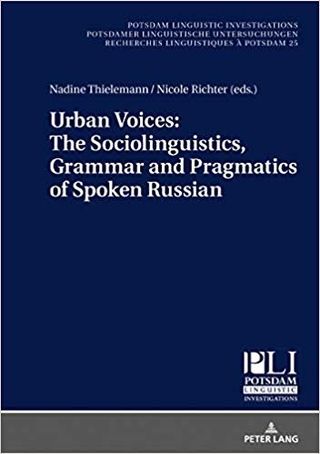
Urban Voices: The Sociolinguistics, Grammar and Pragmatics of Spoken Russian
Peter Lang, 2019.
Similar publications
ВЕСЬ, ВОСВОЯСИ - ВЫПИХНУТЬ
Nikishina E., В кн.: Толковый словарь русской разговорной речи. Вып. 6, дополнительный, часть 1: А-ИЧ. 1: А-И. Вып. 6: дополнительный.: Институт русского языка им. В.В. Виноградова РАН, 2026. С. 194–285.
Added: March 9, 2026
КИТАЙСКИЙ ЯЗЫК: ПРИМЕРЫ ЗАДАНИЙ ОЛИМПИАДНОГО ФОРМАТА
Pavlova O., Иностранные языки в школе 2019 № 12 С. 94–101
В 2018-1019 учебном году в рамках Всероссийской олимпиады школьников по иностранным языкам «Учитель школы будущего», проводимой Московским городским педагогическим университетом с 2009 года [6], впервые состоялся конкурс по китайскому языку. Включение китайского языка в олимпиаду стало логичным ответом на продолжающийся рост его значимости в российском иноязычном образовательном пространстве и введение c 2019 года ЕГЭ по ...
Added: February 24, 2026
Подлежащее при императиве: типологическое исследование
Панова А. В., В кн.: Двадцать первая конференция по типологии и грамматике для молодых исследователей: тезисы докладов. Санкт-Петербург, 21–23 ноября 2024 г.: ИЛИ РАН, 2024. С. 106–110.
В работе рассматривается выражение подлежащего в императивных предложениях языков мира. Материалом для исследования послужили грамматические описания 74 языков. Исследуемые данные позволяют постулировать шкалу обязательности подлежащего при императиве — насколько обязательно его выражение в языках выборки: обязательно, частотно, опционально, редко. Для языков, в которых подлежащее при императиве выражается редко и его присутствие прагматически маркировано, можно выделить основные ...
Added: February 15, 2026
Автоматическое выявление побуждений в тексте: применение методов компьютерной лингвистики в работе эксперта-лингвиста
П.Е. Белова, А.К. Сафарян, В кн.: Научно-практическая конференция с международным участием "Национальные и международные тенденции и перспективы развития судебной экспертизы". Сборник докладов.: Н. Новгород: Изд-во ННГУ им. Н.И. Лобачевского, 2024.
В данной статье представлено описание системы автоматического поиска и извлечения побуждений из текстов на русском языке FindImper, основанной на поиске глагольных форм и синтаксических связей. Алгоритм реализован на языке программирования Python с использованием библиотек для морфологического и синтаксического анализа и набора правил. Данный инструмент направлен на оптимизацию работы эксперта-лингвиста и доступен к использованию через веб-сайт ...
Added: January 30, 2026
Оптативно-императивная семантическая зона в ашхарском диалекте абазинского языка
Dunaeva K., В кн.: Двадцать первая конференция по типологии и грамматике для молодых исследователей: тезисы докладов. Санкт-Петербург, 21–23 ноября 2024 г.: ИЛИ РАН, 2024. С. 55–58.
Доклад посвящен оптативно-императивной зоне ашхарского диалекта абазинского языка. ...
Added: December 6, 2025
Речевые акты с вежливыми диминутивами: жанровые и дискурсивные особенности
Fufaeva I., Вестник Волгоградского государственного университета. Серия 2: Языкознание 2025 Т. 24 № 4 С. 78–90
This study delves into speech acts utilizing diminutives for politeness, focusing on their discursive and genre-related aspects. It draws on authorial recordings of spoken discourse, data from the National Corpus of the Russian Language, and recordings of urban speech from the 1970s and late twentieth century. The research highlights the potential usage of polite diminutives in ...
Added: November 25, 2025
Инструмент для создания речевого профиля обобщенной языковой личности для диагностики ментальных расстройств по транскриптам речевого потока
Khomenko A., Komratova A., Isakov D. et al., В кн.: Экспериментальные исследования языка: материалы конференции 2025.: М.: Наш мир, 2025. С. 17–19.
This study aims to develop a tool for the automated diagnosis of mental disorders based on the analysis of Russian-language speech transcripts. The model uses clustering and stylometric methods to identify differences between the speech of healthy individuals and patients with psychiatric diagnoses. ...
Added: October 19, 2025
Computer tools in mental disorders diagnostics by oral speech
Khomenko A., Komratova A., Isakov D. et al., , in: Computational linguistics and intellectual technologies. Papers from the Annual International Conference "Dialogue" (2025)Vol. 23.: [б.и.], 2025. P. 147–157.
The integration of automated speech analysis in diagnosing mental health disorders is becoming increasingly significant in both clinical and computational linguistics. This study aims to construct linguistic profiles for individuals with neurocognitive and affective mental disorders. Using speech transcriptions and relevant to the study computational techniques like lexical clustering and stylostatistical analysis, this research looks ...
Added: October 19, 2025
Исследование речи: теоретические и прикладные аспекты
Улан-Удэ: Бурятский государственный университет имени Доржи Банзарова, 2025.
В сборнике представлены статьи, посвященные актуальным вопросам исследования и анализа речи на языках разных структур и систем. Сборник адресован студентам, аспирантам, преподавателям и всем, ин- тересующимся вопросами исследования речи. ...
Added: June 6, 2025
Инфинитив с частицей бы и сослагательное наклонение в контекстах с чужой речью в деловых документах XVI–XVII вв.
Iordani N., Русский язык в научном освещении 2023 № 2(46) С. 293–308
Косвенная речь широко представлена в старорусских деловых источниках — в жалованных грамотах, указах и памятях, написанных в ответ на челобитные, содержащие разнообразные просьбы, адресованные наделенному властью лицу. Формы императива, выступающие в такого рода речевых актах, в контекстах с косвенной речью употребляться не могли и требовали замены. В старорусском языке в этой функции наряду с формами ...
Added: November 5, 2024
О субъекте при инфинитиве с частицей бы в старорусском и современном русском языке
Iordani N., Филология и культура 2023 № 1 С. 14–19
В статье рассматриваются особенности заполнения субъектной валентности при инфинитиве с частицей бы в старорусском и современном русском языках. В качестве материала для исследования были использованы данные Национального корпуса русского языка и рукописные сборники заговоров XVII–XVIII вв. Как в современном русском языке, так и в старорусский период инфинитив с частицей бы сочетается только с агентивными субъектами ...
Added: November 5, 2024
(НЕ)ВЕЖЛИВОСТЬ ПО-БАВАРСКИ (на материале политического дискурса южной Германии)
Пономарёва А. А., Немецкая филология в Санкт-Петербургском государственном университете 2023 № 13 С. 358–375
Dialect is used not only as a means of spoken interpersonal communication, nowadays it can be found in advertising, media and political discourse. Dialects, not being the main language of political communication, can be used in contrast to the standard language for explicit and implicit transmission of emotions and evaluation as well as (im)politeness strategy in regional political ...
Added: January 31, 2024
Устный учебный корпус РКИ: новый источник данных для лингвистических и методических исследований
Vlasova E., Бец Ю. В., Северина Е. М., В кн.: «Русская грамматика в диалоге научных школ, направлений, методов».: Владивосток: Издательство ДВФУ, 2022.
В статье анализируются нетривиальные фонетические и грамматические явления устной речи иностранцев, изучающих русский язык. Показано, что устный учебный корпус позволяет получить систематическое представление о компенсаторных механизмах речепорождения, проверять и формулировать гипотезы. ...
Added: November 8, 2023
Трансформация семантики мамочки: от жены до пушки
Krongauz M., Клокова К. С., Shulginov V. et al., Слово.ру: балтийский акцент 2023 Т. 14 № 4 С. 105–124
In the semantic theory of Gottlob Frege, the content of a linguistic sign is determined by the connection between the meaning and a set of subjective perceptions that form the mean- ing. Our study aims to reveal the influence of individual perceptions of the meaning on the extension of the semantic structure of a word, ...
Added: October 30, 2023
Невежливые коммуникативные практики как инструмент создания сообществ в комментариях к спортивным новостям
Shulginov V., Алянский К. А., СибСкрипт 2023 Т. 25 № 4 С. 481–490
Conflict discourse studies provide a valuable insight into linguistic and sociocultural ideologies of online communities. They also may offer effective approaches to linguistic detoxification. This research featured online communication of sport fans. Their discourse is interdiscursive, possesses a certain netiquette, and reflects the social and ideological diversity within the community. The authors explored common speech ...
Added: October 29, 2023
Причастия и деепричастия в русской устной речи: корпусный анализ
Moroz G., Zemicheva S., В кн.: Тезисы докладов 51-й Международной научной филологической конференции имени Людмилы Алексеевны Вербицкой.: СПб.: Издательство Санкт-Петербургского университета, 2023. С. 694–695.
Цель  работы – проанализировать, как причастия и деепричастия используются в современной устной речи (преимущественно сельской). Анализ проводился на материале 20 речевых корпусов из разных регионов России. ...
Added: June 8, 2023
Квазиимперативные формы при пересказе повеления в македонском языке
Наталья Игоревна Кикило, В кн.: Определенность и неопределенность в языках и культурах Балкан. Выпуск 17.: М.: Институт славяноведения РАН, 2023. С. 70–74.
Семантическая зона эвиденциальности объединяет грамматические показатели и лексические единицы, которые указывают на способ доступа к информации о сообщаемой ситуации (Плунгян 2011: 463). Используя эвиденциальные маркеры, говорящий показывает, как он получил сведения: путем собственного наблюдения или же опосредованно (косвенное свидетельство). В македонском языке эвиденциальные показатели непрямого доступа с диффузным значением грамматикализованы на базе перфектных форм на ...
Added: April 3, 2023
Дискурсивные маркеры-регуляторы устной речи (по)слушай, (по)смотри, (по)стой и особенности их употребления
Nikishina E., Русская речь 2022 № 5 С. 47–63
The paper deals with the verbs (po)slušat', (po)smotret', (po)stoyat' in the imperative 2Sg and 2Pl, which have lost their lexical meaning in dialog and passed into the category of discourse markers (DM). As DM these words can have a variety of functions regulating the interaction between the participants of communication: attracting the interlocutor's attention, switching ...
Added: November 1, 2022
Чисто по-русски. Говорим и пишем без ошибок
Koroleva M., М.: АСТ, 2022.
Марина Королёва – журналист, филолог, кандидат филологических наук, признанный специалист по современной речевой норме. Профессор НИУ ВШЭ. Читатели, слушатели, зрители знают ее по программам "Говорим по-русски" и "Как правильно" на радиостанции "Эхо Москвы" (1994 – 2015), еженедельным авторским колонкам в "Российской газете", рубрикам и экспертным интервью на телеканалах "Карусель" и "Культура". К Марине Королёвой обращаются ...
Added: October 25, 2022
Некоторые синтаксические особенности языка «Страстей св. Сусанны» (BHL 7937)
Shumilin M., Индоевропейское языкознание и классическая филология 2022 Т. 26 № 2 С. 1192–1203
The article continues the study of the Passio S. Susannae (BHL 7937) as a text of the 5th or 6th cent. AD that was originally composed in a language characterized by many departures from Classical Latin. Some of the ‘non-classical’ linguistic features connected with syntax that can be indentified in the manuscripts of the Passio ...
Added: August 18, 2022
Русский язык в России и за рубежом: изучение активных процессов в языке и речи
Н. Новгород: Национальный исследовательский Нижегородский государственный университет им. Н.И. Лобачевского, 2021.
В сборнике представлены статьи, подготовленные на основе материалов Международной научной конференции «Русский язык в России и за рубежом: изучение активных процессов в языке и речи» в рамках филологической сессии «Национальные коды в языке и литературе» (Национальный исследовательский Нижегородский государственный университет им. Н.И. Лобачевского, Институт филологии и журналистики, 29–31 октября 2021 г.). В статьях ведущих российских ...
Added: February 11, 2022
Типология метакоммуникативных единиц русской спонтанной монологической речи
Zaides K., В кн.: Компьютерная лингвистика и вычислительные онтологии (Труды XX Международной объединенной конференции «Интернет и современное общество, IMS–2017)Вып. 1.: СПб.: Университет ИТМО, 2017. С. 46–56.
Added: February 3, 2022
  • About
  • About
  • Key Figures & Facts
  • Sustainability at HSE University
  • Faculties & Departments
  • International Partnerships
  • Faculty & Staff
  • HSE Buildings
  • HSE University for Persons with Disabilities
  • Public Enquiries
  • Studies
  • Admissions
  • Programme Catalogue
  • Undergraduate
  • Graduate
  • Exchange Programmes
  • Summer University
  • Summer Schools
  • Semester in Moscow
  • Business Internship
  • Research
  • International Laboratories
  • Research Centres
  • Research Projects
  • Monitoring Studies
  • Conferences & Seminars
  • Academic Jobs
  • Yasin (April) International Academic Conference on Economic and Social Development
  • Media & Resources
  • Publications by staff
  • HSE Journals
  • Publishing House
  • iq.hse.ru: commentary by HSE experts
  • Library
  • Economic & Social Data Archive
  • Video
  • HSE Repository of Socio-Economic Information
  • HSE1993–2026
  • Contacts
  • Copyright
  • Privacy Policy
  • Site Map
Edit