?
Мальтийский язык как объект арабской диалектологии
С. 342–348.
The article discusses the formation, development and current status of the Maltese language and the factors which contributed to the development of one of the Arabic dialects in the official language of a European country.
In book
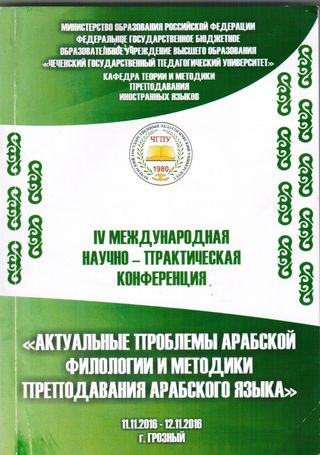
Абдулжалилов И. Г., аль-Хатыб А. У., Фаттахова А. Р. АЛЕФ, 2016.
Kogan L., Journal of the American Oriental Society, США 2025 Vol. 145 No. 3 P. 623–634
Arab lexicographers rarely attempted to search for a foreign origin of Arabic words, trying instead to derive them—not very persuasively—from autochthonous Arabic roots. Known exceptions mostly involve Persian, a foreign language par excellence for most Arab philologists. This article explores this phenomenon in a different linguistic domain, viz., loanwords from Classical Ethiopic (Geʿez), the language ...
Added: September 19, 2025
Leiden: Brill, 2026.
The Handbook of Neo-Aramaic aims to provide an introduction to, and details of the complex world of Neo-Aramaic. This large family of endangered Neo-Semitic languages is (or until recently was spoken by Jewish, Christian and Mandaean minorities in parts of the Middle East. Most members of these communities now live in various diasporas.
Following a series ...
Added: May 1, 2025
Shvedova E., Вопросы лексикографии 2024 № 34 С. 42–61
A group of scholars from Saint Petersburg and Moscow is working on a Lexicon of the Neo-Aramaic verbs. The purpose of the lexicon is to systematise data on the structure of the verb systems of various North-Eastern Neo-Aramaic varieties. The dictionary now contains information on Christian Urmi, Nudez, Mahmudi and Bohtan idioms. The dictionary is ...
Added: January 22, 2025
Kogan L., Zeitschrift der Deutschen Morgenlandischen Gesellschaft 2025 Vol. 175 No. 1 P. 29–59
Added: November 9, 2023
Lyavdansky A., Acta Linguistica Petropolitana. Труды института лингвистических исследований 2023 Т. 19 № 1 С. 193–229
On the basis of field and corpus data, preliminary observations are made about the form and function of serial verb constructions (SVC) in the varieties of Christian Urmi Neo-Aramaic. Serial verb constructions are considered adopting
“wide” understanding of this phenomenon, represented by the works of Plungyan, Aikhenvald and Andrason among many others. Big amount of data ...
Added: August 7, 2023
Bulakh M., Journal of Semitic Studies 2021 Vol. 66 No. 1 P. 263–292
The present study considers the function of the pattern of the so-called stem IV, primarily associated with causatives, in Soqotri (Modern South Arabian). It focuses on the correlation between the semantics of the source verb and that of the derived verb, examines the semantic classes which are compatible with the causative morpheme, and establishes several ...
Added: February 21, 2021
Barsky E., Loesov S., , in: Studies in the Grammar and Lexicon of Neo-Aramaic.: Open Book Publishers, 2021. P. 1–28.
The ultimate source of inspiration for the present study is our ambition to offer a detailed description of the history of the Aramaic verbal system. A key event in this history is what Goldenberg used to call ‘the morphological revolution’, i.e. the shift, within Eastern Aramaic, from the Middle Aramaic2 verbal systems to those of Modern ...
Added: January 23, 2021
Semitic inscriptions in the St. Sophia Cathedral in Novgorod: a reply to alternative interpretations
Gippius A., Gzella H., Mikheev S. M. et al., Russian linguistics 2020 Vol. 44 P. 1–12
In the present article, we offer a detailed reply to alternative interpretations of our explanation of two eleventh-century phrases inscribed many times on the walls of the St. Sophia Cathedral in Novgorod: коуни рони and парехъ мари. According to our previous article in this journal, the phrases have a Semitic origin: Hebrew qūmī ronnī and Syriac /barren̲k mār/, respectively. In ...
Added: June 30, 2020
Bulakh M., , in: Lexicalization patterns in color naming: A cross-linguistic perspective.: Amsterdam: John Benjamins Publishing Company, 2019. Ch. 8 P. 159–189.
The article explores the origins of Semitic color terms for yellow, green, and blue. These fundamental color categories are missing from the reconstructed proto-Semitic basic color term system, but their designations were added into basic color term systems of many daughter languages. This chapter focuses on derivations from designations of “referent objects” (objects typically characterized ...
Added: October 27, 2019
Kogan L., Bulakh M., , in: The Semitic Languages. Second Edition.: L., NY: Routledge, 2019. Ch. 12 P. 280–320.
The chapter presents a synchronic description of the language Soqotri, belonging to the Modern South Arabian branch of the Semitic languages and spoken on the island of Soqotra. The description includes the basic facts on the phonology, morphology and syntax of the language and is accompanied with a short original text in Soqotri provided with ...
Added: March 21, 2019
Bulakh M., , in: The Semitic Languages. Second Edition.: L., NY: Routledge, 2019. Ch. 8 P. 174–201.
The chapter presents the language Tigrinya, spoken in Eritrea and in the Tigray region of Ethiopia. The description presents the essential fact on the phonology, morphology and syntax of the language and is accompanied with a short example of a literary text on Tigrinya, provided with a linguistic glossing. ...
Added: March 21, 2019
L., NY: Routledge, 2019.
The Semitic Languages presents a comprehensive survey of the individual languages and language clusters within this language family, from their origins in antiquity to their present-day forms.
This second edition has been fully revised, with new chapters and a wealth of additional material. New features include the following:
• new introductory chapters on Proto-Semitic grammar and Semitic ...
Added: March 21, 2019
Sarkisov I., В кн.: Acta linguistica Petropolitana. Труды Института лингвистических исследований РАН / Т. XIV. Ч. 2. Материалы Тринадцатой конференции по типологии и грамматике для молодых исследователей (2016 г.).: Институт лингвистических исследований РАН, 2018. С. 380–399.
This research examines the ergativity in Neo-Aramaic languages. It is based on the materials of the previous works and field studies. The results show that the system of Neo-Aramaic preterit constructions, that is usually being called «ergative», in sober fact is not ergative. In reality in Neo-Aramaic languages two different systems of the marking of ...
Added: December 13, 2018
Институт лингвистических исследований РАН, 2018.
This research examines the ergativity in Neo-Aramaic languages. It is based on the materials of the previous works and field studies. The results show that the system of Neo-Aramaic preterit constructions, that is usually being called «ergative», in sober fact is not ergative. In reality in Neo-Aramaic languages two different systems of the marking of ...
Added: December 13, 2018
Chuprygin A., Zeltyn L., Eurasian Arabic Studies 2018 No. 3 P. 42–54
This paper reports the results of the study of the Maltese language and the extent of Arabic influence on the Maltese Language. The factors underlying the vitality of the Arabic source-code in modern Maltese are analyzed.
Novelty of the research consists in using the language material as evidence that the period of stay of the Arabs ...
Added: October 31, 2018
Arkhipov I., , in: Chagar Bazar (Syrie) VI. Les tombes ordinaires de l’âge du Bronze ancien et moyen des chantiers D-F-H-I (1999-2011). Les objets.: P., Leuven, Walpole: Peeters Publishers, 2018. Ch. 3 P. 43–70.
The sixth report on the new excavations at Chagar Bazar contains the complete publication of the objects discovered in the graves that were described in the fourth volume. Particular attention was devoted to the archaeological study of 5105 beads, and this study was completed by the examination of the beads in the cuneiform documents (by ...
Added: April 26, 2018
Ravishankar V., Tyers F. M., Gatt A., Procedia Computer Science 2017 Vol. 117 P. 175–182
This article describes the development of a free/open-source morphological description of Maltese, originally created as the analysis component in a rule-based machine translation system for Maltese to Arabic and later applied to other tasks. The lexicon formalism we use is lttoolbox, part of the Apertium machine translation platform. An evaluation of the analyser shows that ...
Added: November 10, 2017
Berezkin Y., Cherkashin D., Kogan L. et al., AULA ORIENTALIS 2016 Vol. 2 No. 34 P. 201–243
The article is an attempt at comparative analysis of motifs and plots of the oral literature of Soqotra (Gulf of Aden, Yemen). Both the early recordings made in the beginning of the 20th century by D.H. Muller and the recent ones, carried out by V. Naumkin and his team, are involved. For each story we ...
Added: October 23, 2017
Loesov S., Kogan L., В кн.: Языки мира: Семитские языки. Аккадский язык. Северозападносемитские языки.: Институт языкознания РАН, 2009.
Added: October 23, 2017
Loesov S., Kogan L., Lyavdansky A. et al., Институт языкознания РАН, 2009.
This book continues the encyclopedic multi-volume series “Languages of the World”, which is being prepared at the Institute of Linguistics, Russian Academy of Sciences. This is the first part of the two-volume set dealing with Semitic languages. It comprises a general survey of the Semitic language family, as well as descriptions of individual Semitic languages: ...
Added: October 23, 2017
Loesov S., , in: Proceedings of the 14th Italian Meeting of Afroasiatic Linguistics.: [б.и.], 2013. P. 91–106.
The paper is the second part of the author’s essay in the Proto-Aramaic reconstruc
tion. In the first chapter of the present contribution, the writer tries to make plausible
the idea according to which the Eastern Aramaic plural nominal ending -ē made its
appearance in Proto-Eastern Aramaic and had been borrowed by this language from
the Assyrian variety of ...
Added: October 23, 2017