• A
  • A
  • A
  • АБВ
  • АБВ
  • АБВ
  • A
  • A
  • A
  • A
  • A
Обычная версия сайта
  • RU
  • EN
  • HSE University
  • Publications
  • Books
  • Business Cycles in BRICS
  • RU
  • EN
Расширенный поиск
Высшая школа экономики
Национальный исследовательский университет
Priority areas
  • business informatics
  • economics
  • engineering science
  • humanitarian
  • IT and mathematics
  • law
  • management
  • mathematics
  • sociology
  • state and public administration
by year
  • 2027
  • 2026
  • 2025
  • 2024
  • 2023
  • 2022
  • 2021
  • 2020
  • 2019
  • 2018
  • 2017
  • 2016
  • 2015
  • 2014
  • 2013
  • 2012
  • 2011
  • 2010
  • 2009
  • 2008
  • 2007
  • 2006
  • 2005
  • 2004
  • 2003
  • 2002
  • 2001
  • 2000
  • 1999
  • 1998
  • 1997
  • 1996
  • 1995
  • 1994
  • 1993
  • 1992
  • 1991
  • 1990
  • 1989
  • 1988
  • 1987
  • 1986
  • 1985
  • 1984
  • 1983
  • 1982
  • 1981
  • 1980
  • 1979
  • 1978
  • 1977
  • 1976
  • 1975
  • 1974
  • 1973
  • 1972
  • 1971
  • 1970
  • 1969
  • 1968
  • 1967
  • 1966
  • 1965
  • 1964
  • 1963
  • 1958
  • More
Subject
News
May 25, 2026
HSE Scientists Train Neural Network to 'Hear' Faults in Electric Motors
Researchers at the AI and Digital Science Institute of the HSE Faculty of Computer Science have developed a new method—the Signature-Guided Data Augmentation (SGDA) framework—that achieves 99% accuracy in motor fault detection and 86% accuracy in fault classification. The application of this approach can reduce industrial equipment repair costs, minimise downtime, and improve production safety. The study results have been published in Engineering Applications of Artificial Intelligence.
May 25, 2026
'The Humanities Serve as a Conscience'
Maria Mizernaia studies Soviet literature and the history of book publishing. In this interview for the HSE Young Scientists project, she discusses plans to publish a novel about besieged Leningrad, AI-provoked reflections on what it means to be human, and how novels can help satisfy our dopamine hunger.
May 25, 2026
Is It Possible to Predict a Citys Life Based on the Shape of Its Neighbourhoods?
Is it possible to predict, based on the configuration of streets and buildings, where a café will open or where traffic congestion will occur? Participants in the Spatial Analysis and Modelling of Urban Processes research and study group use open data and machine learning to identify universal patterns. Alexander Sheludkov and Eduard Somov discuss the purpose of comparing cities, the need for new forms of urban statistics, and how open data is transforming approaches to urban studies.


Have you spotted a typo?
Highlight it, click Ctrl+Enter and send us a message. Thank you for your help!

Publications
  • Books
  • Articles
  • Chapters of books
  • Working papers
  • Report a publication
  • Research at HSE

?

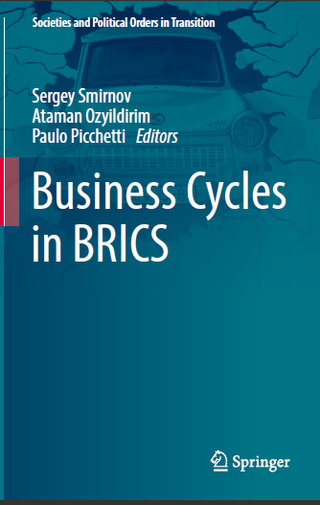
Business Cycles in BRICS

Springer, 2019.
Academic editor: Smirnov S. V., A. Ozyildirim, P. Picchetti
Under the general editorship: Smirnov Sergey, A. Ozyildirim, P. Picchetti

This volume focuses on the analysis and measurement of business cycles in Brazil, Russia, India, China and South Africa (BRICS). Divided into five parts, it begins with an overview of the main concepts and problems involved in monitoring and forecasting business cycles. Then it highlights the role of BRICS in the global economy and explores the interrelatedness of business cycles within BRICS. In turn, part two provides studies on the historical development of business cycles in the individual BRICS countries and describes the driving forces behind those cycles. Parts three and four present national business tendency surveys and composite cyclical indices for real-time monitoring and forecasting of various BRICS economies, while the final part discusses how the lessons learned in the BRICS countries can be used for the analysis of business cycles and their socio-political consequences in other emerging countries.
Chapters
Russian Business Tendency Surveys by HSE and Rosstat
Kitrar Liudmila, Lipkind Tamara, Ostapkovich Georgy, , in: Business Cycles in BRICS.: Springer, 2019. Ch. 13 P. 233–251.
The chapter describes information content, methodological features and national practices of business tendency surveys (BTS) in Russia. These surveys are conducted jointly by the National Research University Higher School of Economics (HSE) and the Russian Federation State Statistic Services (Rosstat), and provide qualitative data on sectoral trends and short-term fluctuations over the last two decades. The ...
Added: July 31, 2017
Institutions, Productivity Change and Growth
Andrei Akhremenko, Petrov A., Yureskul E., , in: Business Cycles in BRICS.: Springer, 2019. Ch. 3 P. 29–54.
In this chapter we aim to consider the interdependence between total factor productivity, economic welfare, and political institutions using BRICS as an empirical example. While relationships between each pair of factors have already been subject to scientific inquiry, we attempt to look at the productivity-institutions nexus in conjunction with economic development. We utilize nonparametric methods ...
Added: July 10, 2018
Introduction
Smirnov Sergey, Ozyildirim A., Picchetti P., , in: Business Cycles in BRICS.: Springer, 2019. Ch. 1 P. 1–6.
Background and motivation for a study of business cycles, business tendency surveys (BTSs), and cyclical indicators in the BRICS countries are specified. The main concepts and problems involved in monitoring and forecasting business cycles in emerging countries and countries in transition are overviewed; the importance of the experience of the BRICS in this context is ...
Added: August 20, 2018
BRICS in the Global Economy
Smirnov Sergey, Avdeeva D., , in: Business Cycles in BRICS.: Springer, 2019. Ch. 2 P. 9–28.
This chapter begins with a brief history of the BRICS – from a purely analytical concept to the real-world political group with its own financial infrastructure. It then considers the role of the member countries in the global economy in terms of macro-indicators (territory, population and GDP), the production of a variety of key goods, ...
Added: August 20, 2018
Economic Fluctuations and Their Drivers in Russia
Smirnov Sergey, , in: Business Cycles in BRICS.: Springer, 2019. Ch. 6 P. 89–119.
In many respects, the historical trajectory of the Russian economy during the Twentieth century has been a terra incognita until now. As for the official statistics, there are at least three important reasons for this. First, many relevant indicators were either not measured, or were kept secret and never published. Second, Russia (as the RSFSR) ...
Added: August 20, 2018
A Survey of Composite Leading Indices for Russia
Smirnov Sergey, , in: Business Cycles in BRICS.: Springer, 2019. Ch. 21 P. 347–361.
Available composite cyclical indicators for Russia are surveyed, their components are enumerated and analysed.  The aims, guiding concepts, and approaches of the newly established Russian Economic Cycle Dating Committee are also described. All the currently available monthly Composite Leading Indices (CLIs) are tested against the most recent cyclical turning points for their capacity to provide ...
Added: August 20, 2018
Indices of Regional Economic Activity for Russia
Smirnov Sergey, Kondrashov Nikolay, , in: Business Cycles in BRICS.: Springer, 2019. Ch. 22 P. 363–375.
In large countries, the development of national macroeconomic business cycles clearly involves regional nuances that, as a rule, fall outside scholars’ fields of vision, especially when monitoring the current economic situation. Regional statistics published by the Russian Federal State Statistics Service (Rosstat) are reviewed in terms of quality, and radical disagreement between “month-on-month” and “year-on-year” ...
Added: August 20, 2018
Measurement, Monitoring, and Forecasting Economic Cycles: BRICS Lessons
Smirnov Sergey, Ozyildirim A., Kershoff G., , in: Business Cycles in BRICS.: Springer, 2019. Ch. 29 P. 499–513.
The current best practices in measuring, monitoring, and forecasting economic cycles are drawn from the experience of mature economies such as the USA, Japan, and several Western European countries. Meanwhile, there are a lot of peculiarities in emerging economies that should be kept in mind when developing a system for tracking and forecasting their short-run ...
Added: August 20, 2018
Research target: Economics and Management
Priority areas: economics
Language: English
Full text
DOI
Text on another site
Keywords: business cyclesBRICS countries
Publication based on the results of:
Analysis and forecasting of development of the Russian economy in the conditions of post-crisis growth. Assessment of prospects and risks of acceleration of the country's socio-economic development under conditions of the instability of the external environment (2018)
Business Cycles in BRICS
Similar publications
Почему растущие доходы не делают людей счастливее: эмоциональное объяснение парадокса Истерлина
Vorchik A., Вопросы экономики 2026
This work is devoted to a theoretical explanation of the Easterlin paradox, according to which long-term economic growth does not make average level of people's happiness increasing. By happiness, we mean the intensity of emotions people experience while comparing their new income with its expected value, or the target income with its original value. In the first case, ...
Added: May 28, 2026
Defining the payback period for nonconventional cash flows: an axiomatic approach
Mikhail V. Sokolov, Engineering Economist 2026 Vol. 71 No. 2 P. 159–173
The payback period is unambiguously defined for conventional investment projects—projects in which a series of cash outflows is followed by a series of cash inflows. Its definition for nonconventional projects is more challenging, since their balances (cumulative cash flow streams) may have multiple break-even points. Academics and practitioners offer a few contradictory recipes to manage ...
Added: May 28, 2026
Sweet-taste liking is associated with preference for less risky and immediate rewards in economic decision-making
Давидович А. С., Shestakova A., Arzumanyan N. et al., Frontiers in Psychology 2026 Vol. 17 - 2026 P. 1–18
Background:  Delay discounting refers to the tendency to choose sooner, smaller rewards over larger, later rewards. Many previous studies link this tendency positively to reward sensitivity, yet the specific mechanisms behind this association remain poorly understood. Reward sensitivity may relate to delay discounting through at least three possible pathways: increased sensitivity to reward size, increased sensitivity ...
Added: May 27, 2026
Система национальных счетов 2025 года: Обзор основных методологических изменений
Tatarinov A., Вопросы статистики 2026 Т. 33 № 2 С. 5–22
The relevance of the article stems from the ongoing transition of national statistical offices to the implementation of the new international macroeconomic accounting standard, SNA 2025. This standard defines modern approaches to measuring economic activity in the context of globalization and digitalization and incorporates assessments of well‑being and sustainability. The subject of the paper is the ...
Added: May 27, 2026
БАЗОВЫЕ ТАБЛИЦЫ «ЗАТРАТЫ-ВЫПУСК» ЗА 2021 ГОД: НЕКОТОРЫЕ АСПЕКТЫ ПРИМЕНЕНИЯ В ИССЛЕДОВАНИЯХ
Kalinin A. M., Проблемы прогнозирования 2026 № 1 С. 45–55
Rosstat's publication of basic input–output tables for 2021, given the five-year periodicity of such materials, represents a significant event for Russian economic science. The article provides an overview of some of the features and properties of the published tables and the results of their use for the analysis of technological changes and import dependence. It ...
Added: May 26, 2026
Китай как новая экономическая империя: проблемы роста и модели взаимодействия с государствами Глобального Юга
Романова В. В., Tkachuk A., Экономические науки 2026 № 2 С. 561–565
Актуальность статьи обусловлена трансформацией мирохозяйственных связей под влиянием Китая. Степень разработанности отражена в полярных оценках экспансии КНР. Объект — экономическая экспансия Китая, предмет — модели взаимодействия со странами Глобального Юга. Методология базируется на геоэкономическом подходе и концепции асимметричной взаимозависимости. Практическая значимость заключается в выявлении рисков долговой и технологической зависимости и рекомендациях для стран-партнеров по выстраиванию сбалансированного сотрудничества. ...
Added: May 26, 2026
ОЦЕНКА ВОЗДЕЙСТВИЯ АДРЕСНЫХ (ПЕРСОНАЛЬНЫХ) САНКЦИЙ США НА РОССИЙСКИЕ КОМПАНИИ В 2014-2023 ГГ.
Kalinin A. M., Вопросы экономики 2025 № 8 С. 26–43
The study of the consequences of the application of individual sanctions instruments at the level of industries or segments of the economy allows us to assess the components and factors of overall sustainability, the effectiveness of the state policy. The paper provides an econometric assessment of the impact of US SDN list sanctions on Russian ...
Added: May 26, 2026
Факторы инвестиционной активности в российской экономике: выводы 2022 г.
Kalinin A. M., Проблемы прогнозирования 2024 № 1(202) С. 35–53
The dynamics of the Russian economy in 2022 did not develop along the trajectories expected in most forecasts. Investments in fixed assets, contrary to expectations, decreased slightly; some industries have seen growth. The article offers an analysis of the 2022 results from the point of view of justification of views on the factors determining investment ...
Added: May 26, 2026
ИМПОРТОЗАВИСИМОСТЬ И ИМПОРТОЗАМЕЩЕНИЕ В РОССИИ: ОЦЕНКА НА ОСНОВЕ ТАБЛИЦ РЕСУРСОВ И ИСПОЛЬЗОВАНИЯ
Kalinin A. M., Проблемы прогнозирования 2024 № 2 С. 21–33
The article discusses issues related to the assessment of import dependence and the results of the import substitution policy in the period 2016–2020. An overview of options for assessing import dependence indicators is provided, and the possibility of using resource and use tables published by Rosstat is substantiated. The main analysis tool is calculated tables ...
Added: May 26, 2026
ЧЛЕНСТВО РОССИИ В ВТО: ОЦЕНКА ВОЗДЕЙСТВИЯ НА ВНЕШНЮЮ ТОРГОВЛЮ
Kalinin A. M., Вопросы экономики 2023 № 7 С. 100–114
The paper assesses some of the consequences of Russia’s accession to the World Trade Organization (WTO). Whereas much discussion about its costs and benefits happened during the WTO negotiations and in the first years after the accession, there was little said on the real consequences afterwards. The aim of the research is to assess the ...
Added: May 26, 2026
СОКРАЩЕНИЕ ИНОСТРАННОГО ПРИСУТСТВИЯ В РОССИЙСКОЙ ОБРАБАТЫВАЮЩЕЙ ПРОМЫШЛЕННОСТИ: РЕЗУЛЬТАТЫ 2022 Г. И БЛИЖАЙШИЕ ПЕРСПЕКТИВЫ
Kalinin A. M., Общество и экономика 2023 № 4 С. 53–63
The withdrawal of foreign companies from the Russian market due to a change in the political situation has been a new trend for the Russian economy. The study shows that the actual scale of closure of foreign legal entities is insignificant, and even smaller than in previous years: the maximum number of legal entities was ...
Added: May 26, 2026
ИСПОЛЬЗОВАНИЕ ПРИНЦИПА КЛИЕНТОЦЕНТРИЧНОСТИ В ГОСУДАРСТВЕННОМ УПРАВЛЕНИИ: ПОВЕСТКА ВНЕДРЕНИЯ
Kalinin A. M., Вопросы государственного и муниципального управления 2023 № 3 С. 7–25
Customer-centricity (client-centricity) is a new concept for Russian public governance. However, since 2022, the implementation of the relevant principles has been brought to the level of a national strategic initiative. The article proposes an analysis of the issues to be considered when implementing customer-centricity in the practice of government agencies and institutions. The article examines ...
Added: May 26, 2026
Оценка влияния внешних факторов на цифровую зрелость органов государственного управления в субъектах Российской Федерации
Styrin E. M., Ataeva A., Жатикова Д. В. et al., Регион: Экономика и Социология 2026 № 2(130) С. 31–55
There remains a pronounced interregional differentiation in the level of digital development across the Russian Federation, which necessitates a comprehensive analysis of the factors influencing the digital maturity of public administration bodies in the country’s regions. This article offers a quantitative assessment of the impact of external socioeconomic, institutional, and technological factors on the level ...
Added: May 26, 2026
Reliability and Statistics in Transportation and Communication: Ecosystems for Smart Connectivity and Intelligent Mobility. Selected Papers from the 25th International Multidisciplinary Conference on Reliability and Statistics in Transportation and Communication, RelStat-2025, October 16–18, 2025, Riga, Latvia
Switzerland: Springer Publishing Company, 2026.
In this volume of “Lecture Notes in Networks and Systems” we are pleased to present the proceedings of the 25th International Multidisciplinary Conference on Reliability and Statistics in Transportation and Communication” (RelStat-2025), which took place in hybrid form in Riga, Latvia on October 16–18, 2025. This event belongs to a con ference series started in ...
Added: May 25, 2026
Demand for consumer loans in Russia: How strong is the interest rate channel of monetary policy?
Шелованова Т. И., Синяков А. А., Russian Journal of Economics 2025 No. 11 P. 47–75
The booming retail trade and the above-target consumer prices inflation in 2023–2024 in Russia, amid tightening monetary policy stance, raise an issue of the strength of the monetary policy interest rate channel. The focus of our paper is the interest rate elasticity (given inflation expectations) of a household’s loan request probability. We argue that a ...
Added: May 25, 2026
Региональная экономика и развитие территорий : сборник научных статей. Вып. 19
Kaisarova V. P., Коклев К. С., СПб.: Издательство СПбГЭУ, 2025.
The article examines the trends in the development of territorial accessibility of public transport for the population of the largest city based on the geoinformation analysis of the spatial features of its infrastructure. The article provides a transport dynamic for the period 2015-2024 based on cluster analysis of data on individual types of transport and ...
Added: May 25, 2026
Unemployment and online job boards in Russia: A Beveridge curve perspective
Paklina S., Parshakov P., Teplykh G., The Journal of the New Economic Association 2026 No. 1(70) P. 279–301
This paper investigates the relationship between online recruitment and unemployment in Russia within the Beveridge curve (the unemployment–vacancy curve) framework. Using panel data for 81 Russian regions over the period 2006–2022, we examine how the expansion of online job boards affects regional unemployment dynamics. The empirical analysis is based on fi xed- effects and instrumental- variable ...
Added: May 22, 2026
Effects of the ECB’s monetary policy on sovereign bonds pricing
Rincon C. J., Alekseeva O., Vukovic D. et al., Risk Management 2026 No. 28 Article 38
This study examines the long-term effects of the European Central Bank’s (ECB) unconventional monetary policy (UMP) interventions on the yields of sovereign bonds in the Eurozone. Using a sample of 14 European countries from January 2009 to December 2023, our findings indicate that increases of 1 billion euros in the ECB’s balance sheet are associated ...
Added: May 22, 2026
Covariate-Balanced Weighted Stacked Difference-in-Differences
Ustyuzhanin V., / Series Econometrics "arxiv". 2026.
This paper proposes Covariate-Balanced Weighted Stacked Difference-in-Differences (CBWSDID), a design-based extension of weighted stacked DID for settings in which untreated trends may be conditionally rather than unconditionally parallel. The estimator separates within-subexperiment design adjustment from across-subexperiment aggregation: matching or weighting improves treated-control comparability within each stacked subexperiment, while the corrective stacked weights of Wing et ...
Added: April 3, 2026
Загадка внутренней мотивации
Vorchik A., / Social Science Research Network. Серия SSRN Working Paper Series "SSRN Working Paper Series". 2026.
This article is devoted to the phenomenon of intrinsic motivation, to understand which two models are proposed. We study how positive/negative intrinsic motivation to work (experienced utility) affects worker's individual labour supply (model I) and the amount of effort they exert (model II). In model I, we use intrinsic motivation to explain the positive/negative slope ...
Added: March 15, 2026
Up and Down the Mount Stupid: An Emotional Explanation of the Dunning-Kruger Effect
Vorchik A., Мамышев М. А., / Series Social Science Research Network "Social Science Research Network". 2025.
In this paper, we develop a formal mathematical model aimed to explain the Dunning-Kruger effect that beginners systematically overestimate their own competence in various fields of knowledge and activity. We argue that the Dunning-Kruger effect arises from the emotional nature of confidence combined with unknown unknowns that it simply can not take into account due ...
Added: February 11, 2026
Microfoundations of the Cultural Modernization Theory
Musaev A. U., Vorchik A., / Series Social Science Research Network "Social Science Research Network". 2026.
This paper attempts to model the evolutionary theory of modernization and democratization. The model reflects the key provisions of R. Inglehart and C. Welzel's theory and provides a microfoundation for the adaptation of subjective values to the objective importances of the survival factors and the structure of the labour markets from the perspective of evolutionary ...
Added: February 10, 2026
Support Link Formation in Contests: Theory and an Experiment
Antsygina A., Teteryatnikova M., Tremewan J. C. et al., / Series "SSRN Working Paper Series". 2025.
Many competitive environments allow for a third party to be indirectly involved by supporting one or both sides in the conflict. Such support can come from trade partners, colleagues, or allies, who can in turn benefit from a supported party's success. We use theory and an experiment to investigate how support relationships develop endogenously in ...
Added: January 31, 2026
Inaction Inertia in Economic Decision Making: The Role of Reference Points
Akhmedova A., / Series "SSRN Working Paper Series". 2026.
The study explores a psychological phenomenon of inaction inertia-avoiding action after missing a more favourable opportunity. Unlike action inertia (e.g.,sunk costs effect), inaction inertia has been less studied, particularly in economic contexts. Considering the reference dependent nature of the phenomenon, I build on the work of Kőszegi and Rabin (2006) to examine how past experiences ...
Added: January 23, 2026
  • About
  • About
  • Key Figures & Facts
  • Sustainability at HSE University
  • Faculties & Departments
  • International Partnerships
  • Faculty & Staff
  • HSE Buildings
  • HSE University for Persons with Disabilities
  • Public Enquiries
  • Studies
  • Admissions
  • Programme Catalogue
  • Undergraduate
  • Graduate
  • Exchange Programmes
  • Summer University
  • Summer Schools
  • Semester in Moscow
  • Business Internship
  • Research
  • International Laboratories
  • Research Centres
  • Research Projects
  • Monitoring Studies
  • Conferences & Seminars
  • Academic Jobs
  • Yasin (April) International Academic Conference on Economic and Social Development
  • Media & Resources
  • Publications by staff
  • HSE Journals
  • Publishing House
  • iq.hse.ru: commentary by HSE experts
  • Library
  • Economic & Social Data Archive
  • Video
  • HSE Repository of Socio-Economic Information
  • HSE1993–2026
  • Contacts
  • Copyright
  • Privacy Policy
  • Site Map
Edit