• A
  • A
  • A
  • АБВ
  • АБВ
  • АБВ
  • A
  • A
  • A
  • A
  • A
Обычная версия сайта
  • RU
  • EN
  • HSE University
  • Publications
  • Book chapter
  • Redistributing Animats Between Groups
  • RU
  • EN
Расширенный поиск
Высшая школа экономики
Национальный исследовательский университет
Priority areas
  • business informatics
  • economics
  • engineering science
  • humanitarian
  • IT and mathematics
  • law
  • management
  • mathematics
  • sociology
  • state and public administration
by year
  • 2028
  • 2027
  • 2026
  • 2025
  • 2024
  • 2023
  • 2022
  • 2021
  • 2020
  • 2019
  • 2018
  • 2017
  • 2016
  • 2015
  • 2014
  • 2013
  • 2012
  • 2011
  • 2010
  • 2009
  • 2008
  • 2007
  • 2006
  • 2005
  • 2004
  • 2003
  • 2002
  • 2001
  • 2000
  • 1999
  • 1998
  • 1997
  • 1996
  • 1995
  • 1994
  • 1993
  • 1992
  • 1991
  • 1990
  • 1989
  • 1988
  • 1987
  • 1986
  • 1985
  • 1984
  • 1983
  • 1982
  • 1981
  • 1980
  • 1979
  • 1978
  • 1977
  • 1976
  • 1975
  • 1974
  • 1973
  • 1972
  • 1971
  • 1970
  • 1969
  • 1968
  • 1967
  • 1966
  • 1965
  • 1964
  • 1963
  • 1958
  • More
Subject
News
September 18, 2026
When Pictures Hinder Understanding: Illustrations May Impede Learning of Abstract Ideas
Illustrations can help remember specific actions but do not always make abstract ideas easier to learn. Researchers from HSE University and Humboldt University compared how people learn from texts with different levels of abstractness. They found that participants remembered illustrations better and performed better on related tasks after reading a multimedia text about yoga asanas than after reading an abstract text about the Nash equilibrium. The findings could help improve the selection of illustrations for educational and informational materials. The study has been published in Learning and Instruction.
September 17, 2026
'I Wish That People Would Place Greater Trust in Science'
When Tatiana Eremicheva chose Fundamental and Computational Linguistics as her field of study, she thought it would be about learning languages. Instead, she discovered it was about helping people. In this interview for the HSE Young Scientists project, she discusses science as a way of understanding the world, billiards as a team-building activity, and why learning to read is not always as easy as it seems.
September 15, 2026
Immunity to Chaos: How Personal Resources Help Us Cope with the Challenges of a Turbulent World
International conflicts, crises and digital overload—the modern world puts our minds to the test every day. Traditional psychology often focuses on the consequences: anxiety, depression, and psychosomatic disorders. But what if we looked at the problem differently—through the lens of the resources that prevent us from breaking down? Psychological immunity is precisely this set of resources. Alena Zolotareva and her group, Psychological Immunity as a Resource for Positive Functioning, are developing an integrative model of this phenomenon, adapting diagnostic tools and preparing for large-scale empirical research. Why do psychologists need to collaborate with medical professionals, and how could their research transform preventive care in clinics and corporations?


Have you spotted a typo?
Highlight it, click Ctrl+Enter and send us a message. Thank you for your help!

Publications
  • Books
  • Articles
  • Chapters of books
  • Working papers
  • Report a publication
  • Research at HSE

?

Redistributing Animats Between Groups

P. 17–29.
Irina Karpova

The paper refers to the research direction in which models of social behavior are the methodological basis for the functioning of robot (animat) groups. The purpose of this study is to implement a complex regulatory behavior of animat groups using previously created models and methods. The applicability of this approach is demonstrated by the task of redistributing animats between groups. To accomplish this, the paper proposes to implement a mechanism similar to the phenomenon of slavery that is characteristic of some species of ants. Slavery is a form of social parasitism and can be considered as a method for the redistribution of individuals between families (groups). The paper describes different types of slavery and the behavior of slave owners and slaves among species of ants. The main processes that make up this behavior are: exploring territory, organization of raids, seizure of slaves and their transfer to the slave-maker nests, and slaves adaptation in the new nest. It is proposed that this behavior is based on the “friend-alien” identification and is an evolutionary development of food and territorial behavior. The paper describes previously created methods, models, and mechanisms for implementing similar forms of animats’ behavior: foraging, pack hunting, territory defense, and domination based on aggression. A method for identifying an animat and determining its internal state, which is necessary for organizing the interaction of animats, is proposed. Finally, the paper describes experiments confirming the applicability of the proposed method.

Language: English
Full text
DOI
Text on another site
Keywords: модели социального поведениягрупповая робототехникаагрессивное поведениеforaging taskgroup roboticssocial behavior modelsaggressive behaviorзадача фуражировкиAnt Slave-Makingмуравьи-рабовладельцы

In book

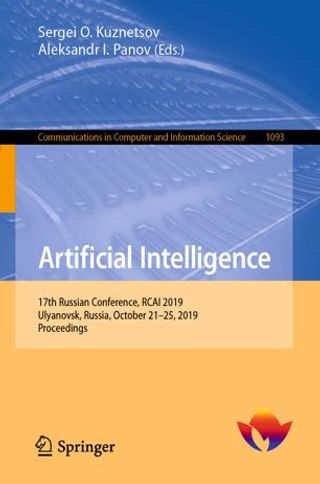
Artificial Intelligence. 17th Russian Conference, RCAI 2019, Ulyanovsk, Russia, October 21–25, 2019, Proceedings
Vol. 1093. , Springer, 2019.
Similar publications
Bioinspired Method of Agent Redistribution between Groups
Irina Petrovna Karpova, Pattern Recognition and Image Analysis 2025 Vol. 35 No. 4 P. 1138–1144
A solution to the problem of redistributing agents between groups based on simulating a form of social parasitism in ants known as slave-making is considered. To provide a comprehensive solution, the problem is integrated with a method of orientation based on visual landmarks and a compass, including route memorization and return. The models and mechanisms ...
Added: April 29, 2026
Decentralized Uncertainty-Aware Multi-Agent Collision Avoidance With Model Predictive Path Integral
Dergachev S., Yakovlev K., , in: 2025 IEEE/RSJ International Conference on Intelligent Robots and Systems (IROS).: IEEE, 2025. P. 12456–12463.
Decentralized multi-agent navigation under uncertainty is a complex task that arises in numerous robotic applications. It requires collision avoidance strategies that account for both kinematic constraints, sensing and action execution noise. In this paper, we propose a novel approach that integrates the Model Predictive Path Integral (MPPI) with a probabilistic adaptation of Optimal Reciprocal Collision ...
Added: March 2, 2026
Ant-inspired navigation algorithm based on visual landmarks
Karpova I. P., Robotics and Autonomous Systems 2025 Vol. 193 Article 105082
This paper describes a method for mobile robot navigation that is similar to the navigation mechanism of social insects. Unlike other bio-inspired methods that mimic certain morphological features of animals or separate natural mechanisms, the proposed approach is based on the phenomenology of the behaviour of some ant species during collective foraging. This method does ...
Added: June 3, 2025
Bio-inspired approach to robot orientation based on navigation mechanisms of some ant species
Karpova I. P., Евразиатский энтомологический журнал 2024 Vol. 23 No. 5 P. 276–282
The paper describes a bio-inspired mechanism for orientation and navigation of mobile robots based on navigation elements of some ant species, namely: Camponotus pennsylvanicus (De Geer, 1773), Formica subsericea Say, 1836, F. rufa Linnaeus, 1761, Cataglyphis fortis (Forel, 1902), Melophorus bagoti Lubbock, 1883 and Myrmecia pyriformis Smith, 1858. The path is represented as a sequence ...
Added: December 17, 2024
“Pitfalls” of Bio-Inspired Models on the Example of Ant Trails
I.P. Karpova, V. E. Karpov, Automation and Remote Control 2024 Vol. 85 No. 7 P. 641–651
This paper explores the problem of influencing the environment by a group of autonomous robots through the creation and use of road infrastructure. The model object is ant roads (trails). We identify the main aspects of the behavior of different ant species in the process of collective foraging, and actions that together lead to the ...
Added: November 6, 2024
Применение управления с прогнозирующими моделями и стохастической оптимизацией в задаче децентрализованного много-агентного избегания столкновений
Dergachev S., Yakovlev K., В кн.: Сборник трудов XIV Всероссийского совещания по проблемам управления ВСПУ-2024.: Институт проблем управления им. В.А. Трапезникова РАН, 2024. С. 1630–1634.
Added: September 26, 2024
Decentralized Unlabeled Multi-agent Pathfinding Via Target And Priority Swapping
Dergachev S., Yakovlev K., , in: ECAI 2024. 27th European Conference on Artificial Intelligence, October 19 – 24 October 2024, Santiago de Compostela, Spain – Including 13th Conference on Prestigious Applications of Intelligent Systems (PAIS 2024).: IOS Press, 2024. P. 4344–4351.
Added: September 11, 2024
Decentralized Unlabeled Multi-agent Navigation in Continuous Space
Dergachev S., Yakovlev K., , in: Interactive Collaborative Robotics. 9th International Conference, ICR 2024, Mexico City, Mexico, October 14–18, 2024, Proceedings.: Cham: Springer, 2024. P. 186–200.
Added: September 11, 2024
Interactive Collaborative Robotics. 9th International Conference, ICR 2024, Mexico City, Mexico, October 14–18, 2024, Proceedings
Cham: Springer, 2024.
This book constitutes the refereed proceedings of the 9th International Conference on Interactive Collaborative Robotics, ICR 2024, held in Mexico City, Mexico, during October 14–18, 2024. The 32 full papers presented here were carefully reviewed and selected from 62 submissions. These papers focus on the challenges, trends and applications of Human-Robot collaboration in various domains such as Industry, Healthcare, Society ...
Added: September 11, 2024
  • About
  • About
  • Key Figures & Facts
  • Sustainability at HSE University
  • Faculties & Departments
  • International Partnerships
  • Faculty & Staff
  • HSE Buildings
  • HSE University for Persons with Disabilities
  • Public Enquiries
  • Studies
  • Admissions
  • Programme Catalogue
  • Undergraduate
  • Graduate
  • Exchange Programmes
  • Summer University
  • Summer Schools
  • Semester in Moscow
  • Business Internship
  • Research
  • International Laboratories
  • Research Centres
  • Research Projects
  • Monitoring Studies
  • Conferences & Seminars
  • Academic Jobs
  • Yasin (April) International Academic Conference on Economic and Social Development
  • Media & Resources
  • Publications by staff
  • HSE Journals
  • Publishing House
  • iq.hse.ru: commentary by HSE experts
  • Library
  • Economic & Social Data Archive
  • Video
  • HSE Repository of Socio-Economic Information
  • HSE1993–2026
  • Contacts
  • Copyright
  • Privacy Policy
  • Site Map
Edit