?
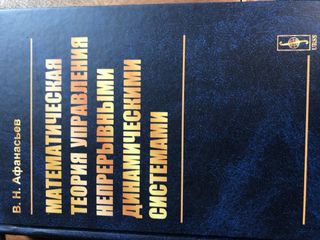
Математическая теория управления непрерывными динамическими системами
This book has been prepared on the basis of lectures on control theory given by the author for a number of years to students of the Department of Applied Mathematics of the National Research University Higher School of Economics and the Faculty of Physics Moscow State University named after M. V. Lomonosov. The content of the book is a significant development of individual chapters of the book "Mathematical Theory of Designing Control Systems" (V.N. Afanasiev, V.B. Kolmanovsky, V.R. Nosov), published in 2003, as well as the addition of new sections of control theory that appeared in the last decade (including the proceedings of the last three International Congresses on Automatic Management (IFAC 2011, 2014, 2018). In the same years, the author of the book obtained a number of results on the application of methods for the synthesis of controls for nonlinear indefinite objects of various physical nature, based on the use of the feedback linearization method and the “extended linearization” method. These methods are insufficiently covered in the domestic literature. In separate chapters of the book, these methods are presented more systematically and in more detail than in the articles and reports of foreign authors, with the expansion of their application in the problems of constructing controls for nonlinear indefinite systems.
The presentation of the material is strict, but accessible. This is facilitated by the consideration of specific controlled systems encountered in various fields of mechanics, astronautics, and medicine. The list of references in the book does not claim to be complete. It includes the main domestic and foreign books and articles covering the current state of management theory. Along with this is a list of some books of the past years, in which the classical beginnings of the theory of optimal control are presented.
On the basis of individual sections of the book, courses for undergraduate and graduate students on modern management theory can be read, as well as mastering the material of the book will help to understand modern articles and monographs on special issues of this theory. The book can also be useful for specialists working in the field of managing various systems.