• A
  • A
  • A
  • АБВ
  • АБВ
  • АБВ
  • A
  • A
  • A
  • A
  • A
Обычная версия сайта
  • RU
  • EN
  • HSE University
  • Publications
  • Book chapter
  • Social Institutions and Basic Principles of Societal Organization
  • RU
  • EN
Расширенный поиск
Высшая школа экономики
Национальный исследовательский университет
Priority areas
  • business informatics
  • economics
  • engineering science
  • humanitarian
  • IT and mathematics
  • law
  • management
  • mathematics
  • sociology
  • state and public administration
by year
  • 2028
  • 2027
  • 2026
  • 2025
  • 2024
  • 2023
  • 2022
  • 2021
  • 2020
  • 2019
  • 2018
  • 2017
  • 2016
  • 2015
  • 2014
  • 2013
  • 2012
  • 2011
  • 2010
  • 2009
  • 2008
  • 2007
  • 2006
  • 2005
  • 2004
  • 2003
  • 2002
  • 2001
  • 2000
  • 1999
  • 1998
  • 1997
  • 1996
  • 1995
  • 1994
  • 1993
  • 1992
  • 1991
  • 1990
  • 1989
  • 1988
  • 1987
  • 1986
  • 1985
  • 1984
  • 1983
  • 1982
  • 1981
  • 1980
  • 1979
  • 1978
  • 1977
  • 1976
  • 1975
  • 1974
  • 1973
  • 1972
  • 1971
  • 1970
  • 1969
  • 1968
  • 1967
  • 1966
  • 1965
  • 1964
  • 1963
  • 1958
  • More
Subject
News
September 11, 2026
How to Assess Students Knowledge in the Age of AI
A researcher at HSE University has proposed a flowchart to help lecturers decide how to assess students who use artificial intelligence. It shows where the use of AI should be restricted and where it can be incorporated into the learning process. The article has been published in IT Professional.
September 9, 2026
‘Balkan Hospitality Opens Doors: Studying Dialects on the Verge of Extinction
You cannot study spoken dialects from books. Instead, you need to go to a village, seek out its elders, and earn the trust of local residents before you can record hours of spontaneous stories. This is how Natalia Muravleva, Associate Professor at the Faculty of Humanities, conducts her research. Her internship in Serbia continued her long-standing study of dialects spoken by Macedonian settlers. In this interview, she discusses how diaspora cultural centres help researchers reach informants, why native speakers need to be interviewed only in their own language (otherwise, as she puts it, they may 'break'), and how a single field season helped her finalise her monograph. She also shares warm memories of autumn in Belgrade and of colleagues with whom grammar can be discussed in three languages at once.
September 9, 2026
Scientists Train Neural Network to Generate Process Plans from 3D Models
Researchers at the HSE FCS AI and Digital Science Institute have developed CAD2TechSpec, a framework that converts 3D models of mechanical parts into machining process plans—step-by-step instructions for machine tools. The solution aims to reduce the time required for the design and preparation of technical process documentation in mechanical engineering, aircraft manufacturing, and other high-tech industries. The study findings have been published in PeerJ Computer Science.


Have you spotted a typo?
Highlight it, click Ctrl+Enter and send us a message. Thank you for your help!

Publications
  • Books
  • Articles
  • Chapters of books
  • Working papers
  • Report a publication
  • Research at HSE

?

Social Institutions and Basic Principles of Societal Organization

Ch. 3. P. 51–78.
Bondarenko D. M.

Aside from complexity measured in levels of political integration, societies as systems of social institutions have another fundamental characteristic that can be called a “basic principle of societal organization.” The principle of organization a society embodies depends on the way its institutions are arranged with respect to one another. Two basic principles can be distinguished: heterarchy—the relation of elements to one another when they are unranked or can be ranked in different ways (as coined by Crumley), and its opposite, homoarchy,—a condition in society in which relationships in most contexts are ordered mainly according to one principal hierarchical relationship. Homoarchy and heterarchy represent the most universal “ideal” (generalized) principles and basic trajectories of socio-cultural organization. There are no universal evolutionary stages: cultures can be (generally) heterarchical or homoarchical having an equal level of complexity. A culture can change its basic organizational principle without transition to another complexity level. Alternativeness also exists within each of the types. So, the heterarchy—homoarchy dichotomy runs throughout the whole of human history: it is observable on all levels of social complexity in all historical periods and culture areas, including the globalized world of our time. Transformations in the ways social institutions and their sets, societal subsystems, are ranked (homoarchically or hetrarchically) on the one hand and changes in the overall cultural complexity on the other are two different, largely unrelated processes.

Language: English
Full text
DOI
Keywords: социальные институтысоциальная организацияsocial institutionssocial organizationнелинейная социальная эволюцияnon-linear social evolution
Publication based on the results of:
Evolution of the Social Institutes: Historical and Anthropological Contexts (2020)

In book

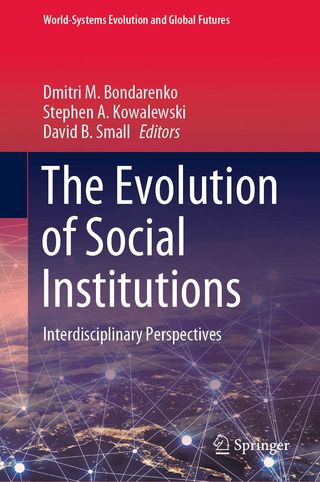
The Evolution of Social Institutions: Interdisciplinary Perspectives
Bondarenko D. M., Kowalewski S., Birch J., Claessen H. M., Kradin N., Nemirovsky A., Korotayev A., Hui V. T., Kim N., Small D., Shchavelev A., Marey A. V., Baskin K., Pozdnyakova A., Denisova T., Harris L., Dye D., Aleksandrov G., Beekman C., Stanish C., Roscoe P., Davletshin A. Springer, 2020.
Similar publications
Conclusion
Gleb V. Aleksandrov, Bondarenko D. M., , in: Principles and Forms of Sociocultural Organization: Historical Contexts of Interaction.: L., NY: Anthem Press, 2026. Ch. 13 P. 251–259.
The brief concluding chapter reiterates the theoretical framework of the book and presents a brief overview of every chapter, highlighting the way chronologically and geographically diverse research subjects tie into the general approach the work utilizes. The author stresses the importance of the overarching goal of this collective work, to showcase the applicability of the ...
Added: January 22, 2026
Principles and Forms of Organization of Societies as Systems of Institutions (The “Conceptual Frame” of This Book)
Bondarenko D. M., , in: Principles and Forms of Sociocultural Organization: Historical Contexts of Interaction.: L., NY: Anthem Press, 2026. Ch. 1 P. 1–29.
Societies are systems composed of a great number of various social institutions. Societies are changing as a result of institutions appearance, transformation, and interaction. As systems of social institutions, societies have a fundamental characteristic that can be called a “basic principle of societal organization.” The principle of organization a society embodies depends on the way ...
Added: January 22, 2026
Principles and Forms of Sociocultural Organization: Historical Contexts of Interaction
Gleb V. Aleksandrov, Bondarenko D. M., Anna K. Aleksandrova et al., L., NY: Anthem Press, 2026.
Edited research collection One paragraph description of the project’s scope and content Societies are systems composed of a great number of various social institutions. Societies change as a result of emergence, transformation, and interaction of institutions. As systems of social institutions, societies have a fundamental characteristic that can be called a “basic principle of societal organization.” The ...
Added: January 22, 2026
АКТУАЛЬНЫЕ ПРОБЛЕМЫ СОЦИАЛЬНОГО РАЗВИТИЯ. ФИЛОСОФСКИЕ И СОЦИОЛОГИЧЕСКИЕ ИССЛЕДОВАНИЯ Архангельск, 16–17 апреля 2021 года
Архангельск: Северный (Арктический) федеральный университет им. М.В. Ломоносова, 2021.
The collection presents articles and abstracts of reports of participants of the IV All-Russian (with international participation) scientific conference of students and schoolchildren "Current issues of development of the problem. Philosophical and sociological research". The conference was organized and held by the Department of Philosophy and Sociology of the Northern (Arctic) Federal University named after ...
Added: May 18, 2025
Переустройство мира. Тренды международной грушинской социологической конференции - 2023
М.: ВЦИОМ, 2023.
Аналитический обзор содержит анализ материалов международной Грушинской социологической конференции - 2023 с использованием оптики и инструментов трендвотчинга. Представлено 4 мегатренда, понимаемых как сдвиги на глобальном уровне: ускорение и гибридизация; углубление социетальных разрывов и дистанций; демографический перелом; персонализация социальных институтов, а также раскрывающие их 13 трендов. В обзоре дается краткий анализ вопросов, вызовов и рисков, которые ...
Added: February 18, 2025
Принципы и формы организации обществ как систем институтов («концептуальная рамка» этой книги)
Bondarenko D. M., В кн.: Принципы и формы социокультурной организации: исторические контексты взаимодействия.: М.: Издательский дом ЯСК, 2024. С. 7–47.
Societies are systems composed of a great number of various social institutions. Societies are changing as a result of institutions appearance, transformation, and interaction. As systems of social institutions, societies have a fundamental characteristic that can be called a “basic principle of societal organization.” The principle of organization a society embodies depends on the way ...
Added: July 19, 2024
Воздействие культурной глобализации на социальные институты России
Сехлеян С. А., Социология. Журнал Российской социологической ассоциации 2023 № 2 С. 65–69
This article examines the impact of cultural globalization on social institutions in Russia. Social institutions, such as education, healthcare, and the legal system, are crucial for governing social behavior and providing services to the public. In Russia, these institutions are largely controlled by the state, but private organizations also play a role in providing social ...
Added: July 16, 2024
Принципы и формы социокультурной организации: исторические контексты взаимодействия
Aleksandrov G., Александрова А. К., Бовыкин Д. Ю. et al., М.: Издательский дом ЯСК, 2024.
Societies are systems composed of a great number of various social institutions. Societies are changing as a result of institutions appearance, transformation, and interaction. As systems of social institutions, societies have a fundamental characteristic that can be called a “basic principle of societal organization.” The principle of organization a society embodies depends on the way ...
Added: May 16, 2024
Образ школьного образования в советском кинематографе: социологическая перспектива
Рыбакова Е. Р., Ivanov I., Журнал Белорусского государственного университета. Социология 2023 № 4 С. 75–83
It is noted that the school education system is a reflection of the processes taking place in the political, economic and cultural spheres of society, which is why educational topics are of particular interest to sociologists. The materials of Soviet cinema can serve as a tool for studying social processes in the context of education. ...
Added: January 13, 2024
Россия реформирующаяся: ежегодник: вып. 21
М.: ФНИСЦ РАН, 2023.
Выходит двадцать первый выпуск ежегодника «Россия реформирующаяся». По сложившейся традиции ежегодник собирает статьи, посвящённые актуальным вопросам российской жизни, содержащие, с одной стороны, теоретические посылы, с другой, данные прикладных исследований. За прошедшие годы ежегодник стал важной площадкой, делающей возможной значимые социологические высказывания. Текущий выпуск не является в этом смысле исключением. Он поделён на три взаимосвязанных раздела. ...
Added: November 27, 2023
Общество Позднего Египта в свидетельствах древнегреческих авторов V–IV вв. до н.э
Ladynin I. A., Аристей. Aristeas: Вестник классической филологии и античной истории 2023 Т. 27 С. 28–47
The article considers the evidence by Herodotus, Plato, Aristotle, Isocrates, Dicaearchus of Messana, Hecataeus of Abdera (followed by Diodorus) and Strabo on the organization of the Ancient Egyptian society. According to this tradition, its major feature was the division into three self-contained and hereditary social groups: priests, warriors and labourers. In the 4th century B.C. ...
Added: October 30, 2023
Экономическое поведение студенческой молодежи как коммуникативная проблема в теории социальных институтов
Buchatskii A., В кн.: Надежды: сборник научных статей студентовВып. 17.: Н. Новгород: Изд-во ННГУ им. Н.И. Лобачевского, 2023. С. 149–154.
The article provides an interpretation of the results of recent empirical studies on the economic strategies of regional and Moscow students of a range of Russian universities; the theoretical basis of the article is the Neo-Institutional Theory of D. North and the concept of Reflexive Sociology of E. Giddens. Based on the mentioned facts, some ...
Added: September 22, 2023
A Civil Body Politick: Governance, Community and Accountability in Early New England
Gleb V. Aleksandrov, Frontiers in Political Science 2022 Vol. 4 Article 804673
In the early XVII century, when the New England colonies were established, the English Crown, preoccupied with domestic matters, interfered little with matters of colonial administration. The government system created by the colonists, was inspired to a certain degree by the religious ideas shared by many Puritan colonists but was shaped by political necessity and ...
Added: November 27, 2022
Образование как источник действия, совершенствующего структуры: теоретические подходы и практические задачи
Sorokin P., Froumin I., Вопросы образования 2022 № 1 С. 116–137
The issue of “transformative agency”, which proactively improves and transforms social structures, is relevant both for theoretical discussions and practical agenda. The field of education is of particular importance in terms of shaping the poten- tial for agency. However, the dominant areas of research in education, including the sociology of education, focus, on the contrary, on the mechanisms and factors of reproduction of social structures and ...
Added: March 22, 2022
Российские медиа: целевые установки, стратегии и технологии воздействия на аудиторию. Статья вторая: эмпирическое исследование
Dzyaloshinsky I. M., Дзялошинская М. И., Вопросы журналистики 2021 № 10 С. 5–38
The article presents the methods and results of the study of the specific features of the interaction of different social institutions with different audiences in different circumstances. The main methods used for the study were content analysis and intent analysis. The study was organized as follows. Selected texts with signs of institutional origin. Masters from ...
Added: December 6, 2021
  • About
  • About
  • Key Figures & Facts
  • Sustainability at HSE University
  • Faculties & Departments
  • International Partnerships
  • Faculty & Staff
  • HSE Buildings
  • HSE University for Persons with Disabilities
  • Public Enquiries
  • Studies
  • Admissions
  • Programme Catalogue
  • Undergraduate
  • Graduate
  • Exchange Programmes
  • Summer University
  • Summer Schools
  • Semester in Moscow
  • Business Internship
  • Research
  • International Laboratories
  • Research Centres
  • Research Projects
  • Monitoring Studies
  • Conferences & Seminars
  • Academic Jobs
  • Yasin (April) International Academic Conference on Economic and Social Development
  • Media & Resources
  • Publications by staff
  • HSE Journals
  • Publishing House
  • iq.hse.ru: commentary by HSE experts
  • Library
  • Economic & Social Data Archive
  • Video
  • HSE Repository of Socio-Economic Information
  • HSE1993–2026
  • Contacts
  • Copyright
  • Privacy Policy
  • Site Map
Edit