?
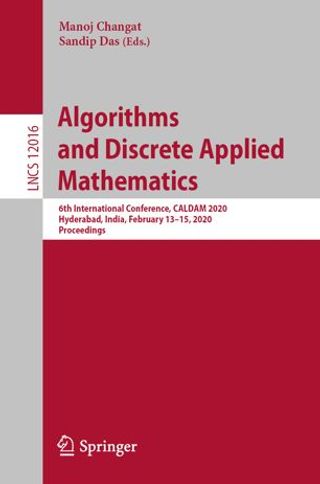
Algorithms and Discrete Applied Mathematics 6th International Conference, CALDAM 2020, Hyderabad, India, February 13–15, 2020, Proceedings
Vol. 12016.
Springer, 2020.
Under the general editorship: M. Changat, S. Das
This book constitutes the proceedings of the 6th International Conference on Algorithms and Discrete Applied Mathematics, CALDAM 2020, held in Hyderabad, India, in February 2020. The 38 papers presented together with 2 invited talks in this volume were carefully reviewed and selected from 102 submissions. The papers are organized in topical sections on graph algorithms, graph theory, combinatorial optimization, distributed algorithms, combinatorial algorithms, and computational complexity.
Chapters
Beaudou L., Foucaud F., Naserasr R., , in: Algorithms and Discrete Applied Mathematics 6th International Conference, CALDAM 2020, Hyderabad, India, February 13–15, 2020, ProceedingsVol. 12016.: Springer, 2020. P. 184–196.
Given a graph H, a graph G is called H-critical if G does not admit a homomorphism to H, but any proper subgraph of G does. Observe that 𝐾𝑘−1-critical graphs are the classic k-(colour)-critical graphs. This work is a first step towards extending questions of extremal nature from k-critical graphs to H-critical graphs. Besides complete ...
Added: February 18, 2020
Medushevsky A. N., Liberal.ru 2026
Today, more than ever before, the contribution of new technologies shapes the conditions of humanity's existence as a biological species, prompting a debate about its prospects for survival. This process of transformation—which spans every sphere of social and moral regulation, from family relations and child-rearing to the very meaning of life—is dividing public opinion between ...
Added: August 26, 2026
Kuznetsov S., Pshenitsyn T., Speranski S. O., Journal of Symbolic Logic 2025 Article jsl.2025.16
The class of all ∗-continuous Kleene algebras, whose description includes an infinitary condition on the iteration operator, plays an important role in computer science. The complexity of reasoning in such algebras — ranging from the equational theory to the Horn one, with restricted fragments of the latter in between — was analyzed by Kozen (2002). This ...
Added: August 12, 2026
Speranski S. O., Математические заметки 2026 Т. 120 № 3 С. 470–483
We show that, in terms of closure ordinals, many infinitary calculi for ‘first-order’ logics of probability (i.e., for languages similar to those in [Abadi & Halpern 1994]) are as hard as possible: the corresponding closure ordinals coincide with the least non-constructive ordinal, denoted by $\omega_1^{\mathrm{CK}}$. ...
Added: August 12, 2026
Speranski S. O., Grefenshtein A., Izvestiya. Mathematics 2026 Vol. 90 No. 4 P. 105–126
The article is concerned with Halpern's first-order logics of probability, which we denote by L_1 and L_2 – the first of these deals with probability distributions on the domain, while the second employs distributions on external sets of possible worlds. The proofs of [Abadi & Halpern 1994] of the complexity lower bound results for L_1 and L_2 ...
Added: August 12, 2026
David J. L., Leonid Grinin, Korotayev A., , in: Complexity in Universal Evolution. A Big History Perspective.: Springer, 2026. Ch. 22 P. 585–608.
This collective monograph explores focus on complexity aspects in Big History against the background of complexity growth in the Universe, on our planet, and in biological, social, and cultural systems. Complexity growth is regarded as the connecting thread of evolutionary development and as a leading trend of Big History. The cosmic development chapters examine symmetries ...
Added: August 10, 2026
Korotayev A., , in: Complexity in Universal Evolution. A Big History Perspective.: Springer, 2026. Ch. 13 P. 359–409.
We have undertaken an attempt to propose a periodization of the Big History Biosocial (Anthropogenesis) Era on the basis of the most recent scientific data. This periodization is complexity-based, that is, the boundaries of the identified epochs are marked with complexity jumps, that is, in our case, such phase transitions that result in significant increases ...
Added: August 10, 2026
Leonid Grinin, Alexander M., Korotayev A., , in: Complexity in Universal Evolution. A Big History Perspective.: Springer, 2026. Ch. 12 P. 283–355.
In the first half of this chapter, Grinin et al. survey general similarities and differences between biological and social macroevolution. They undertake a systematic comparison between biological and social evolution at different levels of analysis and in various aspects, formulating a considerable number of general principles and rules of evolution, and working to develop a ...
Added: August 10, 2026
David J. L., Leonid Grinin, Korotayev A., , in: Complexity in Universal Evolution. A Big History Perspective.: Springer, 2026. Ch. 1 P. 1–25.
Complexity is widely acknowledged as a foundational and pivotal concept in Big History, offering a unifying lens through which to examine the emergence and development of systems—from particles and galaxies to life, civilizations, and beyond. Yet, despite its centrality, major gaps remain in how we define, measure, and interpret complexity across different phases and scales. ...
Added: August 10, 2026
Polyakov S., Smeshkova L., Lapin V. et al., Veredas do Direito 2026 Vol. 23 No. 11 Article e237531
The article examines the significant transformation of the concept of information and its impact on modern security technologies. Until the middle of the 20th century, the concept of information was considered as a philosophical category related to the transfer of knowledge and meaning. With the advent of Claude Shannon's communication theory, information was reinterpreted as ...
Added: July 27, 2026
Samoilov O., Tatarko A., Вопросы теоретической экономики 2026 № 2 С. 209–228
The article presents a theoretical review of literature from the last ten years devoted to the analysis of socio-psychological factors of trust in artificial intelligence. The widespread adoption of automated artificial intelligence systems, which is associated with expected economic growth, reduced resource costs, and the optimization of various work processes, often faces user distrust in ...
Added: May 21, 2026
Kirsanova E., Pakshin P., Право и экономика 2026 № 3 (456) С. 26–34
The article examines the legal regime of intellectual property created by artificial intelligence. Changes to the existing legal framework towards recognizing artificial intelligence as a legal entity would violate the rationale and fundamental principles of the intellectual property rights system. This article provides an overview of different views on the rationale for granting copyright to ...
Added: April 28, 2026
Karpov A., Dvoynikova A., Ryumina E., , in: Lecture Notes in Networks and SystemsVol. 776.: Springer, 2023. P. 3–13.
Abstract. The paper presents a brief review of intelligent interfaces and systems of human-machine interaction. To date, few intelligent interfaces and systems are used in various areas of industry. All the systems of human-machine interaction can be divided into intelligent synthesis and analysis systems. Intelligent synthesis implies the presentation of information from the system to ...
Added: April 25, 2026
Pakshin P., Legal Issues in the Digital Age 2026 Vol. 7 No. 1 P. 32–48
Artificial intelligence plays a significant role in automation, minimizing human intervention in fields such as medicine, art, and law. Despite the historically close relationship between art and technology, generative AI has expanded the potential for creative activity. A significant catalyst for this process has been the proliferation of pre-trained AI systems, which have accelerated the ...
Added: March 31, 2026
Yerbolova A. S., Tomashchuk K., Kogan A. et al., Complexity 2026 Vol. 2026 No. 1 Article 5519690
Tis paper presents a novel approach to analyzing and grouping natural languages based on the degree of their chaoticity. It clusters 52 languages from 18 language families, according to the value of the entropy–complexity pair, to reveal the chaotic properties of semantic trajectories. Te obtained clusters appear to be closely correlated with the family of ...
Added: February 16, 2026
Speranski S. O., Journal of Logic and Computation 2013 Vol. 23 No. 5 P. 1035–1055
In the present article, the quantifiers over propositions are first introduced into the language for reasoning about probability, then the complexity issues for validity problems dealing with the corresponding hierarchy of probabilistic sentences are investigated. We prove, among other things, the $\Pi^1_1$-completeness for the general validity and also indicate the least level in the hierarchy ...
Added: December 27, 2025
Speranski S. O., Computability 2015 Vol. 4 No. 2 P. 159–174
Added: December 27, 2025
Speranski S. O., Studia Logica 2017 Vol. 105 No. 2 P. 407–429
The paper contains a survey on the complexity of various truth hierarchies arising in Kripke’s theory. I present some new arguments, and use them to obtain a number of interesting generalisations of known results. These arguments are both relatively simple, involving only the basic machinery of constructive ordinals, and very general. ...
Added: December 26, 2025
Kuznetsov S., Speranski S. O., Annals of Pure and Applied Logic 2022 Vol. 173 No. 2 Article 103057
We introduce infinitary action logic with exponentiation — that is, the multiplicative-additive Lambek calculus extended with Kleene star and with a family of subexponential modalities, which allow some of the structural rules (contraction, weakening, permutation). The logic is presented in the form of an infinitary sequent calculus. We prove cut elimination and, in the case ...
Added: December 26, 2025
Kuznetsov S., Speranski S. O., Studia Logica 2023 Vol. 111 No. 2 P. 251–280
Infinitary action logic can be naturally expanded by adding exponential and subexponential modalities from linear logic. In this article we shall develop infinitary action logic with a subexponential that allows multiplexing (instead of contraction). Both non-commutative and commutative versions of this logic will be considered, presented as infinitary sequent calculi. We shall prove cut admissibility ...
Added: December 26, 2025
Speranski S. O., Logic Journal of the IGPL 2025 Vol. 33 No. 2 Article jzae042
This paper is concerned with a two-sorted probabilistic language, denoted by QPL, which contains quantifiers over events and over reals, and can be viewed as an elementary language for reasoning about probability spaces. The fragment of QPL containing only quantifiers over reals is a variant of the well-known ‘polynomial’ language from [Fagin et al. 1990, Section 6]. ...
Added: December 26, 2025
Speranski S. O., Logic Journal of the IGPL 2025 Vol. 33 No. 3 Article jzae114
We shall be concerned with two natural expansions of the quantifier-free ‘polynomial’ probability logic of [Fagin et al. 1990]. One of these, denoted by QPL-e, is obtained by adding quantifiers over arbitrary events, and the other, denoted by p-QPL-e, uses quantifiers over propositional formulas — or equivalently, over events expressible by such formulas. The earlier proofs ...
Added: December 26, 2025