• A
  • A
  • A
  • АБВ
  • АБВ
  • АБВ
  • A
  • A
  • A
  • A
  • A
Обычная версия сайта
  • RU
  • EN
  • HSE University
  • Publications
  • Book chapter
  • The Twenty-First-Century Singularity in the Big History Perspective—A Re-analysis
  • RU
  • EN
Расширенный поиск
Высшая школа экономики
Национальный исследовательский университет
Priority areas
  • business informatics
  • economics
  • engineering science
  • humanitarian
  • IT and mathematics
  • law
  • management
  • mathematics
  • sociology
  • state and public administration
by year
  • 2027
  • 2026
  • 2025
  • 2024
  • 2023
  • 2022
  • 2021
  • 2020
  • 2019
  • 2018
  • 2017
  • 2016
  • 2015
  • 2014
  • 2013
  • 2012
  • 2011
  • 2010
  • 2009
  • 2008
  • 2007
  • 2006
  • 2005
  • 2004
  • 2003
  • 2002
  • 2001
  • 2000
  • 1999
  • 1998
  • 1997
  • 1996
  • 1995
  • 1994
  • 1993
  • 1992
  • 1991
  • 1990
  • 1989
  • 1988
  • 1987
  • 1986
  • 1985
  • 1984
  • 1983
  • 1982
  • 1981
  • 1980
  • 1979
  • 1978
  • 1977
  • 1976
  • 1975
  • 1974
  • 1973
  • 1972
  • 1971
  • 1970
  • 1969
  • 1968
  • 1967
  • 1966
  • 1965
  • 1964
  • 1963
  • 1958
  • More
Subject
News
August 13, 2026
‘Working with AI Solves a Wide Range of Engineering Problems
Artificial intelligence is a working tool based on a balanced combination of algorithms and engineering. Experts and doctoral students from the HSE Moscow Institute of Electronics and Mathematics explain how AI technologies can improve an application, device, or system, and what engineering tasks are solved in the process.
August 12, 2026
‘I Would Like My Research to Help Make the World a Calmer and Better Place
Whatever task Saraa Ali, Junior Research Fellow at the Laboratory of Methods for Big Data Analysis (LAMBDA) of the AI and Digital Science Institute (HSE Faculty of Computer Science), is working on, she thinks about how it can benefit people. She told the Young Scientists of HSE University project about her large family, diagnosing three-phase motors, and her dream of building a children’s home in her native country.
August 11, 2026
‘The Peak of Stupidity and ‘The Valley of Despair: HSE Economists Propose an Explanation for the Dunning–Kruger Effect
The Dunning–Kruger effect, which describes a sharp surge in self-confidence among beginners followed by an equally rapid decline as they gain experience, can be explained by the nature of the learning process and the acquisition of new knowledge. This conclusion was reached by Andrey Vorchik of the HSE Faculty of Economic Sciences together with independent researcher Murat Mamyshev. They developed a mathematical model of learning and demonstrated how subjective confidence is formed and changes as knowledge accumulates, as well as how teachers can reduce the ‘valley of despair’ experienced by learners.


Have you spotted a typo?
Highlight it, click Ctrl+Enter and send us a message. Thank you for your help!

Publications
  • Books
  • Articles
  • Chapters of books
  • Working papers
  • Report a publication
  • Research at HSE

?

The Twenty-First-Century Singularity in the Big History Perspective—A Re-analysis

Ch. 2. P. 19–75.
Korotayev A.

The idea that in the near future we should expect “the Singularity” has become quite popular recently, primarily thanks to the activities of Google technical director in the field of machine training Raymond Kurzweil and his book The Singularity Is Near (2005). It is shown that the mathematical analysis of the series of events (described by Kurzweil in his famous book), which starts with the emergence of our galaxy and ends with the decoding of the DNA code, is indeed ideally described by an extremely simple mathematical function (not known to Kurzweil himself) with a singularity in the region of 2029. It is also shown that a similar time series (beginning with the onset of life on Earth and ending with the information revolution—composed by the Russian physicist Alexander Panov completely independently of Kurzweil) is also practically perfectly described by a mathematical function (very similar to the above and not used by Panov) with a singularity in the region of 2027. It is shown that this function is also extremely similar to the equation discovered in 1960 by Heinz von Foerster and published in his famous article in the journal “Science”—this function almost perfectly describes the dynamics of the world population up to the early 1970s and is characterized by a mathematical singularity in the region of 2027. All this indicates the existence of sufficiently rigorous global macroevolutionary regularities (describing the evolution of complexity on our planet for a few billions of years), which can be surprisingly accurately described by extremely simple mathematical functions. At the same time, it is demonstrated that in the region of the Singularity point there is no reason, after Kurzweil, to expect an unprecedented (many orders of magnitude) acceleration of the rates of technological development. There are more grounds for interpreting this point as an indication of an inflection point, after which the pace of global evolution will begin to slow down systematically in the long term.

Language: English
Full text
DOI
Text on another site
Keywords: singularitytechnological developmentBig Historyglobal phase transitionmacrodevelopment
Publication based on the results of:
Instruments and Factors of Socio-Political Destabilization in the Middle East and Central Asia (2019)

In book

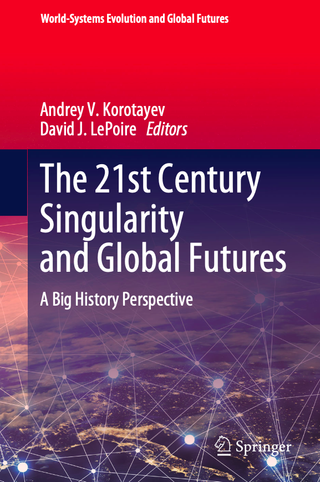
The 21st Century Singularity and Global Futures. A Big History Perspective
Switzerland: Springer, 2020.
Similar publications
Human Evolution in the Complexity Growth Perspective: Toward Periodization of the Big History Biosocial Era
Korotayev A., , in: Complexity in Universal Evolution. A Big History Perspective.: Springer, 2026. Ch. 13 P. 359–409.
We have undertaken an attempt to propose a periodization of the Big History Biosocial (Anthropogenesis) Era on the basis of the most recent scientific data. This periodization is complexity-based, that is, the boundaries of the identified epochs are marked with complexity jumps, that is, in our case, such phase transitions that result in significant increases ...
Added: August 10, 2026
Biological and Social Phases of Big History and Complexity Growth
Leonid Grinin, Alexander M., Korotayev A., , in: Complexity in Universal Evolution. A Big History Perspective.: Springer, 2026. Ch. 12 P. 283–355.
In the first half of this chapter, Grinin et al. survey general similarities and differences between biological and social macroevolution. They undertake a systematic comparison between biological and social evolution at different levels of analysis and in various aspects, formulating a considerable number of general principles and rules of evolution, and working to develop a ...
Added: August 10, 2026
Introduction to Complexity Theory for Big History
David J. L., Leonid Grinin, Korotayev A., , in: Complexity in Universal Evolution. A Big History Perspective.: Springer, 2026. Ch. 2 P. 29–90.
This chapter explores the role of complexity dynamics in Big History through an integrative theoretical framework that spans physical, chemical, biological, social, cognitive, and civilizational domains. Building on foundational work in systemstheory,thermodynamics,andevolutionarytheory,thechapterarguesthat complexity can serve as a conceptual bridge across disciplines. By examining how complexity emerges, is sustained, and transforms across thresholds, as well as ...
Added: August 10, 2026
The Evolution of Complexity in the Stelliferous Era: Observations and Patterns
Korotayev A., David J. L., , in: Complexity in Universal Evolution. A Big History Perspective.: Springer, 2026. Ch. 5 P. 151–171.
A previous study compared the symmetries of the cooling after the Big Bang and thedevelopment oflife, humans,and civilization on Earth. Asimple model ofthe relative rates of change depicts two cones joined at their bases representing the Big Bang expansion and the acceleration of complexity development on Earth through life evolution, human evolution, and civilization development. ...
Added: August 10, 2026
Complexity in Universal Evolution: A Big History Perspective—An Introduction
David J. L., Leonid Grinin, Korotayev A., , in: Complexity in Universal Evolution. A Big History Perspective.: Springer, 2026. Ch. 1 P. 1–25.
Complexity is widely acknowledged as a foundational and pivotal concept in Big History, offering a unifying lens through which to examine the emergence and development of systems—from particles and galaxies to life, civilizations, and beyond. Yet, despite its centrality, major gaps remain in how we define, measure, and interpret complexity across different phases and scales. ...
Added: August 10, 2026
Complexity in Universal Evolution. A Big History Perspective
David J. L., Leonid Grinin, Korotayev A., Springer, 2026.
Complexity is widely acknowledged as a foundational and pivotal concept in Big History, offering a unifying lens through which to examine the emergence and development of systems—from particles and galaxies to life, civilizations, and beyond. Yet, despite its centrality, major gaps remain in how we define, measure, and interpret complexity across different phases and scales. ...
Added: August 7, 2026
Complexity in Big History. An Introductory Exploration
LePoire D., Grinin L. E., Korotayev A., Journal of Big History 2025 Vol. 8 No. 3 P. 98–139
Building on foundational work in systems theory, thermodynamics, and evolutionary theory, this paper argues that complexity can serve as a conceptual bridge across disciplines. It explores the role of complexity dynamics in Big History through an integrative theoretical framework that spans physical, chemical, geological, biological, social, cognitive, and civilizational domains. By examining how complexity emerges, ...
Added: November 1, 2025
Мир стоит на пороге эпохи технологической сингулярности. Как изменятся тренды базовых глобальных процессов и эволюция человечества
Akaev A., Ильин И. В., Korotayev A., Вестник Российской академии наук 2025 № 9 С. 3–15
The article examines the likelihood of creating artificial intelligence (AI) at the human level (“human intelligence level”, AGI) by 2027-2029 and the onset of the era of technological singularity, when a fundamental change in the mechanism of human evolution will occur. It is noted that this probability is close to one, since these dates surprisingly ...
Added: October 28, 2025
Conclusions: Exploring Big History Periodizations Across Cosmic and Biosocial Dimensions with Ideas for Further Research
LePoire D., Leonid Grinin, Korotayev A., , in: Navigating Complexity in Big History. Exploring Periodization Across Cosmic and Biosocial Dimensions.: Springer, 2025. P. 495–525.
This volume, “Navigating Complexity in Big History—Exploring Periodization Across Cosmic and Biosocial Dimensions” explores the aspects and proposals for periodization of Big History. This includes considering cross-cutting aspects of measuring complexity (e.g., energy, information, or a combination), considering different mechanisms of natural selection, developing a set of criteria to base the evaluation of frameworks, and ...
Added: May 12, 2025
Comparing and Contrasting Big History Singularity Trends of the Big Bang and Terrestrial Evolution
Korotayev A., , in: Navigating Complexity in Big History. Exploring Periodization Across Cosmic and Biosocial Dimensions.: Springer, 2025. P. 101–157.
The point that within the Big History the decelerating growth of complexity in the Universe observed after the Big Bang can be contrasted with the accelerating growth of complexity traced on our planet for four billion years after the emergence of life on the Earth has been already noticed on quite a number of occasions. ...
Added: May 12, 2025
Possible Methodological Ideas for Periodizing Big History
Leonid Grinin, Korotayev A., , in: Navigating Complexity in Big History. Exploring Periodization Across Cosmic and Biosocial Dimensions.: Springer, 2025. P. 49–71.
“The effort to understand the universe is one of the very few things which lifts human life a little above the level of farce and gives it some of the grace of tragedy”. These words of Nobel laureate Steven Weinberg undoubtedly deserve attention, although they dramatize the origins of interest in the problems of the Universe. ...
Added: May 12, 2025
Navigating Complexity in Big History—Exploring Periodization Across Cosmic and Biosocial Dimensions: An Introduction
LePoire D., Leonid Grinin, Andrey Korotayev, , in: Navigating Complexity in Big History. Exploring Periodization Across Cosmic and Biosocial Dimensions.: Springer, 2025. P. 1–27.
Not so many would argue with identifying complexity as a central concept in Big History and universal evolutionism. It is partly because, perhaps, today, many of us are convinced that not only our world but Universe itself is in a state of major change, and the awareness that we are living in a period of ...
Added: May 12, 2025
Navigating Complexity in Big History. Exploring Periodization Across Cosmic and Biosocial Dimensions
David J. L., L. Grinin, Korotayev A., Springer, 2025.
In the editors’ introduction (Chapter 1), the effort to periodize is placed within the historical context along with considerations from complexity science. Subsequent chapters explore various aspects of periodization and complexity by (a) identifying symmetrical cosmic and biosocial trends, (b) testing rigor and criteria for evaluating periodization, (c) attempting to integrate different approaches through multiple ...
Added: May 12, 2025
Rethinking medieval margins and marginality: edited by Ann E. Zimo, Tiffany D. Vann Sprecher, Kathryn Ryerson, Debra Blumenthal, London and New York, Routledge, 2020, 272 pp., $48.95 (paperback), ISBN 9780367439569
Asatryan G., Kalpakian J., Rethinking History 2022 Vol. 26 No. 1 P. 116–118
For a serious academic work, this book is very enjoyable and can be said to have appeal beyond its expected academic readership. It takes analytical categories used to understand the present and looks at how they were applied in the past and how Medieval people, primarily but not exclusively in Europe, understood them. Specifically, the ...
Added: February 22, 2025
HISTORY & MATHEMATICS. HISTORICAL AND TECHNOLOGICAL DYNAMICS: FACTORS, CYCLES, AND TRENDS
Volgograd: Uchitel Publishing House, 2022.
The present Yearbook is subtitled Historical and Technological Dynamics: Factors, Cycles, and Trends. Its articles demonstrate different forms, patterns, and modes of evolutionary development of societies and their subsystems both over very long periods (in fact, the whole historical process) and over relatively short time intervals. We believe that without an in-depth analysis of the ...
Added: December 14, 2022
Размышления об "антропологии времени" и режимах темпоральности: реплики к дискуссии
Агапов М. Г., Васильева З. С., Карасева А. И. et al., Этнографическое обозрение 2021 № 6 С. 102–116
© 2021, Russian Academy of Sciences. All rights reserved.This is a forum discussion of the article “The Anthropology of Time: History and the State of the Art” by Nikolai Ssorin-Chaikov. Authors explicate the article’s main argument and critically engage with its main points, particularly with the concept of temporal multiplicity and relations within it. In ...
Added: October 29, 2022
Технологическая дифференциация развития субъектов Уральского макрорегиона
Evseeva M., Journal of New Economy 2020 Т. 21 № 3 С. 132–157
At the local level, regions are the entities that have to grapple with the problem of Russia’s technological breakthrough directly. The paper aims to uncover the reasons behind the differences in technological development of the subjects of the Ural macroregion. The economics of complexity and new Schumpeterian theory of economic growth constitute the methodological basis ...
Added: October 27, 2022
Уровень технологического развития индустриальных регионов: экосистемный подход
Evseeva M., Стариков Е. Н., Воронов М. П., Управленец 2021 Т. 12 № 3 С. 13–30
Providing effective industrial management is a complex task that can be resolved through a qualitative analysis of the state of the controlled object. The article assesses the influence of the Industrial Development Fund as a key financial institution of the RF industrial policy on technological development of regional industrial ecosystems. The methodological basis of the ...
Added: October 27, 2022
Economics of Technological Leapfrogging
Lee K., , in: The Challenges of Technology and Economic Catch-up in Emerging Economies.: Oxford University Press, 2021. Ch. 5 P. 123–159.
Added: August 2, 2022
Биосоциальная проблема в контексте новой глобальной реальности: фокус на трансформационном потенциале индивида
Sorokin P., Психологический журнал 2022 Т. 43 № 1 С. 122–126
The present paper aims to contribute to the discussion, initiated by A.L. Zhuravlev and I.A. Mironen- ko in their recent paper “The Biosocial Problem in the Context of Global Psychological Science: Concerning the “Universal” Human Psychology”. We acknowledge the importance of the mentioned article in terms of novel view on contemporary elaborations around the issues of ...
Added: March 4, 2022
Petro-Gas Chemistry in Russia’s East: Growth Driver or Ballast?
Krukov V. A., Shmat V. V., Regional Research of Russia 2021 No. 11 P. 174–186
The article discusses problems in the development of petro-gas (petroleum) chemistry in Russia’s East. The main modern features of the Russian petrochemical industry and key forks of further development are considered, taking into account the alternative of the domestic and foreign markets. Both sectoral and regional aspects of new projects are analyzed compared to the ...
Added: October 22, 2021
Российский автопром: ключевые особенности, влияние коронакризиса, перспективы развития
Simachev Y. V., Kuzyk M., Бутов А. М., ЭКО 2021 Т. 51 № 8 С. 8–37
Based on in-depth interviews with representatives of Russian auto makers, statistical data, analytical reports and official documents, the paper reviews some key features and trends of the industry prior to the crisis, principal effects of the COVID-19 crisis, and evaluates future prospects of car manufacturing in Russia. The authors demonstrate that the sector utterly depends ...
Added: September 21, 2021
Kinetic singularities at transition points from equilibrium to metastable states of the Lennard-Jones particle system
Negodin V., Polyachenko Y., Fleita D. et al., Journal of Molecular Liquids 2021 Vol. 322 No. 1-3 Article 114954
The equilibrium and metastable states of the Lennard-Jones vapor, liquid, and crystal, are studied in the vicinity of the phase transition points. Vapor-liquid, liquid-vapor, liquid-crystal, and crystal-liquid transitions are modeled within the molecular dynamics method. As a research tool, a four-point correlation function is used for the qualitative detection of collective motions of atoms in ...
Added: May 14, 2021
  • About
  • About
  • Key Figures & Facts
  • Sustainability at HSE University
  • Faculties & Departments
  • International Partnerships
  • Faculty & Staff
  • HSE Buildings
  • HSE University for Persons with Disabilities
  • Public Enquiries
  • Studies
  • Admissions
  • Programme Catalogue
  • Undergraduate
  • Graduate
  • Exchange Programmes
  • Summer University
  • Summer Schools
  • Semester in Moscow
  • Business Internship
  • Research
  • International Laboratories
  • Research Centres
  • Research Projects
  • Monitoring Studies
  • Conferences & Seminars
  • Academic Jobs
  • Yasin (April) International Academic Conference on Economic and Social Development
  • Media & Resources
  • Publications by staff
  • HSE Journals
  • Publishing House
  • iq.hse.ru: commentary by HSE experts
  • Library
  • Economic & Social Data Archive
  • Video
  • HSE Repository of Socio-Economic Information
  • HSE1993–2026
  • Contacts
  • Copyright
  • Privacy Policy
  • Site Map
Edit