• A
  • A
  • A
  • АБВ
  • АБВ
  • АБВ
  • A
  • A
  • A
  • A
  • A
Обычная версия сайта
  • RU
  • EN
  • HSE University
  • Publications
  • Book chapter
  • The Aorist / Perfect distinction in Nizh Udi
  • RU
  • EN
Расширенный поиск
Высшая школа экономики
Национальный исследовательский университет
Priority areas
  • business informatics
  • economics
  • engineering science
  • humanitarian
  • IT and mathematics
  • law
  • management
  • mathematics
  • sociology
  • state and public administration
by year
  • 2027
  • 2026
  • 2025
  • 2024
  • 2023
  • 2022
  • 2021
  • 2020
  • 2019
  • 2018
  • 2017
  • 2016
  • 2015
  • 2014
  • 2013
  • 2012
  • 2011
  • 2010
  • 2009
  • 2008
  • 2007
  • 2006
  • 2005
  • 2004
  • 2003
  • 2002
  • 2001
  • 2000
  • 1999
  • 1998
  • 1997
  • 1996
  • 1995
  • 1994
  • 1993
  • 1992
  • 1991
  • 1990
  • 1989
  • 1988
  • 1987
  • 1986
  • 1985
  • 1984
  • 1983
  • 1982
  • 1981
  • 1980
  • 1979
  • 1978
  • 1977
  • 1976
  • 1975
  • 1974
  • 1973
  • 1972
  • 1971
  • 1970
  • 1969
  • 1968
  • 1967
  • 1966
  • 1965
  • 1964
  • 1963
  • 1958
  • More
Subject
News
July 6, 2026
Ancient Craniiform Brachiopod: A Newly Discovered Species with a Unique Shell Shape and Lifestyle
Scientists from HSE University, MSU, and Tallinn University of Technology have studied a fossil species of ancient brachiopods that lived in a warm sea in what is now northern Estonia more than 445 million years ago. These ancient brachiopods developed a cup-shaped shell with a protective 'cap' that shielded them from overgrowth by other marine organisms. The study has been published in Palaeogeography, Palaeoclimatology, Palaeoecology.
July 2, 2026
Researchers Discover How Spelling Errors Slow Down Reading in Russian
Psycholinguists from the Centre for Language and Brain at HSE University–St Petersburg have shown that words that are frequently misspelled are processed more slowly by readers, even when presented with the correct spelling. The researchers confirmed this effect for the first time using Russian-language materials and found that response speed is most strongly linked to how confidently individuals can distinguish the correct spelling of a word from an incorrect one. The study has been published in The Mental Lexicon.
July 2, 2026
HSE Develops App for Assessing Phonological Processing in Children
Researchers at the HSE Centre for Language and Brain have developed a new digital tool for assessing children's phonological processing skills—the ZARYA (Sound Analysis of the Russian Language) test battery. It is the first standardised application in Russia designed to provide a fast and reliable assessment of children's ability to distinguish speech sounds, retain them in working memory, and perform phonemic analysis. The app runs on Android tablets and smartphones and is available for download from RuStore. Details of the test validation have been published in the Journal of Speech, Language, and Hearing Research.


Have you spotted a typo?
Highlight it, click Ctrl+Enter and send us a message. Thank you for your help!

Publications
  • Books
  • Articles
  • Chapters of books
  • Working papers
  • Report a publication
  • Research at HSE

?

The Aorist / Perfect distinction in Nizh Udi

P. 120–165.
Maisak T.

The paper considers the two main synthetic past tenses in Udi and argues that they should be identified as the aorist (‘perfective past’) and the perfect (‘past with present relevance’) respectively. While the former is the main means of foregounding in discourse, the latter has the prototypical ‘current relevance’ meaning, and is also used with experiential and resultative functions. The perfect is also the source for the pluperfect, derived by means of the “retrospective shift” enclitic. The hypothesis put forward in the paper deals with the putative grammaticalization paths of the two forms: most probably, the aorist was based on the perfective converb, and the perfect on the construction with the perfective participle. The evidence for such a development is both typological / comparative (especially stemming from the data of genetically related languages) and language-specific. In particular, it is the perfect in Udi that has a special negative construction involving a perfective participle and a postpositional negation, which may point at the participle as a diachronic source of this particular form.

Language: English
Full text
DOI
Text on another site
Keywords: Lezgic languagesperfectresultativenegationUdiNakh-Daghestanian languagesaoristpluperfect

In book

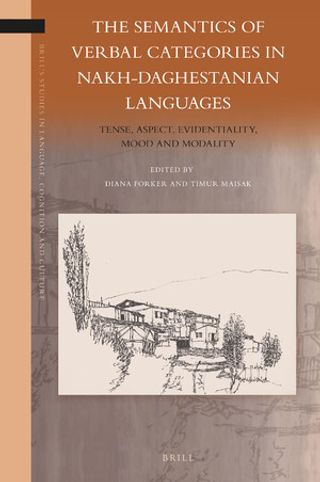
The semantics of verbal categories in Nakh-Daghestanian languages: Tense, aspect, evidentiality, mood and modality
Vol. 16. , Leiden: Brill, 2018.
Similar publications
Слова фигушки и хренушки как специфическое средство выражения отрицания в русской разговорной речи
Nikishina E., Russian Linguistics 2026 Т. 50 Статья 4
The article examines the words фигушки and хренушки (derivatives of the vulgar words фиг and хрен) as specific means of expressing negation in Russian colloquial speech. They have two main uses: first, they function as an independent response – a refusal to do something (– Лучше вылезай! – Фигушки, вы драться будете ‘– You’d better get out! – No ...
Added: March 9, 2026
Такие же, как вокруг: эквасимилятивные конструкции в хваршинском языке
Poliakova E., RHEMA. РЕМА 2024 № 1 С. 28–60
Equasimilative constructions belong to the semantic field of comparison, but have been studied to a much less extent than comparative constructions. There are practically no areal-typological studies in this area. This paper focuses on equasimilative constructions in Khwarshi proper (Nakh-Dagestanian). Additionally, it provides an overview of equasimilative constructions in the languages of the Caucasus to determine the parameters that ...
Added: November 16, 2025
Интерпретация сложных предложений с разными типами матричных предикатов в контексте отрицания и модальных операторов
Letuchiy A., Russian Linguistics 2025 Т. 49 № 2 Статья 2
The article discusses types of interpretation that Russian complex sentences with factive,implicative and interpretation verbs get under negation and modal operators. By default,the external negative and modal context affects only the main situation. However, one findsexceptions of this rule. We call ‘transparent readings’ those readings in which the exter-nal context affects semantically both the matrix ...
Added: November 5, 2025
Симметрическая и ретроспективная темпоральная подвижность в андийских языках
Filatov K., Томский журнал лингвистических и антропологических исследований 2025 № 4(50) С. 75–86
The article is dedicated to the typology of temporal mobility, that is the ability of verbal forms to have temporal opposition. Based on several Andic languages (< Avar-Andic-Tsezic < Nakh-Dagestanian), two formal subtypes of temporal mobility are introduced. The first subtype, — symmetric mobility, assumes that the basic and the past forms are equally marked, ...
Added: August 21, 2025
Отпричастные -ши-формы в двух псковских и одном смоленском говорах: сопоставление подсистем
Ermolova M., Moroz G., Slovĕne 2024 Т. 13 № 2 С. 157–183
The paper comperes the functioning of the shi-forms in two Pskov dialects and one Smolensk dialect. Participial forms have different predicative functions in the Pskov dialects: they are used for marking not only a perfective action, but also a consecutive action and a main predicate in the adverbial clause. The Smolensk dialect differs from Pskov ...
Added: April 4, 2025
Фазовая полярность: нарушенное ожидание или контраст?
Volkov O., Известия РАН. Серия литературы и языка 2023 Т. 82 № 4 С. 82–90
In the present paper I make several observations on the semantics of Russian particle uzhe and alike. I suggest that contrastivity effect is central to its semantics. Crosslinguistically, such particles tend to develop into perfect markers in the course of grammaticalization process. I argue that it is exactly the presence of contrastive meaning in the ...
Added: February 13, 2025
Агентивность японских результативных конструкций: скрытый деятель и семантика состояния
Strizhak U., Урало-алтайские исследования 2024 № 3(54) С. 84–107
This article deals with Japanese resultatives in terms of the degree of prototypical agentive characteristics expressed by their participants. The research material was Japanese lexical verb pairs with regular semantic correspondence, in which an intransitive verb is opposed by a transitive verb. Such semantic pairing makes it possible to compare aspectual verb constructions with different ...
Added: January 31, 2025
Плюсквамперфект в шугнанском и других памирских языках
Melenchenko M., Индоиранские языки 2025 Т. 1 № 1 С. 50–88
The article presents a comparative review of Pluperfects in Pamir languages, describing both structural and semantic properties of these forms. The data comes from the existing grammatical descriptions as well as recent work with speakers of contemporary Shughni and Ishkashimi conducted in Tajikistan. In the majority of Pamir languages (Bartangi, Roshorvi, Wakhi, Ishkashimi, Sanglechi, Yazghulami), ...
Added: December 27, 2024
Negative concord in fragments: Reexamining the evidence against the negativity of negation markers
Rudnev P., Glossa: a journal of general linguistics 2024 Vol. 9 No. 1 P. 1–21
I argue that particular restrictions on the recoverability of elided negation in fragment answers in negative-concord languages follow from the semantics of questions. Drawing parallels with other ellipsis phenomena, I also highlight the role of Agree in making certain elided heads recoverable. This invalidates a major argument against the analysis of negative-concord items as universal ...
Added: June 11, 2024
Variation in focus constructions in Nakh-Daghestanian
Maisak T., , in: Songs and Trees: Papers in Memory of Sasha Vydrina.: СПб.: Институт лингвистических исследований РАН, 2023. P. 363–424.
Dedicated focus constructions have been identified as an important means of managing information structure in Nakh-Daghestanian languages. In a typical focus construction, a focalizing element, which is often a grammatical marker with another basic function, is placed immediately after the focused constituent. Being present in many languages of the family, focus constructions are subject to ...
Added: February 3, 2024
Эвиденциальный перфект в шугнанском языке
Melenchenko M., Вопросы языкознания 2023 № 6 С. 120–137
This paper describes the semantics of one of the verb forms in Shughni, traditionally called Perfect. This form displays many areally-motivated typological similarities with perfects in other languages of Western and Central Asia. In particular, Shughni has developed an evidential opposition between the Preterite and the Perfect, in which the Perfect is used for non-witnessed ...
Added: December 27, 2023
К типологии перфекта в языках мира
Plungian V., Acta Linguistica Petropolitana. Труды института лингвистических исследований 2016 Т. 12 № 2 С. 7–36
Статья открывает сборник статей, посвященный типологии глагольной граммемы перфекта в языках мира. Отмечается, что можно выделить три круга проблем, связанных с типологическим описанием перфекта. Первая и самая очевидная сложность – это определение семантики соответствующих глагольных показателей. Сущности, отождествляемые как перфект, демонстрируют высокую степень полисемии, контексты их употреблений в разных языках, как правило, не совпадают, иногда ...
Added: November 11, 2023
Перфект в старославянском: был ли он результативным?
Plungian V., Урманчиева А. Ю., Slovĕne 2017 Т. 6 № 2 С. 13–56
Перфект, как известно, является одной из самых загадочных форм старославянского языка, семантика которой упорно не поддается описанию. Старославянские тексты представляют собой переводы (прежде всего — с греческого), и в них в значительной степени наблюдается калькирование как в сфере лексики, так и в сфере грамматических форм и конструкций. Но именно перфект нарушает эту картину: соответствия перфектных ...
Added: November 11, 2023
К типологии нерезультативного перфекта (на материале старославянского языка)
Plungian V., Урманчиева А. Ю., Slavisticna Revija 2018 Т. 66 № 4 С. 421–440
В работе предпринята попытка приблизиться к пониманию семантики старославянского перфекта — аналитической глагольной формы, состоящей из l-причастия смыслового глагола и вспомогательного глагола byti в презенсе. Выделены типичные контексты употребления данной формы; основной задачей исследования является оценка получившегося «семантического портрета» старославянского перфекта с точки зрения типологических ожиданий, сформировавшихся в отношении перфектных форм в языках мира. Показано, ...
Added: November 11, 2023
Употребление неопределенных местоимений серии на -ЛИБО в контексте прямого отрицания
Kuvshinskaya Y. M., Труды института русского языка им. В.В. Виноградова 2024 № 2(40) С. 150–174
The paper is devoted to the question of the use of pronouns of the libo-series in the context of the direct negation. The question remains  highly controversial, despite fundamental research on the semantics of indefinite pronouns. The study is based on the data of the Russian National Corpus and in the Corpus of Russian Student ...
Added: October 25, 2023
Социолингвистическое исследование в цудахарской зоне
Меленченко Максим, Конча Кирилл, Добрушина Нина., В кн.: Songs and Trees: Papers in Memory of Sasha Vydrina.: СПб.: Институт лингвистических исследований РАН, 2023. С. 451–484.
— ...
Added: September 27, 2023
The Udi language: Its History and Modern Development
Maisak T., Journal of Endangered Languages 2023 Vol. 13 No. 22 P. 55–72
The paper presents an overview of Udi, a Nakh-Daghestanian language of the Lezgic branch and an indigenous language of Azerbaijan. After a general introduction about the Udi people and their language, I focus on the history of the study of Udi and Caucasian Albanian, on the development of modern writing systems for Udi, as well ...
Added: August 20, 2023
К вопросу о причастном функционировании -л-формы в истории русского языка в свете русских диалектных данных и инославянского материала
Ermolova M., Slovĕne 2022 Т. 11 № 1 С. 245–280
The article analyzes the hypothesis about the participial functioning of the l-form in the history of the Russian language in the light of Russian dialectal data and the material of the other Slavic languages. Many facts that confirm this hypothesis are found both in Russian dialects and Slavic languages. The first part of the paper ...
Added: January 27, 2023
Russian nibud'-indefinites and Neg-Raising
Denis Pisarenko, Типология морфосинтаксических параметров 2022 Vol. 5 No. 1 P. 72–90
This paper discusses the phenomenon of ambiguous interpretation of Russian nibud’-indefinites in Neg-Raising contexts. There are two major approaches to Neg-Raising: the syntactic approach which considers it an instance of the syntactic process of raising and the pragmatic approach which takes it as a result of pragma-semantic processes happening to NegRaising predicates. In this work ...
Added: December 10, 2022
К диахронии систем числительных лезгинских языков
Melenchenko M., В кн.: Девятнадцатая конференция по типологии и грамматике для молодых исследователей: тезисы докладов.: СПб.: ИЛИ РАН, 2022. С. 81–84.
The talk is dedicated to some problems of diachronic development of numeral systems in Lezgic languages. ...
Added: December 5, 2022
Perfective, performative and present: Some non-standard combinations in Slavic and beyond
Plungian V., Rakhilina E. V., Reznikova T., Russian Journal of Linguistics 2022 Vol. 26 No. 4 P. 1012–1030
The combination of perfective aspect and present tense is frequently considered as an example of semantically incompatible grams. If verbal forms including markers of both perfective aspect and present tense do exist in a language, they tend not to express present resp. perfective in the strict sense. Thus, in Russian such forms usually convey the ...
Added: November 21, 2022
Адвербиализатор guža (гужа) в андийском языке
Maisak T., Родной язык: лингвистический журнал 2022 № 1 С. 50–72
The present article examines the marker guža (гужа) in Andi, a language of the Avar-Andic branch of the Nakh-Daghestanian family. This marker often co-occurs with finite verb forms, so one may think of analysing it as a verbal suffix that derives converbs from finite verbs. However, as I show with examples taken from Andi texts, ...
Added: October 31, 2022
О некоторых особенностях употребления перфектных и плюсквамперфектных конструкций в псковских говорах (на материале одного говора Опочецкого района Псковской области)
Скачедубова М.В., Известия РАН. Серия литературы и языка 2022 Т. 81 № 2 С. 92–105
В статье рассматривается ряд особенностей употребления перфектных и плюсквамперфектных конструкций в одном говоре Опочецкого района Псковской области. Выдвигается гипотеза о происхождении «усеченных» форм в конструкциях типа вода принесен: показывается, что их следует трактовать не как усеченные формы ед. ч. ср. р., а как морфологическую форму м. р. Анализируется два ряда плюсквамперфектных форм типа был пришедши и ...
Added: May 24, 2022
  • About
  • About
  • Key Figures & Facts
  • Sustainability at HSE University
  • Faculties & Departments
  • International Partnerships
  • Faculty & Staff
  • HSE Buildings
  • HSE University for Persons with Disabilities
  • Public Enquiries
  • Studies
  • Admissions
  • Programme Catalogue
  • Undergraduate
  • Graduate
  • Exchange Programmes
  • Summer University
  • Summer Schools
  • Semester in Moscow
  • Business Internship
  • Research
  • International Laboratories
  • Research Centres
  • Research Projects
  • Monitoring Studies
  • Conferences & Seminars
  • Academic Jobs
  • Yasin (April) International Academic Conference on Economic and Social Development
  • Media & Resources
  • Publications by staff
  • HSE Journals
  • Publishing House
  • iq.hse.ru: commentary by HSE experts
  • Library
  • Economic & Social Data Archive
  • Video
  • HSE Repository of Socio-Economic Information
  • HSE1993–2026
  • Contacts
  • Copyright
  • Privacy Policy
  • Site Map
Edit