• A
  • A
  • A
  • АБВ
  • АБВ
  • АБВ
  • A
  • A
  • A
  • A
  • A
Обычная версия сайта
  • RU
  • EN
  • HSE University
  • Publications
  • Book chapter
  • Aspectual Stems in Three East Caucasian Languages
  • RU
  • EN
Расширенный поиск
Высшая школа экономики
Национальный исследовательский университет
Priority areas
  • business informatics
  • economics
  • engineering science
  • humanitarian
  • IT and mathematics
  • law
  • management
  • mathematics
  • sociology
  • state and public administration
by year
  • 2027
  • 2026
  • 2025
  • 2024
  • 2023
  • 2022
  • 2021
  • 2020
  • 2019
  • 2018
  • 2017
  • 2016
  • 2015
  • 2014
  • 2013
  • 2012
  • 2011
  • 2010
  • 2009
  • 2008
  • 2007
  • 2006
  • 2005
  • 2004
  • 2003
  • 2002
  • 2001
  • 2000
  • 1999
  • 1998
  • 1997
  • 1996
  • 1995
  • 1994
  • 1993
  • 1992
  • 1991
  • 1990
  • 1989
  • 1988
  • 1987
  • 1986
  • 1985
  • 1984
  • 1983
  • 1982
  • 1981
  • 1980
  • 1979
  • 1978
  • 1977
  • 1976
  • 1975
  • 1974
  • 1973
  • 1972
  • 1971
  • 1970
  • 1969
  • 1968
  • 1967
  • 1966
  • 1965
  • 1964
  • 1963
  • 1958
  • More
Subject
News
June 5, 2026
Neural Network Maps as a Method for Constructing Mathematical Models
Scientists from HSE University–Nizhny Novgorod and the Institute of Physics Belgrade, Serbia, are jointly exploring the application of machine learning techniques and neural networks to the study of nonlinear dynamics. Natalya Stankevich, Leading Research Fellow at the Laboratory of Topological Methods in Dynamics of the Faculty of Informatics, Mathematics, and Computer Science at HSE University–Nizhny Novgorod, spoke to the HSE News Service about this international project.
June 5, 2026
‘In the Age of Technology, It Is Interesting to Look into the Past and Think about What We Can Take from It
Polina Tabakova decided to apply for a Philology degree at HSE in Nizhny Novgorod because she grew up in Mari El and did not want to move far away from the Russian forests. In an interview for the Young Scientists of HSE University project, she spoke about the genre of the campus novel, the existential drama of Kolobok, and a blackout version of Eugene Onegin.
June 5, 2026
HSE Scientists Develop Method to Compress Large Language Models Without Losing Quality
Researchers from the AI and Digital Science Institute at the HSE Faculty of Computer Science have developed a new compression method for large language models such as GPT and LLaMA that reduces their size by 25–36% without additional training or significant loss of accuracy. This is the first approach to use mathematical transformations—specifically, rotations of model weights—to make models more amenable to compression with structured matrices. The study results have been published in ACL Findings 2025. The code is available on GitHub.


Have you spotted a typo?
Highlight it, click Ctrl+Enter and send us a message. Thank you for your help!

Publications
  • Books
  • Articles
  • Chapters of books
  • Working papers
  • Report a publication
  • Research at HSE

?

Aspectual Stems in Three East Caucasian Languages

P. 247–266.
Daniel M.

The morphology of aspect in many East Caucasian languages is usually described in terms of two aspectual stems. One stem, called ‘perfective’, derives perfective forms, including perfective past (i.e. aorist), perfective converb, perfective participle and other forms. The other stem, called ‘imperfective’, derives imperfective forms, including e.g. imperfective past (i.e. imperfect) and imperfective present, imperfective converb, imperfective participle and some others. Some of the imperfective- vs. perfective-based forms may be formally identical in terms of inflection (e.g. aorist and imperfect may be produced by the same suffix), but this is a matter of variation. In addition to the forms with clear aspectual semantics (e.g. aorist vs. imperfect), there is a number of forms that are not obvious in their aspectual quality. Thus, the prohibitive, expressed morphologically, is consistently derived from the imperfective stem. Imperative and infinitive, on the other hand, may be derived from both stems, thus distinguishing between perfective and imperfective, as in Dargwa (including Mehweb), or from separate secondary stems, as in Archi.

The parallels between East Caucasian languages are not absolute. The study of intra-family variation may focus on two different issues – the distribution of the forms lacking a clear aspectual meaning between the two stems (e.g. where do the prohibitive and the imperative or various types of special converbs go) or on the formal correlation between the perfective and the imperfective stem. It is the latter issue that I consider below. I study the mutual relation between the two stems, the ways in which they are formally different, and whether and to what extent one of them may be considered the primary one and the other derived. I will address this issue in three languages belonging to three different branches of the family: Archi (Lezgic), Mehweb (Dargwa) and Khinalug (Khinalug). My main conclusion is that, notwithstanding a plethora of patterns that differs across and within languages, the general tendency is that the imperfective stem is, in various ways, the marked member of the opposition, either straightforwardly derived from the perfective stem (Khinalug) or being structurally marked in the sense of Croft (2002).

I use the same parameters to arrive at conclusions comparable across the three languages, including:


  • formal asymmetry of the two sets of inflectional forms: if the two sets include comparable functional categories (past, general converb, participle, action nominal), are they produced by the same affixes?


  • (un)markedness of one of the stems in paradigmatic terms (structural markedness): whether one of the stems shows more irregularities and formal diversity, including especially expression of noun class agreement


  • relative morphological primacy of the two stems (morphological markedness): whether one of the stems may be shown to derive from the other;


The languages considered in the paper show different degrees of such asymmetry, from clearly asymmetrical Archi through Mehweb whose system seems to be perfectly symmetrical but where the imperfective stem is somewhat more marked to Khinalug where the imperfective stem is almost unequivocally derived from the perfective stem. The data comes from descriptions, including (Kibrik 1977) (also the dictionary (Chumakina et al. 2008) for Archi; (Kibrik et al. 1972) for Khinalug, and (Magometov 1982, Daniel in preparation) for Mehweb.

Sections 2, 3 and 4 treat Archi, Mehweb and Khinalug, respectively. Section 5 is a comparison of the three languages across the relevant parameters. Section 6 is a summary of the results.

Language: English
Full text
DOI
Text on another site
Keywords: лингвистическая маркированностьaspectнахско-дагестанские языкиKhinalugArchiарчинский языкмегебский языкMehwebaspectual stemвидовая основаmarkednessхиналугский язык
Publication based on the results of:
­­­ Documentation of the Languages of Daghestan: Tsekob Dialect of Southern Akhvakh (2018)

In book

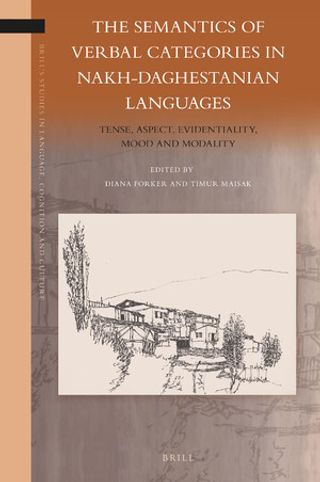
The semantics of verbal categories in Nakh-Daghestanian languages: Tense, aspect, evidentiality, mood and modality
Vol. 16. , Leiden: Brill, 2018.
Similar publications
Событийная структура морфологического каузатива в собственно хваршинском
Сибилев Г. О., Типология морфосинтаксических параметров 2023 Т. 6 № 1 С. 112–129
he article discusses the event structure of morphological causative in Khwarshi Proper dialect of the Khwarshi language (Tsezic< Avar-Ando-Tsezic<Nakh-Daghestanian). We also analyzed the semantic parameters of the morphological causative on -χ-/-k’- and compared them with the semantic parameters of the analytical causative construction. Note that a construction with a morphological causative can be either monoeventive ...
Added: December 22, 2025
Локутивная модальность в хваршинском языке
Сибилев Г. О., Acta Linguistica Petropolitana. Труды института лингвистических исследований 2025 Т. 21 № 1 С. 163–185
The purpose of this article is to demonstrate the ways speaker-oriented modality can be expressed in Khwarshi Proper (Tsezic<Avar-Ando-Tsezic<Nakh-Daghestanian). Our field data also serves to fill some data gaps in the grammatical sketch of Khwarshi Proper [Testelets, Khalilova in print]. In this article, we describe hortative, imperative, optative, preventive constructions and the jussive construction with ...
Added: December 22, 2025
Такие же, как вокруг: эквасимилятивные конструкции в хваршинском языке
Poliakova E., RHEMA. РЕМА 2024 № 1 С. 28–60
Equasimilative constructions belong to the semantic field of comparison, but have been studied to a much less extent than comparative constructions. There are practically no areal-typological studies in this area. This paper focuses on equasimilative constructions in Khwarshi proper (Nakh-Dagestanian). Additionally, it provides an overview of equasimilative constructions in the languages of the Caucasus to determine the parameters that ...
Added: November 16, 2025
Когда обо всем узнаешь последним: эвиденциальность в хваршинском языке
Poliakova E., Вопросы языкознания 2024 № 4 С. 77–95
One of the common features of the Nakh-Daghestanian languages is the evidential opposition between some of the past tense verb forms, which mark (in)direct access to the information. Khwarshi has two synthetic past forms that are traditionally considered to form this kind of opposition, but, according to our data, it may in fact not be based on ...
Added: November 13, 2025
Симметрическая и ретроспективная темпоральная подвижность в андийских языках
Filatov K., Томский журнал лингвистических и антропологических исследований 2025 № 4(50) С. 75–86
The article is dedicated to the typology of temporal mobility, that is the ability of verbal forms to have temporal opposition. Based on several Andic languages (< Avar-Andic-Tsezic < Nakh-Dagestanian), two formal subtypes of temporal mobility are introduced. The first subtype, — symmetric mobility, assumes that the basic and the past forms are equally marked, ...
Added: August 21, 2025
Russian neologism verb’s prefixes: Against the semantic invariants approach
Bubnov G., RHEMA. РЕМА 2024 No. 4 P. 42–66
In this paper, the hypothesis of semantic invariants, which claims that the selection of natural telicizer prefixes depends on the semantics of the verb, is refuted based on verbs derived from English loanwords. The data from neologism verbs, collected through a Google Forms survey, demonstrate the existence of a universal natural telicizer prefix za-, the ...
Added: June 7, 2025
Агентивность японских результативных конструкций: скрытый деятель и семантика состояния
Strizhak U., Урало-алтайские исследования 2024 № 3(54) С. 84–107
This article deals with Japanese resultatives in terms of the degree of prototypical agentive characteristics expressed by their participants. The research material was Japanese lexical verb pairs with regular semantic correspondence, in which an intransitive verb is opposed by a transitive verb. Such semantic pairing makes it possible to compare aspectual verb constructions with different ...
Added: January 31, 2025
Функции аддитивной частицы =lo в зиловском говоре андийского языка: самостоятельное использование аддитива и его сочетание с другими показателями
Russkih A., Родной язык: лингвистический журнал 2024 № 2 С. 6–37
The additive particle =lo in the Upper Andi variety of Zilo is a multifunctional clitic which is used both in contexts typologically frequent for additive particles and in peripheral ones. The paper provides a comprehensive description of the functions of additive =lo in the Zilo Andi in a typological perspective, with special attention to the ...
Added: January 30, 2025
Numeral systems in Lezgic languages
Melenchenko M., Folia Linguistica 2025 Vol. 59 No. 3 P. 785–821
The paper presents an overview of numeral systems in Lezgic languages (East Caucasian) and discusses hypotheses about their diachronic development. Similarly to other branches of the East Caucasian family, languages of the Lezgic branch have either a decimal (base-10) or a vigesimal (base-20) system. Decimal systems are attested in languages and dialects in the northwestern ...
Added: December 27, 2024
Проприетивные и привативные аффиксы в некоторых уральских языках: о маркированности и (не)словоизменительном статусе
Лапшина К. М., Вопросы языкознания 2025 № 1 С. 95–118
This paper studies the morphosyntactic properties of bound proprietive and privative markers in some Uralic languages using corpus data and grammatical descriptions. Such affixes are predominantly attached to substantive bases and form derivatives with the meaning of ‘possessing X’ and ‘deprived of X’, respectively. The first part of the study is devoted to the comparison of ...
Added: December 19, 2024
Континуативные конструкции в лезгинских языках и их употребление в параллельных контекстах (на материале переводов Евангелия от Луки)
Maisak T., Вопросы языкознания 2024 № 3 С. 60–98
В работе дается обзор грамматикализованных глагольных конструкций с континуативным значением (‘все еще делать, продолжать делать’), отмечаемых в ряде языков лезгинской группы нахско-дагестанской семьи, однако до сих пор не привлекавших должного внимания исследователей. Особенностью четырех лезгинских языков является наличие стативного глагола, описывающего продолжение существования или нахождения в определенном месте (‘все еще быть, оставаться’), именно этот глагол ...
Added: September 3, 2024
Социолингвистическое исследование в цудахарской зоне
Меленченко Максим, Конча Кирилл, Добрушина Нина., В кн.: Songs and Trees: Papers in Memory of Sasha Vydrina.: СПб.: Институт лингвистических исследований РАН, 2023. С. 451–484.
— ...
Added: September 27, 2023
Маркирование глагола по числу в нахско-дагестанских языках
Zakirova A., Известия РАН. Серия литературы и языка 2022 Т. 81 № 6 С. 102–114
The purpose of this article is to provide a review of dedicated number marking on verbs in the East Caucasian languages. The review is based on the data drawn from grammatical descriptions. First of all, possible ways to analyze number marking on verbs are discussed: 1) as agreement, i.e. as an operation by which morphological features are copied from word ...
Added: September 8, 2023
Согласование прилагательных по числу в нахско-дагестанских языках: генеалогические и ареальные закономерности
Zakirova A., Родной язык: лингвистический журнал 2022 № 1 С. 5–49
This paper provides a survey of number agreement in the East Caucasian languages and languages of other language families in contact with East Caucasian. For a sample of 59 idioms I considered number agreement strategies of adjectives in the attributive position and established what factors license agreement in these idioms. Besides, I assessed the weight ...
Added: August 29, 2023
Aspect and subjectivity in the modal readings of tenses in Russian
Trnavac R., Leiden Papers in Linguistics 2006 Vol. 3 No. 1 P. 51–73
In the aspectual linguistic literature, a connection between imperfective aspect and modality/subjectivity is quite often mentioned. This article investigates a possible counterargument to this connection by analyzing modal readings of tenses in Russian. Two types of uses of tenses are described: (1) temporal reading of the tense with a modal inference and (2) strictly modal ...
Added: January 27, 2023
Однос вида и субјективности у модалној употреби времена у српском језику
Trnavac R., , in: Когнитивнолингвистичка проучавања српског језика.: Beograd: САНУ, 2006. P. 353–373.
Analysis of subjectivity and aspect in Serbian modal constructions ...
Added: January 27, 2023
Cognitive Approaches to Tense, Aspect, and Epistemic Modality.
Amsterdam: John Benjamins Publishing Company, 2011.
Edited volume ...
Added: January 14, 2023
Aspect and subjectivity in modal constructions
Trnavac Radoslava, Utrecht: LOT, 2006.
This books deals with the interaction of aspect and subjectivity in modal constructions. In the linguistic literature dealing with the connection between aspect and modality, a link has often been observed between imperfective aspect and modal readings (Townsend 1979, Caenepeel 1989, Fleischman 1995, Smith 1997, Boogaart 1999, 2006, Ippolito 2004, Giannakidou & Zwarts, to appear). However, ...
Added: December 28, 2022
К диахронии систем числительных лезгинских языков
Melenchenko M., В кн.: Девятнадцатая конференция по типологии и грамматике для молодых исследователей: тезисы докладов.: СПб.: ИЛИ РАН, 2022. С. 81–84.
The talk is dedicated to some problems of diachronic development of numeral systems in Lezgic languages. ...
Added: December 5, 2022
Конкуренция обстоятельств срока с предлогами в и за в русском языке в XVIII–XX вв.
Logvinova N., Русский язык в научном освещении 2019 Т. 37 № 1 С. 184–207
This article analyzes diachronic and synchronous aspects of distribution of the prepo- sitions v ‘in’ and za ‘during’ in the Russian telic-extent adverbials in the 18–20th centuries. After discussing main tendencies in the distribution of the prepositions in combination with various semantic types of noun phrases with the meaning ‘time interval’, the conclusion is drawn ...
Added: December 4, 2022
  • About
  • About
  • Key Figures & Facts
  • Sustainability at HSE University
  • Faculties & Departments
  • International Partnerships
  • Faculty & Staff
  • HSE Buildings
  • HSE University for Persons with Disabilities
  • Public Enquiries
  • Studies
  • Admissions
  • Programme Catalogue
  • Undergraduate
  • Graduate
  • Exchange Programmes
  • Summer University
  • Summer Schools
  • Semester in Moscow
  • Business Internship
  • Research
  • International Laboratories
  • Research Centres
  • Research Projects
  • Monitoring Studies
  • Conferences & Seminars
  • Academic Jobs
  • Yasin (April) International Academic Conference on Economic and Social Development
  • Media & Resources
  • Publications by staff
  • HSE Journals
  • Publishing House
  • iq.hse.ru: commentary by HSE experts
  • Library
  • Economic & Social Data Archive
  • Video
  • HSE Repository of Socio-Economic Information
  • HSE1993–2026
  • Contacts
  • Copyright
  • Privacy Policy
  • Site Map
Edit