?
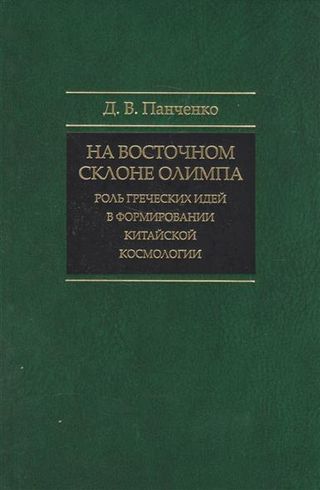
На восточном склоне Олимпа: Роль греческих идей в формировании китайской космологии
Dmitri Panchenko
On the Eastern Slope of Olympus: The Impact of Greek Ideas on Chinese Cosmology
Contents
Preface and acknowledgements
Starting with the More or Less Obvious
Difficulties of communication between the Greek world and China in antiquity; no sign of awareness of each other for a long time
The establishment of official relations between the Han Empire and Hellenized Central Asia at the end of the second century BC
Reasons to assume earlier contacts
Shared ideas of unlikely independent origin:
Physiognomy
A son informing on his farther
The world’s destruction and restoration according to a certain period in the revolution of the celestial bodies
A common illustration of the movement of the planets
Heaven that knows everything because it is air
Hun tian and the Greek notion of the celestial sphere
The nontriviality of the notion of the celestial sphere
Its sudden emergence within Chinese cosmology
The universe like an egg
Zhang Heng and Archimedes
Gai tian and early Greek astronomy
The Zhou bi suan jing
Cosmography based on the principle of optical illusion
The shadow rule and its origin
– Reasons to doubt the Chinese origin of the shadow rule: incompatibility with the stated Chinese measure of length, inadequate application, the vagueness of tradition
– The shadow rule by Cosmas Indicopleustes
– The confusion in respect to how shadows behave in the latitudes of Syene and Meroe goes back to an early stage of Greek science
– The same mistake by Arrian who cites Nearchus who read the work by Hecataeus of Miletus
– Gnomon and gnomonics in Miletus in the sixth century BC: Anaximander and Anaximenes
– The evolution of Greek measures of length
– Eratosthenes was not able to provide an accurate measurement of the circumference of the earth without using the shadow rule
– Why are the Greek scientists silent about the shadow rule?
– Anaximander’s «geōmetria»
– Parmenides about the width of the torrid zone
– Thales’ measuring of the height of a pyramid and Sea island by Liu Hui
– Inadequate expansion of the shadow rule in the Zhou bi
– Signs of the inadequate expansion of the shadow rule in Greek and Latin sources: the Pythagoreans on the distance of the Moon, Sun and stars
–The range of solar illumination: from the equinoctial circle to the pole
–The range of solar illumination: from the equinoctial circle to a circumpolar circle
–Eccentres and epicycles of the early Pythagoreans in the light of Chinese parallels
–«Pythagoreans» and «mathematicians»
–The range of solar illumination: 167 000 li or 167 000 stadia?
The ways of how ideas and techniques spread from the Greek world to China
Physicians as itinerary experts
The Milesians settled at the Persian Gulf (494 BC)
The story of the Branchidae: the Milesians settled near the future Silk Road (479 – 329 BC)
Greek and Chinese cosmogonies: similar and related
The same basic motives
The original formlessness
The distribution of the stuff within the cosmic edifice
Music, number and heavenly harmony
Ling Lun
Pythagoras, Hippasus and Lasus of Hermione
Heavenly music: the origin of the doctrine
Heavenly music in China?
Yin-Yang: a Greek idea that became Chinese
Illness caused by the predominance of the one of the opposites
The opposites in early Greek cosmology and medicine
Tsou Yen and his role in the rise of correlative thinking
Indian and Greek parallels to several ideas of Tsou Yen
Medicine and cosmology (an additional note)
The Grand one, the Boundless, and the Dao
Convergence on the basis of common legacy?
The Greeks as the Europeans
The Shang: with a pantheon headed by the supreme god of the Indo-Europeans
The Zhou: «the people of western lands »
The ritual plough
Shangdi and Skaði
Sæmingr and Prince Millet
The Mandate of Heaven
What follows from all that?
CONCLUSION