• A
  • A
  • A
  • АБВ
  • АБВ
  • АБВ
  • A
  • A
  • A
  • A
  • A
Обычная версия сайта
  • RU
  • EN
  • HSE University
  • Publications
  • Book chapter
  • Russia: The institutional landscape of Russian higher education
  • RU
  • EN
Расширенный поиск
Высшая школа экономики
Национальный исследовательский университет
Priority areas
  • business informatics
  • economics
  • engineering science
  • humanitarian
  • IT and mathematics
  • law
  • management
  • mathematics
  • sociology
  • state and public administration
by year
  • 2027
  • 2026
  • 2025
  • 2024
  • 2023
  • 2022
  • 2021
  • 2020
  • 2019
  • 2018
  • 2017
  • 2016
  • 2015
  • 2014
  • 2013
  • 2012
  • 2011
  • 2010
  • 2009
  • 2008
  • 2007
  • 2006
  • 2005
  • 2004
  • 2003
  • 2002
  • 2001
  • 2000
  • 1999
  • 1998
  • 1997
  • 1996
  • 1995
  • 1994
  • 1993
  • 1992
  • 1991
  • 1990
  • 1989
  • 1988
  • 1987
  • 1986
  • 1985
  • 1984
  • 1983
  • 1982
  • 1981
  • 1980
  • 1979
  • 1978
  • 1977
  • 1976
  • 1975
  • 1974
  • 1973
  • 1972
  • 1971
  • 1970
  • 1969
  • 1968
  • 1967
  • 1966
  • 1965
  • 1964
  • 1963
  • 1958
  • More
Subject
News
May 25, 2026
HSE Scientists Train Neural Network to 'Hear' Faults in Electric Motors
Researchers at the AI and Digital Science Institute of the HSE Faculty of Computer Science have developed a new method—the Signature-Guided Data Augmentation (SGDA) framework—that achieves 99% accuracy in motor fault detection and 86% accuracy in fault classification. The application of this approach can reduce industrial equipment repair costs, minimise downtime, and improve production safety. The study results have been published in Engineering Applications of Artificial Intelligence.
May 25, 2026
'The Humanities Serve as a Conscience'
Maria Mizernaia studies Soviet literature and the history of book publishing. In this interview for the HSE Young Scientists project, she discusses plans to publish a novel about besieged Leningrad, AI-provoked reflections on what it means to be human, and how novels can help satisfy our dopamine hunger.
May 25, 2026
Is It Possible to Predict a Citys Life Based on the Shape of Its Neighbourhoods?
Is it possible to predict, based on the configuration of streets and buildings, where a café will open or where traffic congestion will occur? Participants in the Spatial Analysis and Modelling of Urban Processes research and study group use open data and machine learning to identify universal patterns. Alexander Sheludkov and Eduard Somov discuss the purpose of comparing cities, the need for new forms of urban statistics, and how open data is transforming approaches to urban studies.


Have you spotted a typo?
Highlight it, click Ctrl+Enter and send us a message. Thank you for your help!

Publications
  • Books
  • Articles
  • Chapters of books
  • Working papers
  • Report a publication
  • Research at HSE

?

Russia: The institutional landscape of Russian higher education

P. 337–362.
Platonova D., Semyonov D.

In this chapter we explore the higher education institutional landscape taking the case of the largest post-Soviet higher education system: Russia. In the Post-Soviet period, Russian higher education has tremendously expanded. The dramatic growth of the number of students and institutions has been facilitated by the introduction of tuition fees in public and a new private sector. The shifts in social and economic demand for professional fields affected the disciplinary and organisational structure of higher educational institutions.

The external forces (economic, political, social conditions) and higher education policy have been changing during the last decades. In the first part of transitional period, the state provided limited regulation of the higher education system. In the 2000s, it has returned to its role of the main agent of change of the higher education system design. The diversity of institutional types that evolved in Russian higher education illustrate the consequences of massification and marketization, such as new “broad access” segments and institutional programme drift. Also, the governmental role in shaping institutional diversity can been seen through attempts to increase vertical diversity (excellence initiatives), on the one hand, and to restrain it by closing down bottom tier institutions, on the other.

Language: English
Full text
DOI
Keywords: Russian universitiesdiversityhigher education

In book

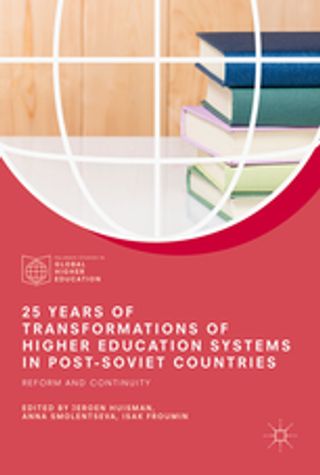
25 Years of Transformations of Higher Education Systems in Post-Soviet Countries. Reform and Continuity
Palgrave Macmillan, 2018.
Similar publications
Оценка критического мышления студентов университета: вклад предметного знания в результаты тестирования
Talov D., Tarasova K., Высшее образование в России 2026 Т. 35 № 4 С. 85–104
The development of critical thinking is currently regarded as one of the key objectives of higher education. In this context, there is a growing number of instruments aimed at assessing critical thinking in domain-specific and more authentic educational settings. However, considerably less attention has been paid to the question of the extent to which the ...
Added: May 6, 2026
Социальное происхождение и содержание труда на старте карьеры выпускников российских вузов
Nikitin M., Lukina A., Социологические исследования 2026 № 4 С. 43–57
The article examines the relationship between family socio-economic status and the content of work performed by university graduates in Russia at the beginning of their professional careers. While most studies of educational inequality focus on income or employment outcomes, this study shifts attention to the characteristics of the work performed as an indicator of job ...
Added: March 29, 2026
Физико-математическое образование – фундамент технологического лидерства: вызовы и перспективы: материалы Всероссийской научно‑практической конференции (Москва, 11 декабря 2025 г.)
Solodikhina A., М.: Издательство "Перо", 2025.
Современный глобальный технологический ландшафт, определяемый процессами конвергенции (NBIC) и ускорения инновационных циклов, формирует новый социальный заказ системе высшего образования. Сегодня от выпускника инженерно‑технического профиля ожидается не только глубокое понимание законов фундаментальных и прикладных наук, но и способность трансформировать это знание в успешные рыночные продукты. Физико‑математическая и инженерная подготовка становятся не просто базой, но и источником ...
Added: March 2, 2026
SMMR: Sampling-Based MMR Reranking for Faster, More Diverse, and Balanced Recommendations and Retrieval
Liakhnovich K., Lashinin O., Babkin A. et al., Proceedings of the 48th International ACM SIGIR Conference on Research and Development in Information Retrieval 2025 P. 2754–2758
Relevance and diversity are critical objectives in modern information retrieval (IR), particularly in recommender systems. Achieving a balance between relevance (exploitation) and diversity (exploration) optimizes user satisfaction and business goals such as catalog coverage and novelty. While existing post-processing reranking methods address this trade-off, they usually rely on greedy strategies, leading to suboptimal outcomes for ...
Added: February 3, 2026
Между меритократией и структурными барьерами: как студенты первого поколения оценивают социальную мобильность
Lukina A., Tolstykh D., Экономическая социология 2026 Т. 27 № 1 С. 153–193
Amidst the ongoing crisis of social mobility and pronounced differentiation within the Russian higher education sector, investigating perceptions of inequality and mobility experiences among socially disadvantaged groups becomes particularly relevant. This study analyzes patterns of subjective upward mobility and stratification beliefs among first-generation students (FGS) — individuals without familial experience of higher education — compared ...
Added: January 20, 2026
Организация учебного процесса в системе заочного юридического образования в СССР
Боголюбов Е. А., Вестник Пермского университета. Серия: История 2025 № 4(71) С. 12–24
Legal education will soon be transformed in connection with Russia's withdrawal from the Bologna system. These circumstances actualize the understanding of the Soviet experience in the field of legal training. During the Soviet period, the training of lawyers was mainly carried out in correspondence form. The purpose of the article is to reconstruct the process ...
Added: December 29, 2025
Education in Figures: 2025 : Pocket Data Book
Gokhberg L., Ozerova O. K., Portnyagina O. et al., Higher School of Economics, National Research University, 2025.
This pocket data book contains main education indicators for the Russian Federation. The publication also covers key education indicators for foreign countries. The data book includes information of the Federal State Statistics Service, Ministry of Education of the Russian Federation, Departmental Situation Center of the Russian Ministry of Science and Higher Education monitoring the education ...
Added: December 22, 2025
Does reducing communication barriers promote diversity?
Dong M., Mayskaya Tatiana, Journal of Economic Theory 2024 Vol. 222 Article 105932
We study how a reduction in communication cost affects equilibrium diversity (in expertise) in hiring decisions. The key trade-off is that, while hiring a more diverse team may enlarge the team's pool of knowledge, it also makes communication between the hired experts more challenging. Equilibrium diversity balances this trade-off. We find that equilibrium diversity may ...
Added: November 22, 2025
Higher education system development in Russia. In search of increasing contribution to socioeconomic transformation
Pavel S. Sorokin, Vyatskaya Y., Chernenko S., , in: Transformations of Higher Education in BRICS. Policy, Procedures, and Practice.: Abingdon: Routledge, 2025. Ch. 6 P. 105–135.
This chapter looks at the transformations of the Russian higher education system with special attention to the most recent years, beginning from 2020. Currently, socioeconomic development is problematic, and the external pressures (international sanctions and risks of “brain drain” as well as social tensions) are unprecedentedly high, which demands that higher education institutions produce a ...
Added: November 5, 2025
Transformations of Higher Education in Brics: Policy, Procedures, and Practice
Sun-Keung Pang N., Niemczyk E., Abingdon: Routledge, 2026.
The book aims to study the current transformations of higher education in the BRICS countries. The conditions imposed by the pandemic exposed many vulnerabilities in higher education systems, but also provided valuable lessons that led to the implementation of effective changes. Educational changes are being applied to programmes, projects, practices, and policies with varying degrees of ...
Added: November 5, 2025
Generative artificial intelligence in higher education: challenges, opportunities and future course of actions to achieve sustainable development goals
Nazir Ahmed Jogezai, Koroleva D., Ivanov I., International Journal of Educational Management 2026 Vol. 40 No. 1-2 P. 133–157
Purpose This study explores the challenges, opportunities and future course for the use of generative artificial intelligence (GAI) in higher education to attain the targets of the sustainable development goals (SDG4). Design/methodology/approach A phenomenological approach within the qualitative research tradition was adopted. Data were collected through semi-structured interviews with 11 purposefully selected university faculty members. A hybrid data ...
Added: October 23, 2025
The Role of Social Relationships with Peers and Teachers for Undergraduate Students’ Subjective Wellbeing in the Context of University Synchronous Online Learning
Andronova E., Online Learning Journal 2025 Vol. 29 No. 4 P. 467–488
Social interactions with peers and teachers significantly impact students’ subjective wellbeing (SWB), influencing their achievements, mental health, and motivation. Students who study online often lack these interactions, leading to lower SWB. However, studies show differences in the experience of social relationships within different contexts. Therefore, by examining the specific context of an online programme integrated ...
Added: October 21, 2025
Зачем студенческая оценка преподавания университетам России?
Knyaginina N., Тишкина К. О., Puchkov E., Высшее образование в России 2025 Т. 34 № 8-9 С. 74–92
Article analyzes the use of Student evaluation of teaching (SET) in Russian universities—one of the key feedback tools in higher education. The authors examined documents from 694 universities to identify the presence of SET, its goals, and implementation features. The results show that only 13% of universities conduct SET targeting specific instructors. In most cases, ...
Added: September 29, 2025
Can successful female STEM graduates contribute to narrowing the gender pay gap in the EU?
Petrenko O., Cadil J., European Journal of Education 2024 Vol. 59 No. 2
Drawing upon contemporary research, this paper examines whether there is a relationship of STEM (science, technology, engineering and maths) bachelor and master graduates to the gender pay gap (GPG) in the 27 EU Member states in 2013–2020 using a novel cross-sectional data set based on the 2013 International Standard Classification of Education (ISCED). International panel ...
Added: September 26, 2025
Современные проблемы и перспективы развития научно-исследовательского образования
Shcheglova D., Garmonova A., Gavrilov S. et al., Ер.: Ալվարդ Օհանջանյան Վառլենի ԱՁ, 2024.
Proceedings of the international conference "Modern Problems and Prospects for the Development of Research Education" held at the National Academy of Sciences of the Republic of Armenia, May 31, 2024 ...
Added: September 9, 2025
Upbringing work as local order: Understanding peripheral universities in post‑soviet Russia
Romanenko K., Platonova D. P., International Journal of Educational Research 2025 Vol. 133 Article 102748
This article explores the concept and practice of up-bringing work in regional universities in post-Soviet Russia, particularly those located in economically challenged and demographically declining areas. The study is based on qualitative field data collected between 2016 and 2023 at six classical universities that originated as Soviet teacher-training institutes. It draws on interviews with over ...
Added: August 19, 2025
Bridging Horizons: Social Entrepreneurship in Malaysia and Russia
Gaete Sepulveda M. A., Kuala Lumpur: UTM Press, 2025.
Recognising the transformative power of social entrepreneurship, the Laboratory for Reputation Management in Education (RepLab) at HSE University Saint Petersburg and the ACT Lab at Azman Hashim International Business School (AHIBS), Universiti Teknologi Malaysia (UTM), jointly established the Satellite Laboratory for Social Entrepreneurship in 2023. This collaborative initiative aims to explore and analyse the dynamics ...
Added: August 4, 2025
Агентность студентов и выпускников вузов в сфере труда и занятости: связь с образовательным опытом и благополучием
Sorokin P. S., Afanaseva I., Vyatskaya Y. et al., Высшее образование в России 2025 Т. 34 № 7 С. 133–152
The article offers an approach to identifying “agentic” students and graduates in the field of work and employment of university, and analyzes the differences between the respective groups in terms of their educational experience (with an emphasis on higher education) and well-being. To identify agency, understood as an activity related to proactive influence on surrounding ...
Added: August 2, 2025
Бюрократы без бюро: Новгород Великий как лаборатория выработки московского языка описания
Selin A. A., В кн.: Языки описания социального в Средневековье и раннее Новое время.: СПб.: Наука, 2025. С. 66–82.
The article is about the history of the formation of the language of Muscovite bureaucratic language of description in the context of the study of the development of ranks in the northwestern borderland of the Novgorod land in late 15th—early 16th c. The article raises the issue of the construction of new ranks by Muscovite clerks depending ...
Added: July 13, 2025
Generative Ai In Higher Education: University Faculty Perspectives On Opportunities And Challenges
Nazir Ahmed Jogezai, Baloch F. A., Jaffar M. et al., Turkish Online Journal of Distance Education 2025 Vol. 26 No. 3 P. 128–143
This study aims to understand how faculty members at higher education institutions in Pakistan respond to the opportunities and challenges associated with using GAI in teaching and learning. The research employed a phenomenological approach within the qualitative research tradition. Data were collected from 33 university faculty members through semi-structured interviews, which were analyzed thematically. Our ...
Added: July 3, 2025
Neurodiverse AI
Vallverdú J., Alshanskaia E., BioNanoScience 2025 Vol. 15 Article 406
Artificial intelligence (AI) systems have predominantly mirrored neurotypical brain architectures (NBA), optimizing for efficiency, predictability, and standardized cognitive patterns. However, non-neurotypical brains (NNB) exhibit unique neurochemical, hormonal, and functional mechanisms that underpin divergent thinking, creativity, and alternative problem-solving strategies. Drawing from evolutionary biology, we emphasize how neurodiversity serves as a critical mechanism for adaptability, survival, ...
Added: June 14, 2025
Взаимосвязь возможностей выбора учебных дисциплин в университете со студенческой вовлеченностью
Maloshonok N., Музыка П. А., Социологический журнал 2026 Т. 32 № 1 С. 156–176
The article presents the results of an empirical study aimed at exploring the relationship between providing students with the opportunity to choose academic disciplines and their engagement in the learning process. In recent decades, the flexibility of educational programs and offering students the choice of courses has become essential for shaping non-linear career trajectories and ...
Added: May 31, 2025
  • About
  • About
  • Key Figures & Facts
  • Sustainability at HSE University
  • Faculties & Departments
  • International Partnerships
  • Faculty & Staff
  • HSE Buildings
  • HSE University for Persons with Disabilities
  • Public Enquiries
  • Studies
  • Admissions
  • Programme Catalogue
  • Undergraduate
  • Graduate
  • Exchange Programmes
  • Summer University
  • Summer Schools
  • Semester in Moscow
  • Business Internship
  • Research
  • International Laboratories
  • Research Centres
  • Research Projects
  • Monitoring Studies
  • Conferences & Seminars
  • Academic Jobs
  • Yasin (April) International Academic Conference on Economic and Social Development
  • Media & Resources
  • Publications by staff
  • HSE Journals
  • Publishing House
  • iq.hse.ru: commentary by HSE experts
  • Library
  • Economic & Social Data Archive
  • Video
  • HSE Repository of Socio-Economic Information
  • HSE1993–2026
  • Contacts
  • Copyright
  • Privacy Policy
  • Site Map
Edit