?
«Ильдятино селище»: комментарий к новгородской берестяной грамоте № 71
С. 231–234.
In book
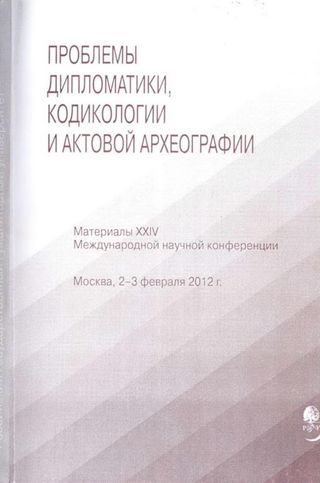
М.: Российский государственный гуманитарный университет, 2012.
Litvina A., Успенский Ф. Б., В кн.: Имена и письмена. К юбилею Анны Абрамовны Пичхадзе.: М.: Институт русского языка им. В.В. Виноградова РАН, 2026. С. 542–551.
Одним из самых насущных, многообразных и долгоживущих объектов рецепции византийского наследия на Руси оказываются христианские антропонимы. В самом деле, со времени обращения страны каждый человек здесь непременно получает при крещении имя из церковного месяцеслова, и хотя, разумеется, далеко не все из этих имен были греческими с точки зрения этимологии, византийское посредство и византийские образцы играли ...
Added: October 2, 2026
Лавренченко М. Л., Древнейшие государства Восточной Европы 2025 С. 125–139
The article examines the status and functions of peace mediators in conflicts of the pre-Mongol Rus’ based on materials of three chronicles: the Primary Chronicle, the Kievan Chronicle (according to the Hypatian and similar manuscripts) and the First Novgorodian Chronicle. Among mediators of this period, two main groups can be distinguished: (1) the closest younger ...
Added: August 15, 2026
СПб.: Институт лингвистических исследований РАН, 2025.
Сборник тезисов Пятой конференции по уральским, алтайским и палеоазиатским языкам (Санкт-Петербург, Институт лингвистических исследований РАН, 24–26 ноября 2025 г.). ...
Added: July 26, 2026
Баркова Л. А., Родной язык: лингвистический журнал 2026 № 1 С. 9–58
This article examines the syntax of constructions with aspectual verbs in Sakha (a.k.a. Yakut). Such constructions contain two predicates: a lexical verb which is a converb, and a finite aspectual verb that conveys some grammatical meaning. The syntax of such constructions has already been studied for some other Turkic languages. The pre‑ sent research examines ...
Added: July 23, 2026
Maisak T., Transactions of the Philological Society 2026 Vol. 124 No. 2 P. 386–427
This paper presents a first typological study of a particular type of imperative interjections, namely interjections with the meaning ‘here, take it!’ used by a speaker when they ask the addressee to take something from the speaker's hands (often combined with a gesture of giving). The sample of languages is both geographically and genealogically restricted ...
Added: July 9, 2026
Russkih A., Урало-алтайские исследования 2026 № 1(60) С. 42–65
This paper examines constructions that express universal quantification in the Poshkart variety of the Chuvash language. This variety has five quantifier words for universals: por, mënbor, pëdëm, kaʐni, and veɕ. These words may combine with an additive or emphatic clitic, a possessive marker, or the instrumental case. The paper describes the semantic distribution of universal ...
Added: April 29, 2026
Knyazev M., Voprosy Jazykoznanija 2026 No. 1 P. 74–104
The paper is a descriptive survey of reported speech constructions in standard and Maloe Ka-rachkino (Poshkart) Chuvash based on a typological questionnaire. On the basis of corpus data, it isshown that reported speech constructions vary depending on whether reported speech is introduced bya complementizer-like element in combination with an ordinary speech verb; directly by the ...
Added: January 22, 2026
Gippius A., В кн.: Русское денежное обращение IX—XVII вековТ. 2: Нумизматический сборник к 70-летию Петра Григорьевича Гайдукова.: М.: Институт археологии Российской академии наук, 2025. С. 62–68.
Th e article continues the series of works on Old Russian money-weight systems, launched by the publication of the Novgorod birchbark document No. 1072 of the late 12th century. Th e critical analysis of the alternative interpretation of this document, proposed by A. A. Kupranis and A. A. Popov (2019), allows the author to stay ...
Added: November 20, 2025
Gippius A., Вопросы языкознания 2025 № 4 С. 7–41
This article contains a preliminary publication of 30 birchbark letters found during the 2024 archaeological season at the Troitsky excavation in Veliky Novgorod. The vast majority of the published texts date back to the 12th century. Most important in historical and philological terms are the following items: a letter mentioning a military campaign and related ...
Added: September 21, 2025
Belova D., Tomsk Journal of Linguistics and Anthropology 2024 Vol. 1 No. 43 P. 9–19
The paper deals with morphological causatives in the Tatyshly subdialect of the Udmurt language (Republic of Bashkortostan). Surrounded by the Turkic languages (Tatar and Bashkir), Tatyshly Udmurt developed a more complex system of causative markers than Standard Udmurt. It consists of two suffixes: -t, of Uralic origins, and a Turkic borrowing -ttə̑ r absent in Standard Udmurt. In ...
Added: March 28, 2025
Травников С. Н., Июльская Е. Г., Петривняя Е. К. et al., Русский язык за рубежом 2024 № 4(305) С. 80–89
The paper discusses the peculiarities of poetic onomastics in Pushkin's The Young Lady-Peasant. The researcher's perusal of Pushkin's story discovering the function of the personal names, correlation the semantic meaning thereof with the plot and combination of the theme and idea; highlighting of the cultural, historical and literature components of the names allow to regard ...
Added: October 29, 2024
Aibazova Z., Savelyev A., Mudrak O. et al., Oriental Studies 2020 Т. 13 № 3 С. 696–713
Цель статьи — продемонстрировать некоторые новые результаты, полученные при работе над составлением Диалектологического атласа тюркских языков России. При подготовке атласа авторский коллектив, кроме уже имеющихся опубликованных и архивных источников, использует целенаправленный полевой сбор материала по специально составленным анкетам, ориентированным на известные факты из истории тюркских языков. Материал собирается в виде звуковых файлов, которые затем обрабатываются ...
Added: October 24, 2024
Aibazova Z., Алжанбекова З., Российская тюркология 2024 № 40-41 С. 6–23
В данной статье исследуются несколько типов развития семантики в базисной лексике карачаево-балкарского языка в сравнении с другими тюркскими языками. Рассматриваются случаи семантических сдвигов, обусловленных природно-климатическими факторами, такие как переосмысление значений лексем ‘туман’, ‘облако’, ‘туча’ в черекском диалекте карачаево-балкарского языка, имеющее параллель с аналогичным явлением в тёлёсском говоре алтайского языка. Анализируются сдвиги на основе метонимических переносов ...
Added: October 21, 2024
Braginskaya N., Studia Religiosa Rossica: научный журнал о религии 2024 № 2 С. 12–41
In Passio Perpetuae et Felicitatis, some characters are referred to by their names, others by substitute names or descriptively, others only by function, office or kinship etc. The article explores names in their social aspect: what they say or can say us about their bearers, and the presumed perception of names by the anonymous Narrator, ...
Added: September 24, 2024
Gippius A., Вопросы языкознания 2024 № 4 С. 7–26
The article contains a preliminary publication of nineteen birchbark letters found during the archaeological season of 2023 in Veliky Novgorod (Nos. 1158–1172) and Staraya Russa (Nos. 55–58). The published documents date back to the 12th— early 16th centuries. From the historical point of view, three 14th-century documents are of the greatest value: No. 1164 is ...
Added: September 7, 2024
Gippius A., Вопросы языкознания 2023 № 5 С. 7–28
: The article contains a preliminary publication of twelve birchbark letters of the twelfth— first half of the fifteenth century, found in the archaeological season of 2022 in Veliky Novgorod (Nos. 1146– 1157), and letters Nos. 52 and 53 from Staraya Russa. Letters Nos. 1142 and 1143 from the excavations of 2021, which were not included ...
Added: February 13, 2024