?
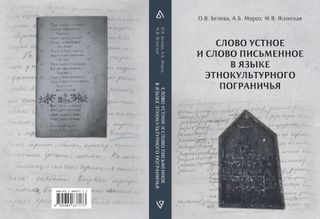
Слово устное и слово письменное в языке этнокультурного пограничья
The collective monograph is devoted to the description of the linguocultural situation on the Russian-Belarusian-Ukrainian and East Slavic-Polish borderland, the main markers of self-identification of the local population (language and confession), perceptions of "own" and "foreign" language, and perception of the language of ethnic neighbors, peculiarities of functioning of liturgical (Church Slavonic) language and paraliturgical texts in a polylingual environment, memorial epigraphy, which reflects the linguistic peculiarities of "frontier" traditions, vocabulary and terminology of rituals practiced in the frontier cultures. The book includes materials of long-term field research conducted in the Smolensk, Bryansk and Pskov regions of the Russian Federation, in the Vitebsk region of the Russian Federation, and in the Vitebsk region of the Russian Federation.
Russian Federation, in the Vitebsk, Mogilev, Grodno regions of the Republic of Belarus, in the Podlaskie Voivodeship of the Republic of Poland, as well as in the regions of Ukraine (Podolia, Galicia, Bukovina) and Moldova (Bessarabia), where the neighborhood of Slavs with non-Slavic peoples has a long history. A significant part of the materials was made up of data from archival sources of the XIX-XXI centuries.