Neural networks are no longer simple travel assistants; now they decide what to include on the route and what to skip. Artificial intelligence changes how people perceive a place and shapes the image of tourist centres. At the II International Scientific and Practical Conference ’Information Technologies in the Preservation and Promotion of Cultural Heritage,’ researchers discussed who controls algorithmic solutions and in what ways, and whether authentic traditions get lost in them.
Worldwide, road injuries are the leading cause of death among males aged 10–39. An international team of researchers reached this conclusion as part of the Global Burden of Disease Study 2023, analysing data from 204 countries between 1990 and 2023. Their findings have been published in The Lancet Public Health, with HSE University Professor Vasily Vlassov listed among the collaborators.
The 23rd Annual Meeting of the Valdai Discussion Club was held from September 28 to October 1, 2026 under the theme ‘Responsibility for the Future: Limits of the Possible, or Limitless Possibilities?’ The forum brought together 120 experts from 40 countries, including representatives of China, the United States, India, Brazil, the United Kingdom, Germany, Egypt, Iran, and Japan.
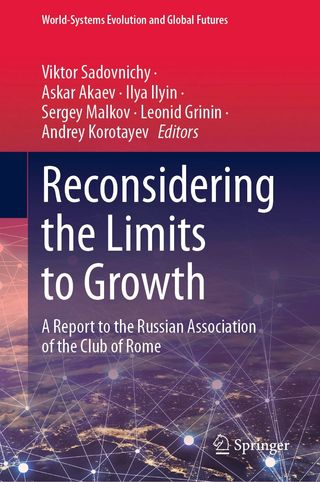
Malkov S., Leonid Grinin, Anton Grinin et al., , in: Reconsidering the Limits to Growth. A Report to the Russian Association of the Club of Rome.: Springer, 2023. P. 387–417.
This chapter presents the results of using the set of basic models outlined in Chapter “Modeling Social Self-Organization and Historical Dynamics. A General Approach” to model transitional eras, when, due to technological revolutions, there is a sharp acceleration in the pace of economic (and, after that, demographic) development, a “society of stability/stagnation” is transformed into ...
Садовничий В. А., Akaev A., Ильин И. В. et al., История и современность 2022 № 2 С. 124–138
This article discusses the methodological approach on the basis of which the report to the Club of Rome studies the processes taking place in the world in recent decades. This approach is called macro-historical by the authors. It is based on the analysis of ongoing processes in a broad and long-term historical context, as well ...