• A
  • A
  • A
  • АБВ
  • АБВ
  • АБВ
  • A
  • A
  • A
  • A
  • A
Обычная версия сайта
  • RU
  • EN
  • HSE University
  • Publications
  • Books
  • The Uralic Languages. Second edition
  • RU
  • EN
Расширенный поиск
Высшая школа экономики
Национальный исследовательский университет
Priority areas
  • business informatics
  • economics
  • engineering science
  • humanitarian
  • IT and mathematics
  • law
  • management
  • mathematics
  • sociology
  • state and public administration
by year
  • 2028
  • 2027
  • 2026
  • 2025
  • 2024
  • 2023
  • 2022
  • 2021
  • 2020
  • 2019
  • 2018
  • 2017
  • 2016
  • 2015
  • 2014
  • 2013
  • 2012
  • 2011
  • 2010
  • 2009
  • 2008
  • 2007
  • 2006
  • 2005
  • 2004
  • 2003
  • 2002
  • 2001
  • 2000
  • 1999
  • 1998
  • 1997
  • 1996
  • 1995
  • 1994
  • 1993
  • 1992
  • 1991
  • 1990
  • 1989
  • 1988
  • 1987
  • 1986
  • 1985
  • 1984
  • 1983
  • 1982
  • 1981
  • 1980
  • 1979
  • 1978
  • 1977
  • 1976
  • 1975
  • 1974
  • 1973
  • 1972
  • 1971
  • 1970
  • 1969
  • 1968
  • 1967
  • 1966
  • 1965
  • 1964
  • 1963
  • 1958
  • More
Subject
News
October 8, 2026
HSE Experts Take Part in 23rd Annual Meeting of Valdai Discussion Club
The 23rd Annual Meeting of the Valdai Discussion Club was held from September 28 to October 1, 2026 under the theme ‘Responsibility for the Future: Limits of the Possible, or Limitless Possibilities?’ The forum brought together 120 experts from 40 countries, including representatives of China, the United States, India, Brazil, the United Kingdom, Germany, Egypt, Iran, and Japan.
October 7, 2026
‘Our Team Consists of True Leaders in Their Respective Academic Disciplines
The HSE International Centre of Decision Choice and Analysis studies a wide range of methods for analysing decision-making and possible scenarios for the development of natural, socio-economic, and political phenomena using various mathematical models. The application of advanced mathematical methods to forecasting helps to prevent negative outcomes and avoid erroneous decisions. The HSE News Service spoke to the centre’s director, Prof. Fuad Aleskerov, about its work.
October 6, 2026
International N5 Symposium ‘Neural Networks and Nonlinearity in Nizhny Novgorod Brings Together Scientists from Russia and Serbia
The International N5 Symposium ‘Neural Networks and Nonlinearity in Nizhny Novgorod’ was held at the Nizhny Novgorod House of Scientists from September 23 to 26. The event was organised by HSE University–Nizhny Novgorod and the Nizhny Novgorod House of Scientists, with the participation of Sberbank and the Institute of Physics Belgrade. The symposium was held for the second time: the first conference took place in 2025 and attracted considerable interest from the academic community.


Have you spotted a typo?
Highlight it, click Ctrl+Enter and send us a message. Thank you for your help!

Publications
  • Books
  • Articles
  • Chapters of books
  • Working papers
  • Report a publication
  • Research at HSE

?

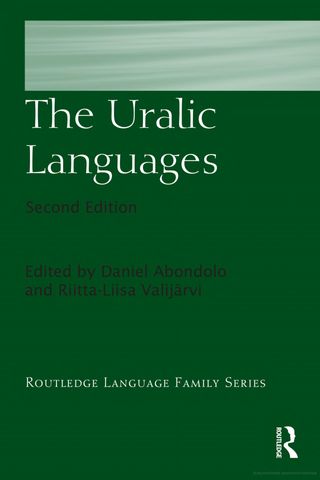
The Uralic Languages. Second edition

NY , Abingdon : Routledge, 2023.
Under the general editorship: D. Abondolo, R. Valijärvi

The Uralic Languages, second edition, is a reference book which brings together detailed discussions of the historical development and specialized linguistic structures and features of the languages in the Uralic family.

The Uralic languages are spoken today in a vast geographical area stretching from Dalarna County in Sweden to Dudinka, Taimyr, Russia. There are currently approximately 50 languages in the group, the largest one among them being the state languages Finnish, Estonian, and Hungarian; other Uralic languages covered in the book are South Saami, Skolt Saami, Võro, Moksha Mordvin, Mari, Udmurt, Zyrian Komi, Mansi, Khanty, Nganasan, Forest and Tundra Enets, Nenets, and Selkup. The book also contains a chapter on Finnic languages, the reconstruction of Uralic, the history of Uralic studies, connections of Uralic to other language families, and language names, demographics, and degrees of endangerment. This second and thoroughly revised edition updates and augments the authoritative accounts of the first edition and reflects recent and ongoing developments in linguistics and the languages themselves, as well as our further enhanced understanding of the relations and patterns of influence between them. Each chapter combines modern linguistic analysis and documentary linguistics; a relatively uniform structure allows for easy typological comparison between the individual languages.
Chapters
Reconstruction of Proto-Uralic
Zhivlov M., , in: The Uralic Languages. Second edition.: NY, Abingdon: Routledge, 2023. Ch. 3 P. 117–175.
Added: July 22, 2023
Research target: Philology and Linguistics
Language: English
DOI
Keywords: Uralic languagesFinno-Ugric languagesSamoyed languagesUgric languagesFinnic languagesOb-Ugric languagesSaami languages
The Uralic Languages. Second edition
Similar publications
Рецепция философии Ф.В.Й. Шеллинга в поздних работах А.Ф. Лосева
Rezvykh P. V., Вестник Российского университета дружбы народов. Серия: Философия 2026 Т. 30 № 1 С. 127–143
The issue delivers an analysis of schellingian motives in the later works by A.F. Losev. The author brings information about Losev’s retrospective evaluation of Schelling’s influence on the formation of his own philosophical approach, it’s specific character and it’s grade. The author shows that all the main investigation projects of the later Losev which have ...
Added: October 7, 2026
Выставка крокодилов в Пассаже в 1864 году: к истории замысла повести «Крокодил» и заметки «Нечто личное» Ф. М. Достоевского
Pershkina A., Slovĕne 2026 Т. 15 № 1 С. 174–192
The article newly presents archival materials from the Directorate of Imperial Theaters relative to the organization of a crocodile exhibition held in St. Petersburg Passage department store in the autumn of 1864, along with newspaper reports on the event. The close analysis of specific articles demonstrates that this exhibition served as the direct inspiration and ...
Added: October 5, 2026
Nomos e poikilía dell'Essere. Genesi metafisica del molteplice. Una deduzione schellinghiana
Dezi A., Sesto San Giovanni: Mimesis, 2026.
This book is a metaphysical inquiry into the nature and origin of the manifold. Taking Schelling’s Erlangen lectures of 1820–1821 as its point of departure and hermeneutic horizon, it develops an interpretation of Nomos that transcends its political, juridical, and social determinations. Nomos thereby emerges as the ontological principle of an infinite, variegated multiplicity of ...
Added: October 2, 2026
Файзов, Д. оии: стихи 2024-2026 годов / Данил Файзов; предисл. М. Павловца. М.: Новое литературное обозрение, 2026. — 160 с. (Серия «Новая поэзия»)
Файзов Д., М.: Новое литературное обозрение, 2026.
Новая книга Д. Файзова пронизана голосами других поэтов. Речь не о расхожей постмодернистской центонности. Это микроинтертекстуальность на уровне конкретных слов и приемов, коллаж осколков чужих голосов, однако таких осколков, которые сохраняют способность отсылать к целому и к тому же вписаны — вклеены на манер аппликации — в узнаваемую интонацию самого поэта. Данил Файзов—поэт, культуртрегер, редактор. ...
Added: October 2, 2026
Manuscript tradition of Kallistos Angelikoudes’ Hesychastic consolation: myths and realities of a fluid text
Vinogradov A., Rodionov O., Travaux et Memoires 2026 Vol. 30 No. 2 P. 1075–1089
This article examines the manuscript tradition of Kallistos Angelikoudes’ Hesychastic consolation, a fluid and complex corpus of thirty Logoi preserved primarily in Vat. gr. 736. The authors survey all known witnesses—including the autograph Barb. gr. 420, the Lond. Arund. 520, and several later copies—and analyze their textual relationships, variant readings, and codicological features. They demonstrate ...
Added: October 1, 2026
Какой национальности лицо? Семантика и прагматика одной конструкции
Громенко Е. С., Krongauz M., Антропологический форум 2026 № 70 С. 163–183
The paper describes the construction litso takoy-to natsionalnosti ‘a person of such-and-such an ethnicity’ in Russian with its semantic and pragmatic characteristics. The purpose of the study is to trace the appearance of the construction and analyse how it is used and how it is perceived. Three expressions representing this construction are considered in more ...
Added: September 30, 2026
Kildin Saami negation is not where you would expect it
Поцелуев В. А., Ural-Altaic Studies 2026 Vol. 62 No. 3 P. 62–81
In recent years, the researchers working on Uralic languages within Minimalism seem to have built a consensus on how to define the position of negation in any language with a negative verb. The main and usually the only argument is based on the work [Mitchell 2006]. The argument is as follows: if the negative verb expresses tense, ...
Added: September 30, 2026
Наука о языке - Новые горизонты. Коллективная монография к юбилеям доктора филологических наук, профессора Ольги Ивановны Максименко, доктора филологических наук, профессора Георгия Теймуразовича Хухуни
Государственный университет просвещения, 2026.
Настоящее издание представляет собой коллективный труд, посвящённый юбилеям основателей-руководителей научных школ лингвистического факультета Государственного университета просвещения Максименко Ольги Ивановны, доктора филологических наук, профессора, профессора кафедры теории языка, англистики и прикладной лингвистики, Председателя диссертационного совета 72.2.020.05 и Хухуни Георгия Теймуразовича, доктора филологических наук, профессора, профессора кафедры теории языка, англистики и прикладной лингвистики. Цель издания – обобщение современных достижений в ...
Added: September 29, 2026
Postnominal numerals are over-specified in referential communication: Evidence from Thai in comparison to Russian
Zevakhina N., Щипкова А. А., Chinkova A., Voprosy Jazykoznanija 2025 No. 2 P. 105–122
This paper presents experimental evidence for the over-specification (redundant use) of Thai postnominal numerals in referential communication. The first experiment reveals high rates of over-specification in oral responses that include Thai postnominal and Russian prenominal numerals tested in a contrastive multi-number visual context. The second experiment demonstrates lower but still relatively high rates of over-specification in written responses that ...
Added: September 29, 2026
Прагматика употреблений глагола resultar ‘оказываться’ для выражения эвиденциальных значений и нового знания в испанских академических текстах
Вилинбахова Е. Л., Zevakhina N., Terra Linguistica 2025 Т. 16 № 3 С. 13–30
Настоящая работа посвящена исследованию употреблений испанского глагола resultar ‘оказываться’ в рамках эвиденциального подхода и подхода возникновения нового знания, представленных в литературе. Согласно первому подходу, глагол resultar передает инферентивное значение: субъект оценки делает умозаключение на основании наблюдаемых результатов. Сторонники второго подхода считают основным компонентом семантики глагола возникновение нового знания, а инферентивное значение объясняется воздействием других элементов контекста. В работе каждый ...
Added: September 29, 2026
The role of extralinguistic knowledge in the derivation of scalar implicatures
Zevakhina N., Пономарева П., Краснощёкова С., Acta linguistica Petropolitana 2025 Vol. 21 No. 2 P. 270–286
The paper reports on an experimental study that reveals a difference between two types of under-informative utterances with the quantifier “nekotoryj” (‘some’) in Russian. The experiment was conducted as an inference task based on [Geurts, Pouscoulous 2009; Val Tiel et al. 2016] with some modifications. The experiment showed that both types of utterances more often have inference-based interpretations rather than ...
Added: September 29, 2026
A combination of properties of direct, indirect, and free indirect discourse: A case study of the Russian particle “mol”
Zevakhina N., Voprosy Jazykoznanija 2026 No. 3 P. 54–70
The paper demonstrates that the Russian particle mol exhibits a combination of properties associated with direct, indirect, and free indirect discourse (FID). First, mol-clauses license shiftable linguistic items (adverbial indexicals, expressive speech acts, imperatives, evaluative lexical items) not only in FID, as typically assumed for such linguistic items, but also in indirect discourse. Second, first- and second-person pronouns in ...
Added: September 29, 2026
Causativization and (a)telicity: A Northern Samoyedic perspective
Stenin I., , in: Шестая международная конференция по самодистике памяти Ариадны Ивановны Кузнецовой (1932—2015). Тезисы.: М.: Институт языкознания РАН, 2016. P. 67–69.
The talk is devoted to the interplay of causativization and telicity in Tundra Nenets. ...
Added: July 26, 2026
Review of I. Nikolaeva. A Grammar of Tundra Nenets
Stenin I., LINGUIST List 2015 No. 26.5101
The paper is a review of “A Grammar of Tundra Nenets” by Irina Nikolaeva (2014). This review is mostly a short English digest of a rather volume review article by the same reviewer which has been published in Russian as Stenin (2015) in the Russian journal “Voprosy jazykoznanija”. ...
Added: July 26, 2026
Congressus Duodecimus Internationalis Fenno-Ugristarum, Oulu 2015. Book of Abstracts
Oulu: University of Oulu, 2015.
This book of abstracts contains all the abstracts of CIFU XII presentations that were accepted. Chapter 1 includes the abstracts of the plenary presentations, chapter 2 the abstracts of the general session papers and chapter 3 the abstracts of the papers submitted to the symposia. The abstracts are presented in alphabetical order by authors' last ...
Added: July 26, 2026
Комитативно-аддитивная полисемия в пуровском диалекте лесного ненецкого языка
Kozlov A., Лапшина К. М., Вопросы языкознания 2026 № 4 С. 132–146
This article examines two functions of the suffix -samae in the Pur dialect of Forest Nenets based on fieldwork data: comitative (expression of jointness: ‘with X’) and scalar additive (focus particle with the meaning ‘even X’). The comitative use of the suffix -samae primarily marks an inanimate companion. However, its use is also possible with other types ...
Added: July 13, 2026
Лично-числовая асимметрия: согласование пассивных миративов в казымском диалекте хантыйского языка
Starchenko A., Toldova S., Типология морфосинтаксических параметров 2023 Т. 6 № 1 С. 130–148
The study focuses on a previously unrecorded model of split agreement in the mirative paradigm in Kazym Khanty. Split agreement is found when comparing active and passive mirative constructions, as well as in a limited set of uses of non-finite forms. In the passive voice, unlike the active voice, the 3rd person is unmarked and the ...
Added: May 14, 2026
The emergence of hierarchical alignment in Northern Khanty: a comparative dialectal corpus study
Muraviev N., Linguistica Uralica 2025 Vol. 61 No. 2 P. 106–130
This study investigates the morphosyntactic coding of core arguments in Northern Khanty, with a focus on the use of active/passive voice and subjective/objective conjugation. The goal is to offer a more detailed understanding of the coding patterns across dialects. To achieve this, I analyze corpus data from four Northern Khanty dialects: Obdorsk, Shuryshkary, Tegi, and Kazym Khanty, using ...
Added: December 24, 2025
The influence of internal possessors on argument coding in Northern Khanty
Muraviev N., Voprosy Jazykoznanija 2024 Vol. 5 P. 65–79
The study examines contexts in Northern Khanty where the presence of internal possessors in the noun phrases of the core arguments influences their morphosyntactic coding. Based on the corpus data from the Kazym dialect of Khanty, I investigate contexts in which the presence of a third-person topical possessor in the agent or patient NP leads ...
Added: December 24, 2025
Проприетивные и привативные аффиксы в некоторых уральских языках: о маркированности и (не)словоизменительном статусе
Лапшина К. М., Вопросы языкознания 2025 № 1 С. 95–118
This paper studies the morphosyntactic properties of bound proprietive and privative markers in some Uralic languages using corpus data and grammatical descriptions. Such affixes are predominantly attached to substantive bases and form derivatives with the meaning of ‘possessing X’ and ‘deprived of X’, respectively. The first part of the study is devoted to the comparison of ...
Added: December 19, 2024
Кириллические памятники на уральских и алтайских языках. Графико-фонетические особенности книг XIX в.
Амелина М. К., Норманская Ю. В., Дыбо А. В. et al., М.: Издательство «Альма Матер», 2022.
I том. Графико-фонетические особенности книг XIX в. ...
Added: May 12, 2024
Digital resources on the Uralic languages of Siberia: an overview, evaluation and application.
Кошелюк Н. А., Fedotova I., / OSF Preprints. Серия 0 "Arts and Humanities". 2023.
The paper reviews digital resources on the Uralic languages of Siberia, defining their scope and testing applicability for different tasks in linguistic studies. We focus on the resources featuring at least one Uralic language of Siberia. A short case-study for Nenets outlines applicability of the resources and the types of data that can be obtained ...
Added: May 12, 2024
Digital resources on the Uralic languages of Siberia: an overview, evaluation and application
Fedotova I., / Series No "Arts and Humanities". 2023.
Added: January 21, 2024
Reconstruction of Proto-Uralic
Zhivlov M., , in: The Uralic Languages. Second edition.: NY, Abingdon: Routledge, 2023. Ch. 3 P. 117–175.
Added: July 22, 2023
  • About
  • About
  • Key Figures & Facts
  • Sustainability at HSE University
  • Faculties & Departments
  • International Partnerships
  • Faculty & Staff
  • HSE Buildings
  • HSE University for Persons with Disabilities
  • Public Enquiries
  • Studies
  • Admissions
  • Programme Catalogue
  • Undergraduate
  • Graduate
  • Exchange Programmes
  • Summer University
  • Summer Schools
  • Semester in Moscow
  • Business Internship
  • Research
  • International Laboratories
  • Research Centres
  • Research Projects
  • Monitoring Studies
  • Conferences & Seminars
  • Academic Jobs
  • Yasin (April) International Academic Conference on Economic and Social Development
  • Media & Resources
  • Publications by staff
  • HSE Journals
  • Publishing House
  • iq.hse.ru: commentary by HSE experts
  • Library
  • Economic & Social Data Archive
  • Video
  • HSE Repository of Socio-Economic Information
  • HSE1993–2026
  • Contacts
  • Copyright
  • Privacy Policy
  • Site Map
Edit