?
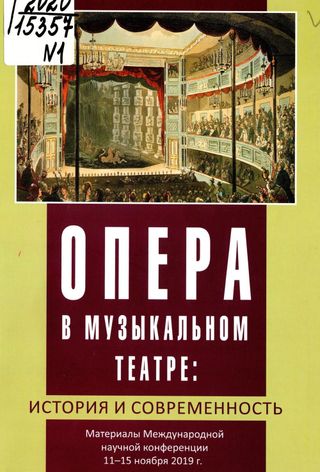
Опера в музыкальном театре: история и современность Материалы Международной научной конференции, 11–15 ноября 2019 г.
The articles included in the collection are written based on the reports read at the International Scientific Conference "Opera in the Musical Theater: History and Modernity" (November 11–15, 2019) at the Russian Academy of Music. Gnesins and the State Institute of Art Studies. The event was supported by the Russian Foundation for Basic Research (Project No. 19-012-20019). The concept of the conference was determined by the attitude to opera as a phenomenon, first of all, not purely musical, but a theatrical, synthetic phenomenon. This approach made it possible to consolidate the efforts of scientists of various specialties - musicologists, theater critics, fine arts specialists, theater theorists and practitioners. The need for such a union is long overdue, since the generally accepted thesis about the synthetic nature of opera, as a rule, is poorly implemented in practice, and scientists rarely go beyond their scientific specialties. The relevance of the interdisciplinary study of operatic art is especially acute in our time, when the opera has become the arena of avant-garde composer and director experiments, causing heated discussions and requiring new criteria for analysis and evaluation, new approaches to interpretation. The structure of this publication reflects the problems of the conference.Among the fundamental problems that determined the thematic areas of the scientific forum are the following: a new understanding of the historical development of opera in the sociocultural and theatrical contexts, cleared of ideological clichés and based on current scientific and documentary research; the attitude of modern musical theater to the classical heritage, the processes of formation of new genres, musical-dramatic, stage forms and their correlation with historical experience; development and testing of "integral" methodological approaches to the study of opera art in the unity of all its components (music, words, visual embodiment) and, accordingly, the search for common ground between related art history and the humanities.