?
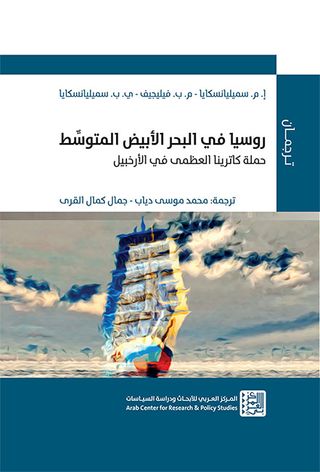
Россия в Средиземноморье. Поход Екатерины Великой в Архипелаг (на арабском языке)
The translation into Arabic of the text (enlarged and corrected) of the monograph by Irina Smilyanskaya, Mikhail Velizhev, Elena Smilyanskaya " Russia in the Mediterranean. The Archipelago Expedition of Catherine the Great" (first ed. in Russian - Moscow, 2011). The Russian presence in the Mediterranean began with the Archipelago expedition in conjunction with the Russo-Turkish War of 1768-1774, specifically with the arrival and military actions of the Russian fleet under the command of Count Aleksei Grigorevich Orlov. Russia widely asserted that it was inserting itself into the Eastern Mediterranean in order to aid the Orthodox Greeks, but the Russian Empress also had more ambitious goals. The great victory of Chesma (June 24-25, 1770) helped to realise many her former dreams: to blockade the capital of the Porte, to become masters of maritime transportation in the Levant, and to declare twenty islands in Aegean Sea as a “Russian archipelago principality.” Russia’s presence in the Mediterranean helped to strengthen political, diplomatic, cultural relations with Italian states and Malta, to establish contacts with Arab rulers in Egypt, Palestine and Lebanon and to conquer Beirut. However through the Mediterranean expedition not only did Russia begin to explore its military interest in the Mediterranean, but the expedition members also had the rare experience of leaving the borders of their intellectual home. These men had the opportunity to compare the mythological with the real, and to place themselves into the great flow of Mediterranean civilization. The book consists of 10 chapters accompanied by primary source documents and additional essays.