• A
  • A
  • A
  • АБВ
  • АБВ
  • АБВ
  • A
  • A
  • A
  • A
  • A
Обычная версия сайта
  • RU
  • EN
  • HSE University
  • Publications
  • Book chapter
  • Яма, Ями и ведийская частица ghā̆: К интерпретации РВ 10.10.10
  • RU
  • EN
Расширенный поиск
Высшая школа экономики
Национальный исследовательский университет
Priority areas
  • business informatics
  • economics
  • engineering science
  • humanitarian
  • IT and mathematics
  • law
  • management
  • mathematics
  • sociology
  • state and public administration
by year
  • 2027
  • 2026
  • 2025
  • 2024
  • 2023
  • 2022
  • 2021
  • 2020
  • 2019
  • 2018
  • 2017
  • 2016
  • 2015
  • 2014
  • 2013
  • 2012
  • 2011
  • 2010
  • 2009
  • 2008
  • 2007
  • 2006
  • 2005
  • 2004
  • 2003
  • 2002
  • 2001
  • 2000
  • 1999
  • 1998
  • 1997
  • 1996
  • 1995
  • 1994
  • 1993
  • 1992
  • 1991
  • 1990
  • 1989
  • 1988
  • 1987
  • 1986
  • 1985
  • 1984
  • 1983
  • 1982
  • 1981
  • 1980
  • 1979
  • 1978
  • 1977
  • 1976
  • 1975
  • 1974
  • 1973
  • 1972
  • 1971
  • 1970
  • 1969
  • 1968
  • 1967
  • 1966
  • 1965
  • 1964
  • 1963
  • 1958
  • More
Subject
News
June 5, 2026
Neural Network Maps as a Method for Constructing Mathematical Models
Scientists from HSE University–Nizhny Novgorod and the Institute of Physics Belgrade, Serbia, are jointly exploring the application of machine learning techniques and neural networks to the study of nonlinear dynamics. Natalya Stankevich, Leading Research Fellow at the Laboratory of Topological Methods in Dynamics of the Faculty of Informatics, Mathematics, and Computer Science at HSE University–Nizhny Novgorod, spoke to the HSE News Service about this international project.
June 5, 2026
‘In the Age of Technology, It Is Interesting to Look into the Past and Think about What We Can Take from It
Polina Tabakova decided to apply for a Philology degree at HSE in Nizhny Novgorod because she grew up in Mari El and did not want to move far away from the Russian forests. In an interview for the Young Scientists of HSE University project, she spoke about the genre of the campus novel, the existential drama of Kolobok, and a blackout version of Eugene Onegin.
June 5, 2026
HSE Scientists Develop Method to Compress Large Language Models Without Losing Quality
Researchers from the AI and Digital Science Institute at the HSE Faculty of Computer Science have developed a new compression method for large language models such as GPT and LLaMA that reduces their size by 25–36% without additional training or significant loss of accuracy. This is the first approach to use mathematical transformations—specifically, rotations of model weights—to make models more amenable to compression with structured matrices. The study results have been published in ACL Findings 2025. The code is available on GitHub.


Have you spotted a typo?
Highlight it, click Ctrl+Enter and send us a message. Thank you for your help!

Publications
  • Books
  • Articles
  • Chapters of books
  • Working papers
  • Report a publication
  • Research at HSE

?

Яма, Ями и ведийская частица ghā̆: К интерпретации РВ 10.10.10

С. 47–59.
Kulikov L.

Yama, Yamī and the Vedic particle ghā̆: on the interpretation of RV 10.10.10

In the present paper I argue that the traditional translation of the Vedic Sanskrit discourse particle ghā̆ as “perhaps, indeed, certainly”, etc., albeit acceptable for some of its occurrences, cannot explain a number of difficult passages from the R̥gveda, in particular, in the hymn-dialog of the first humans, the twins Yama and Yamī (RV 10.10). On the basis of a pragmatic analysis of this dialogue as well as a philological study of other attestations of ghā̆ in Vedic, I reconsider the traditional interpretation of ghā̆. I argue that ghā̆ functions as a consecutive connector, meaning “then, (if so) then, as a result”. Additional evidence in support of this analysis is provided by the cognates of ghā̆ in other Indo-European languages, first of all, by Slavic že, which can serve to express causal relations, as well as by numerous typological parallels.
Language: Russian
Full text
Keywords: частицаincestинцестславянские языкиSlavic languagesVediccausal relationsparticlesпричинно-следственный механизмProto-Indo-Europeanведийский санскритпраиндоевропейский языкconsecutiveконсекутивный

In book

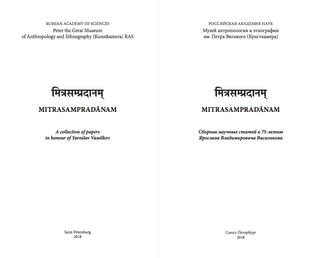
Mitrasampradānam
Mitrasampradānam
СПб.: МАЭ РАН, 2018.
Similar publications
Глаголы перемещения веществ в славянских языках
Fedorov D., Jezikoslovni Zapiski 2026 Т. 32 № 1 С. 23–52
This article describes verbs denoting motion of liquid and dry substances in Slavic langu­ages. The research explores how Slavic languages lexicalize different situations within the semantic field of substance motion and identifies the parameters that drive this lexicalization (e.g., type of substance, intensity and quantization of flow, and causation). Adjacent gram­matical phenomena such as argument ...
Added: May 13, 2026
Proceedings of the 10th Workshop on Slavic Natural Language Processing (Slavic NLP 2025)
Association for Computational Linguistics, 2025.
Added: March 10, 2026
Apposition (Appositional Constructions)
Natalia N. Logvinova, , in: Encyclopedia of Slavic Languages and Linguistics Online.: Brill, 2025. Ch. 11.
Two types of appositional phrases are distinguished in Slavic languages: close and loose. With close constructions, the issues of syntactic headedness and optional case concord between the parts are discussed. Loose appositions are functionally different from close appositions, having a role comparable to secondary predication. ...
Added: December 22, 2025
Nominative Object
Ronko R., Wiemer B., , in: Encyclopedia of Slavic Languages and Linguistics Online.: Brill, 2020.
The nominative object describes a clause type in which the object of a transitive verb takes nominative morphology, and this coding is not conditioned by voice operations. It is a salient property in regions in which Slavic varieties have been in contact with Finnic- and/or Baltic-speaking population, i.e., in the eastern part of the Circum-Baltic ...
Added: December 19, 2025
Диалектометрический подход к диалектной классификации восточнославянских языков на материале сборника «Восточнославянские изоглоссы»
Manusov A. V., Кузьмина А. С., Вопросы языкового родства 2024 № 22/3-4 С. 342–366
The article proposes a new dialectometric approach to the division of East Slavic languages. Our dialectometry is based on the material from the collection of articles “Vostochnoslavyanskie izoglossy” (“East Slavic isoglosses”, 1995–2006), which is a generalization of data from atlases of East Slavic languages (Dialectological atlas of the Russian language, Dialectological atlas of the Belarusian ...
Added: November 13, 2025
Палеославистика 6. Славянское и балканское языкознание. Выпуск 25
Савич В., Паскаль А. Д., Вершинин К. В. et al., Полимедиа, 2025.
The volume of the “Slavic and Balkan Linguistics” series presents the monograph “Palaeoslavistica – 6” written by the international team of researchers. The sections of the co-authored monograph are devoted to the latest results of the ongoing research of the Slavic manuscripts written in the 10th–14th centuries, their language, textology, and palaeography. ...
Added: November 12, 2025
BERT-like Models for Slavic Morpheme Segmentation
Morozov D., Astapenka L., Glazkova A. et al., , in: Proceedings of the 62nd Annual Meeting of the Association for Computational Linguistics (Volume 1: Long Papers)Vol. 1: Long papers.: Association for Computational Linguistics, 2025. P. 6795–6815.
Automatic morpheme segmentation algorithms are applicable in various tasks, such as building tokenizers and language education. For Slavic languages, the development of such algorithms is complicated by the rich derivational capabilities of these languages. Previous research has shown that, on average, these algorithms have already reached expert-level quality. However, a key unresolved issue is the ...
Added: July 17, 2025
Обзор семейства конструкций с функцией «понижения агенса» в славянских языках
Plungian V., Подгорная А. Д., Славистика 2023 Т. 27 № 2 С. 54–70
В данной работе представлен обзор конструкций, выполняющих функцию «понижения агенса», в славянских языках, что включает причастный пассив, субъектный имперсонал с кратким пассивным причастием (на -no/to), форма с континуантом праславянского *sę, в разных языках демонстрирующая свойства пассива или имперсонала, конструкции с глаголом в форме 3-го лица мн.ч. и ед.ч. (ср.р.), универсальные употребления 2-го лица ед.ч., 1-го ...
Added: June 6, 2024
On Tocharian A cognates of the Tocharian B words meaning 'spleen' and 'liver'
Itkin I., Journal of Language Relationship 2022 No. 20/3-4 P. 177–180
In 2022 A. Huard and R. Chen independently established that words meaning ʽspleenʼ and ʽliverʼ can be reliably identified in Tocharian B. These words, spalce (Acc spalc*) ʽspleenʼ and yakär* ʽliverʼ, go back to Indo-European. In this article, we show that the names of both of these organs can be identified with the same degree ...
Added: February 17, 2024
Корпусное исследование конкуренции конструкций с функцией «понижения агенса» в славянских языках
Plungian V., Подгорная А. Д., Studia Slavica 2022 Т. 67 № 1-2 С. 115–131
В статье рассматриваются конструкции с функцией «понижения агенса» и их переводные эквиваленты на материале параллельного корпуса романа М. А. Булгакова «Мастер и Маргарита» в переводах на польский, чешский, болгарский, сербский и немецкий языки. Под данным ярлыком объединяются средства, лишающие агенс привилегированного коммуникативного статуса, что проявляется в его реализации в нехарактерной синтаксической позиции, полном опущении или ...
Added: November 8, 2023
Слово устное и слово письменное в языке этнокультурного пограничья
Белова О. В., Moroz A., Ясинская М. В., Издательский дом "Неолит", 2023.
The collective monograph is devoted to the description of the linguocultural situation on the Russian-Belarusian-Ukrainian and East Slavic-Polish borderland, the main markers of self-identification of the local population (language and confession), perceptions of "own" and "foreign" language, and perception of the language of ethnic neighbors, peculiarities of functioning of liturgical (Church Slavonic) language and paraliturgical ...
Added: October 24, 2023
From an adverb/postposition ‘behind’ to a discourse marker: The particle reχu in Andi
Maisak T., , in: Discourse phenomena in typological perspective.: John Benjamins Publishing Company, 2023. Ch. 5 P. 93–133.
The paper describes two uses of the discourse particle reχu in Andi (Nakh-Daghestanian, Avar-Andic), namely the consecutive, or sequential, use found in the non-final clauses of multiclausal sentences and reinforcing the idea of temporal sequence (‘and then’), and the pragmatic use with retrospective contrastive meaning, predominantly found in imperatives and questions. A diachronic scenario is proposed for ...
Added: August 20, 2023
Case Marking and Definiteness in Slavic Appositional Constructions
Logvinova N., Slovene 2022 Vol. 11 No. 1 P. 281–304
This paper is a corpus-based study of Slavic appositional constructions. Out of material taken from seven Slavic languages, two aspects of the morphosyntax of close appositions in Slavic are considered: case concord and definiteness marking. The first section of the paper considers the factors that affect case concord in appositions in Russian, Ukrainian, Belarusian, Czech, ...
Added: May 1, 2023
  • About
  • About
  • Key Figures & Facts
  • Sustainability at HSE University
  • Faculties & Departments
  • International Partnerships
  • Faculty & Staff
  • HSE Buildings
  • HSE University for Persons with Disabilities
  • Public Enquiries
  • Studies
  • Admissions
  • Programme Catalogue
  • Undergraduate
  • Graduate
  • Exchange Programmes
  • Summer University
  • Summer Schools
  • Semester in Moscow
  • Business Internship
  • Research
  • International Laboratories
  • Research Centres
  • Research Projects
  • Monitoring Studies
  • Conferences & Seminars
  • Academic Jobs
  • Yasin (April) International Academic Conference on Economic and Social Development
  • Media & Resources
  • Publications by staff
  • HSE Journals
  • Publishing House
  • iq.hse.ru: commentary by HSE experts
  • Library
  • Economic & Social Data Archive
  • Video
  • HSE Repository of Socio-Economic Information
  • HSE1993–2026
  • Contacts
  • Copyright
  • Privacy Policy
  • Site Map
Edit