• A
  • A
  • A
  • АБВ
  • АБВ
  • АБВ
  • A
  • A
  • A
  • A
  • A
Обычная версия сайта
  • RU
  • EN
  • HSE University
  • Publications
  • Book chapter
  • Dynamics of Technological Growth Rate and the Forthcoming Singularity
  • RU
  • EN
Расширенный поиск
Высшая школа экономики
Национальный исследовательский университет
Priority areas
  • business informatics
  • economics
  • engineering science
  • humanitarian
  • IT and mathematics
  • law
  • management
  • mathematics
  • sociology
  • state and public administration
by year
  • 2027
  • 2026
  • 2025
  • 2024
  • 2023
  • 2022
  • 2021
  • 2020
  • 2019
  • 2018
  • 2017
  • 2016
  • 2015
  • 2014
  • 2013
  • 2012
  • 2011
  • 2010
  • 2009
  • 2008
  • 2007
  • 2006
  • 2005
  • 2004
  • 2003
  • 2002
  • 2001
  • 2000
  • 1999
  • 1998
  • 1997
  • 1996
  • 1995
  • 1994
  • 1993
  • 1992
  • 1991
  • 1990
  • 1989
  • 1988
  • 1987
  • 1986
  • 1985
  • 1984
  • 1983
  • 1982
  • 1981
  • 1980
  • 1979
  • 1978
  • 1977
  • 1976
  • 1975
  • 1974
  • 1973
  • 1972
  • 1971
  • 1970
  • 1969
  • 1968
  • 1967
  • 1966
  • 1965
  • 1964
  • 1963
  • 1958
  • More
Subject
News
May 25, 2026
HSE Scientists Train Neural Network to 'Hear' Faults in Electric Motors
Researchers at the AI and Digital Science Institute of the HSE Faculty of Computer Science have developed a new method—the Signature-Guided Data Augmentation (SGDA) framework—that achieves 99% accuracy in motor fault detection and 86% accuracy in fault classification. The application of this approach can reduce industrial equipment repair costs, minimise downtime, and improve production safety. The study results have been published in Engineering Applications of Artificial Intelligence.
May 25, 2026
'The Humanities Serve as a Conscience'
Maria Mizernaia studies Soviet literature and the history of book publishing. In this interview for the HSE Young Scientists project, she discusses plans to publish a novel about besieged Leningrad, AI-provoked reflections on what it means to be human, and how novels can help satisfy our dopamine hunger.
May 25, 2026
Is It Possible to Predict a Citys Life Based on the Shape of Its Neighbourhoods?
Is it possible to predict, based on the configuration of streets and buildings, where a café will open or where traffic congestion will occur? Participants in the Spatial Analysis and Modelling of Urban Processes research and study group use open data and machine learning to identify universal patterns. Alexander Sheludkov and Eduard Somov discuss the purpose of comparing cities, the need for new forms of urban statistics, and how open data is transforming approaches to urban studies.


Have you spotted a typo?
Highlight it, click Ctrl+Enter and send us a message. Thank you for your help!

Publications
  • Books
  • Articles
  • Chapters of books
  • Working papers
  • Report a publication
  • Research at HSE

?

Dynamics of Technological Growth Rate and the Forthcoming Singularity

Ch. 15. P. 287–344.
Grinin L. E., Grinin A., Korotayev A.

In this chapter, we consider the process of technological progress presenting one of the options for measuring its speed throughout the entire historical process. We find that the general dynamics of accelerating technological growth over the past 40 thousand years can be described with amazing accuracy (R2 = 0.99) using the following simplest hyperbolic equation: yt = C/t0 − t, where yt is the technological growth rate measured as a number of technological phase transitions per unit of time. Although since 40,000 BP the speed of technological progress tended to generally increase, however, according to the theory of production principles on which we rely, the acceleration of technological progress had noticeable fluctuations. These fluctuations can be explained by the fact that technological development proceeded within the framework of super-long cycles. We show that, within these cycles, the phases of accumulation of basic breakthrough innovations are replaced by phases of rapid growth of improvements in basic innovations and their wide distribution. These fluctuations between cycle phases affect the pattern of acceleration of technological progress. Currently, there are a number of calculations of the point of singularity of the Big History and global evolution, which generally localize the singularity around the first half of the twenty-first century. The point of singularity in our calculations, if we rely only on historical time points, falls on 2018, that is, in principle, it fully fits the results of other studies. There is a fairly reasonable idea of slowing down a number of important social processes (such as demographic development, urbanization), including the speed of technological progress. Indeed, there are already some grounds for talking about signs of a slowdown in progress from the 1960 to 1970s. However, according to the theory of production principles, as already mentioned, there are strong fluctuations in the acceleration of technological progress. We assume that at the moment technological progress is in the fourth—the scientific and cybernetic—production principle. According to this theory, we expect a powerful acceleration of technological progress in the area between the 2030s and the 2070s. In this case, if we take into account the expected time points, the point of singularity, according to our calculations, is estimated to be around 2106. That is, with this method of calculation, we should first expect a new way of acceleration of technological progress, and then, its slowdown in the region of the end of the twenty-first century—the beginning of the 22nd. We also identify the social mechanism for such acceleration and deceleration: in the coming decades, the process of global ageing can cause technological acceleration first and change its direction, and then closer to the end of the present and the beginning of the next century, on the contrary, elderly society can be a brake on scientific-technological progress.

Language: English
Full text
DOI
Text on another site
Keywords: singularityhistorical processBig Historytechnological progress

In book

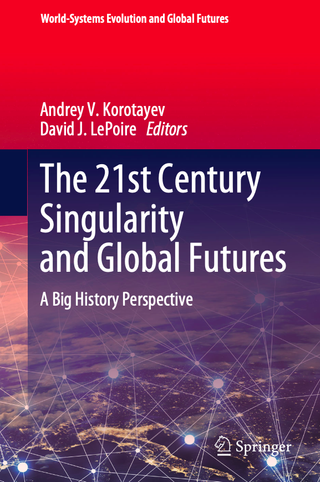
The 21st Century Singularity and Global Futures. A Big History Perspective
Switzerland: Springer, 2020.
Similar publications
Complexity in Big History. An Introductory Exploration
LePoire D., Grinin L. E., Korotayev A., Journal of Big History 2025 Vol. 8 No. 3 P. 98–139
Building on foundational work in systems theory, thermodynamics, and evolutionary theory, this paper argues that complexity can serve as a conceptual bridge across disciplines. It explores the role of complexity dynamics in Big History through an integrative theoretical framework that spans physical, chemical, geological, biological, social, cognitive, and civilizational domains. By examining how complexity emerges, ...
Added: November 1, 2025
Мир стоит на пороге эпохи технологической сингулярности. Как изменятся тренды базовых глобальных процессов и эволюция человечества
Akaev A., Ильин И. В., Korotayev A., Вестник Российской академии наук 2025 № 9 С. 3–15
The article examines the likelihood of creating artificial intelligence (AI) at the human level (“human intelligence level”, AGI) by 2027-2029 and the onset of the era of technological singularity, when a fundamental change in the mechanism of human evolution will occur. It is noted that this probability is close to one, since these dates surprisingly ...
Added: October 28, 2025
Conclusions: Exploring Big History Periodizations Across Cosmic and Biosocial Dimensions with Ideas for Further Research
LePoire D., Leonid Grinin, Korotayev A., , in: Navigating Complexity in Big History. Exploring Periodization Across Cosmic and Biosocial Dimensions.: Springer, 2025. P. 495–525.
This volume, “Navigating Complexity in Big History—Exploring Periodization Across Cosmic and Biosocial Dimensions” explores the aspects and proposals for periodization of Big History. This includes considering cross-cutting aspects of measuring complexity (e.g., energy, information, or a combination), considering different mechanisms of natural selection, developing a set of criteria to base the evaluation of frameworks, and ...
Added: May 12, 2025
Comparing and Contrasting Big History Singularity Trends of the Big Bang and Terrestrial Evolution
Korotayev A., , in: Navigating Complexity in Big History. Exploring Periodization Across Cosmic and Biosocial Dimensions.: Springer, 2025. P. 101–157.
The point that within the Big History the decelerating growth of complexity in the Universe observed after the Big Bang can be contrasted with the accelerating growth of complexity traced on our planet for four billion years after the emergence of life on the Earth has been already noticed on quite a number of occasions. ...
Added: May 12, 2025
Possible Methodological Ideas for Periodizing Big History
Leonid Grinin, Korotayev A., , in: Navigating Complexity in Big History. Exploring Periodization Across Cosmic and Biosocial Dimensions.: Springer, 2025. P. 49–71.
“The effort to understand the universe is one of the very few things which lifts human life a little above the level of farce and gives it some of the grace of tragedy”. These words of Nobel laureate Steven Weinberg undoubtedly deserve attention, although they dramatize the origins of interest in the problems of the Universe. ...
Added: May 12, 2025
Navigating Complexity in Big History—Exploring Periodization Across Cosmic and Biosocial Dimensions: An Introduction
LePoire D., Leonid Grinin, Andrey Korotayev, , in: Navigating Complexity in Big History. Exploring Periodization Across Cosmic and Biosocial Dimensions.: Springer, 2025. P. 1–27.
Not so many would argue with identifying complexity as a central concept in Big History and universal evolutionism. It is partly because, perhaps, today, many of us are convinced that not only our world but Universe itself is in a state of major change, and the awareness that we are living in a period of ...
Added: May 12, 2025
Navigating Complexity in Big History. Exploring Periodization Across Cosmic and Biosocial Dimensions
David J. L., L. Grinin, Korotayev A., Springer, 2025.
In the editors’ introduction (Chapter 1), the effort to periodize is placed within the historical context along with considerations from complexity science. Subsequent chapters explore various aspects of periodization and complexity by (a) identifying symmetrical cosmic and biosocial trends, (b) testing rigor and criteria for evaluating periodization, (c) attempting to integrate different approaches through multiple ...
Added: May 12, 2025
Как технологии меняют требования к навыкам и образованию? (обзор дискуссии)
Maltseva V., Nikitin M., Мировая экономика и международные отношения 2025 Т. 69 № 5 С. 121–131
The paper explores the changing demand for skills and qualifications under the influence of technological progress and the implementation of artificial intelligence. The research issue is examined in three dimensions: the structure of skills in the labour market, the returns to education, and the demand for specific skills and competences. A systematic analysis of 125 ...
Added: February 26, 2025
Rethinking medieval margins and marginality: edited by Ann E. Zimo, Tiffany D. Vann Sprecher, Kathryn Ryerson, Debra Blumenthal, London and New York, Routledge, 2020, 272 pp., $48.95 (paperback), ISBN 9780367439569
Asatryan G., Kalpakian J., Rethinking History 2022 Vol. 26 No. 1 P. 116–118
For a serious academic work, this book is very enjoyable and can be said to have appeal beyond its expected academic readership. It takes analytical categories used to understand the present and looks at how they were applied in the past and how Medieval people, primarily but not exclusively in Europe, understood them. Specifically, the ...
Added: February 22, 2025
Socio-economic Systems: Paradigms for the Future, Studies in Systems, Decision and Control (SSDC, volume 314)
Springer, 2021.
This book is reflective of a science-based vision of the future development paradigm of economic and social systems. It deals with the digitization as the technological basis for the future development of economic and social systems and presents a review of groundbreaking technologies and prospects for their application. The specific character of the industry and ...
Added: October 7, 2024
Socio-economic Systems: Paradigms for the Future
Tabolin V., Springer Publishing Company, 2021.
This book is reflective of a science-based vision of the future development paradigm of economic and social systems. It deals with the digitization as the technological basis for the future development of economic and social systems and presents a review of groundbreaking technologies and prospects for their application. The specific character of the industry and ...
Added: February 12, 2023
HISTORY & MATHEMATICS. HISTORICAL AND TECHNOLOGICAL DYNAMICS: FACTORS, CYCLES, AND TRENDS
Volgograd: Uchitel Publishing House, 2022.
The present Yearbook is subtitled Historical and Technological Dynamics: Factors, Cycles, and Trends. Its articles demonstrate different forms, patterns, and modes of evolutionary development of societies and their subsystems both over very long periods (in fact, the whole historical process) and over relatively short time intervals. We believe that without an in-depth analysis of the ...
Added: December 14, 2022
Размышления об "антропологии времени" и режимах темпоральности: реплики к дискуссии
Агапов М. Г., Васильева З. С., Карасева А. И. et al., Этнографическое обозрение 2021 № 6 С. 102–116
© 2021, Russian Academy of Sciences. All rights reserved.This is a forum discussion of the article “The Anthropology of Time: History and the State of the Art” by Nikolai Ssorin-Chaikov. Authors explicate the article’s main argument and critically engage with its main points, particularly with the concept of temporal multiplicity and relations within it. In ...
Added: October 29, 2022
Контуры новой модели конкуренции за энергетические ресурсы
Silkin V., Мировая экономика и международные отношения 2017 Т. 61 № 4 С. 60–70
Abstract. By focusing on energy security issues this paper examines the changes in the global energy industry competition mechanisms. Gaining sovereignty over energy resources by developing countries and the revision of the access regime to oil and gas resources for the international oil companies (IOCs) resulted in changing the balance of power in the industry. In ...
Added: October 29, 2022
Rostovtzeff and his Social and Economic History of the Roman Empire: A Comment on a Scholarly Masterpiece
Panchenko D., Hyperboreus 2021 Vol. 27 No. 1 P. 134–143
The reputation of The Social and Economic History of the Roman Empire (1926) is contradictory. On the one hand, Rostovtzeff’s work has been recognized as a masterpiece. On the other hand, its main ideas have been repeatedly dismissed. The critics pointed to the personal experience of Rostovtzeff, an exile from revolutionary Russia; they saw in ...
Added: October 27, 2022
Особенности бизнес-модели юридической компании и влияющие на неё факторы
Kosov M., Вестник Московского университета МВД России 2019 № 5 С. 241–249
Features of law firm’s business models are determined by the company’s product and key resources. In the context of rapid technological development, successful economic activity is impossible without monitoring and managing the factors influencing the activities of the law firm. ...
Added: September 2, 2021
Kinetic singularities at transition points from equilibrium to metastable states of the Lennard-Jones particle system
Negodin V., Polyachenko Y., Fleita D. et al., Journal of Molecular Liquids 2021 Vol. 322 No. 1-3 Article 114954
The equilibrium and metastable states of the Lennard-Jones vapor, liquid, and crystal, are studied in the vicinity of the phase transition points. Vapor-liquid, liquid-vapor, liquid-crystal, and crystal-liquid transitions are modeled within the molecular dynamics method. As a research tool, a four-point correlation function is used for the qualitative detection of collective motions of atoms in ...
Added: May 14, 2021
Восприятие новых технологий населением как показатель открытости к инновациям
Pishnyak A., Khalina N., Форсайт 2021 Т. 15 № 1 С. 39–54
Rapid technological progress is one of the basic processes in the modern world. It is an integral part both in the field of labor and employment and in leisure and recreation. The request for an accelerated implementation of digital technologies in the economy and social sphere, which is inherent in one of the national development ...
Added: April 2, 2021
Conclusion
Korotayev A., LePoire D., , in: The 21st Century Singularity and Global Futures. A Big History Perspective.: Switzerland: Springer, 2020. P. 599–620.
This concluding chapter summarizes major findings of the present collective monograph. It traces the emergence of accelerating innovation rates through history and the major historical transformations through the evolution of life, humans, and civilization. It draws on the concepts from physics and evolutionary biology to offer potential models of the underlying mechanisms driving this acceleration ...
Added: November 13, 2020
Research and developing methods of solving engineering optimization problems for parallel structure robots
Maminov A., Posypkin M., International Journal of Open Information Technologies 2019 Т. 7 № 11 С. 1–7
— We consider the optimization of the key design parameters of the 2-RPR parallel robot in this paper. Optimization is carried out according to two criteria: the area of the workspace of the 2-RPR robot and the controllability index - global dexterity index (GDI). In the process of analyzing the robot, the direct and inverse ...
Added: November 11, 2020
Constrained Multi-objective Robot’s Design Optimization
Posypkin M., Maminov A., , in: IEEE NW Russia Young Researchers in Electrical and Electronic Engineering Conference (EIConRusNW) 2020.: IEEE, 2020. P. 1992–1995.
In this article, we consider an approach for the optimal multi-objective constrained design of the parallel robots. Optimization is carried out according to two key criteria: the workspace area and the global dexterity index (GDI) concerning constrain. The workspace is the area that the robot can serve. The value of the GDI correlates with the quality of this service. Both objectives ...
Added: November 1, 2020
Characteristic points, fundamental cubic form and Euler characteristic of projective surfaces
Kazaryan M., Uribe-Vargas R., Moscow Mathematical Journal 2020 Vol. 20 No. 3 P. 511–530
We define local indices for projective umbilics and godrons (also called cusps of Gauss) on generic smooth surfaces in projective 3-space. By means of these indices, we provide formulas that relate the algebraic numbers of those characteristic points on a surface (and on domains of the surface) with the Euler characteristic of that surface (resp. ...
Added: August 24, 2020
Extended $r$-spin theory and the mirror symmetry for the $A_{r-1}$-singularity
Buryak A., Moscow Mathematical Journal 2020 Vol. 20 No. 3 P. 475–493
By a famous result of K. Saito, the parameter space of the miniversal deformation of the $A_{r-1}$-singularity carries a Frobenius manifold structure. The Landau-Ginzburg mirror symmetry says that, in the flat coordinates, the potential of this Frobenius manifold is equal to the generating series of certain integrals over the moduli space of $r$-spin curves. In ...
Added: May 22, 2020
  • About
  • About
  • Key Figures & Facts
  • Sustainability at HSE University
  • Faculties & Departments
  • International Partnerships
  • Faculty & Staff
  • HSE Buildings
  • HSE University for Persons with Disabilities
  • Public Enquiries
  • Studies
  • Admissions
  • Programme Catalogue
  • Undergraduate
  • Graduate
  • Exchange Programmes
  • Summer University
  • Summer Schools
  • Semester in Moscow
  • Business Internship
  • Research
  • International Laboratories
  • Research Centres
  • Research Projects
  • Monitoring Studies
  • Conferences & Seminars
  • Academic Jobs
  • Yasin (April) International Academic Conference on Economic and Social Development
  • Media & Resources
  • Publications by staff
  • HSE Journals
  • Publishing House
  • iq.hse.ru: commentary by HSE experts
  • Library
  • Economic & Social Data Archive
  • Video
  • HSE Repository of Socio-Economic Information
  • HSE1993–2026
  • Contacts
  • Copyright
  • Privacy Policy
  • Site Map
Edit