• A
  • A
  • A
  • АБВ
  • АБВ
  • АБВ
  • A
  • A
  • A
  • A
  • A
Обычная версия сайта
  • RU
  • EN
  • HSE University
  • Publications
  • Book chapter
  • About the Singularity in Biological and Social Evolution
  • RU
  • EN
Расширенный поиск
Высшая школа экономики
Национальный исследовательский университет
Priority areas
  • business informatics
  • economics
  • engineering science
  • humanitarian
  • IT and mathematics
  • law
  • management
  • mathematics
  • sociology
  • state and public administration
by year
  • 2027
  • 2026
  • 2025
  • 2024
  • 2023
  • 2022
  • 2021
  • 2020
  • 2019
  • 2018
  • 2017
  • 2016
  • 2015
  • 2014
  • 2013
  • 2012
  • 2011
  • 2010
  • 2009
  • 2008
  • 2007
  • 2006
  • 2005
  • 2004
  • 2003
  • 2002
  • 2001
  • 2000
  • 1999
  • 1998
  • 1997
  • 1996
  • 1995
  • 1994
  • 1993
  • 1992
  • 1991
  • 1990
  • 1989
  • 1988
  • 1987
  • 1986
  • 1985
  • 1984
  • 1983
  • 1982
  • 1981
  • 1980
  • 1979
  • 1978
  • 1977
  • 1976
  • 1975
  • 1974
  • 1973
  • 1972
  • 1971
  • 1970
  • 1969
  • 1968
  • 1967
  • 1966
  • 1965
  • 1964
  • 1963
  • 1958
  • More
Subject
News
July 9, 2026
HSE Economists Use Search Queries to Forecast Birth Rates
Researchers from the HSE Faculty of Economic Sciences have shown that the accuracy of birth rate forecasts for Russia can be improved by almost 50% by incorporating the dynamics of online search queries related to pregnancy and childbirth into forecasting models. In the best-performing models, the forecasting error fell from 4.6% to 3.2%. The findings have been published in Populations and Economics.
July 8, 2026
HSE Researchers Discover Who Eats Out in Russia-And Why
Around one-third of Russians (31.3%) rarely eat out or buy ready-made meals. The core group of active consumers—those who eat out or purchase prepared food almost every day or several times a week—accounts for only about 9% of the population. These are the findings of a study conducted by the HSE Institute for Social Policy. According to the researchers eating out is no longer a marker of high social status in Russia.
July 8, 2026
HSE University and RREDA Join Forces to Support 2026 Renewable Energy of the Planet Competition
HSE University and the Russia Renewable Energy Development Association (RREDA) have signed a partnership and information cooperation agreement to support Renewable Energy of the Planet—2026, a national competition with international participation for students and early-career researchers. Applications are open on the competition's website until September 20, 2026.


Have you spotted a typo?
Highlight it, click Ctrl+Enter and send us a message. Thank you for your help!

Publications
  • Books
  • Articles
  • Chapters of books
  • Working papers
  • Report a publication
  • Research at HSE

?

About the Singularity in Biological and Social Evolution

Ch. 23. P. 517–534.
Malkov S. Y.

Using mathematical modeling, we consider the phenomenon of singularity in the biological and social history. It is shown that hyperbolic trends in biological and social evolution can be explained by transitional processes that accompany the expansion of ecological niches due to periodically occurring revolutionary innovations. During these periods, strong positive feedbacks are actualized, leading to hyperbolic growth. However, this growth is then inhibited, and the system goes into a new qualitative state. Then, there is a relatively slow development of the updated system with a gradual accumulation of quantitative characteristics and a new innovative breakthrough. This cycle then repeats multiple times. In this regard, the system’s hyperbolic growth trends indicate the transitivity of its current state, while the time of singularity in this hyperbolic trend indicates the end of the transition process.

Language: English
Full text
DOI
Text on another site
Keywords: singularitydemographic processesBig Historybiological evolutionsocial evolution
Publication based on the results of:
Instruments and Factors of Socio-Political Destabilization in the Middle East and Central Asia (2019)

In book

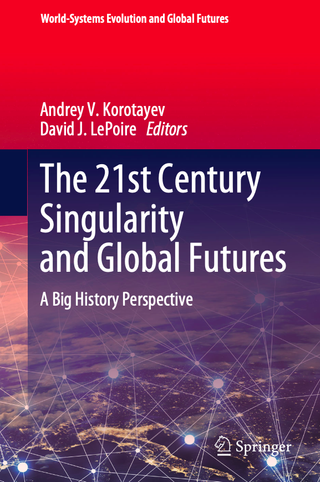
The 21st Century Singularity and Global Futures. A Big History Perspective
Switzerland: Springer, 2020.
Similar publications
Biological and Social Phases of Big History and Universal Evolution: Similarities, Differences, and the Growth of Complexity
Leonid Grinin, Markov A., Korotayev A., Journal of Big History 2025 Vol. 8 No. 3 P. 1–51
In this paper, Grinin et al. survey general similarities and differences between biological and social macroevolution and phases of Big History. The comparison of biological and social evolution is an important but (regrettably) understudied subject. The authors have endeavored to make a systematic comparison between biological and social evolution at different levels of analysis and ...
Added: November 1, 2025
Complexity in Big History. An Introductory Exploration
LePoire D., Grinin L. E., Korotayev A., Journal of Big History 2025 Vol. 8 No. 3 P. 98–139
Building on foundational work in systems theory, thermodynamics, and evolutionary theory, this paper argues that complexity can serve as a conceptual bridge across disciplines. It explores the role of complexity dynamics in Big History through an integrative theoretical framework that spans physical, chemical, geological, biological, social, cognitive, and civilizational domains. By examining how complexity emerges, ...
Added: November 1, 2025
Мир стоит на пороге эпохи технологической сингулярности. Как изменятся тренды базовых глобальных процессов и эволюция человечества
Akaev A., Ильин И. В., Korotayev A., Вестник Российской академии наук 2025 № 9 С. 3–15
The article examines the likelihood of creating artificial intelligence (AI) at the human level (“human intelligence level”, AGI) by 2027-2029 and the onset of the era of technological singularity, when a fundamental change in the mechanism of human evolution will occur. It is noted that this probability is close to one, since these dates surprisingly ...
Added: October 28, 2025
Conclusions: Exploring Big History Periodizations Across Cosmic and Biosocial Dimensions with Ideas for Further Research
LePoire D., Leonid Grinin, Korotayev A., , in: Navigating Complexity in Big History. Exploring Periodization Across Cosmic and Biosocial Dimensions.: Springer, 2025. P. 495–525.
This volume, “Navigating Complexity in Big History—Exploring Periodization Across Cosmic and Biosocial Dimensions” explores the aspects and proposals for periodization of Big History. This includes considering cross-cutting aspects of measuring complexity (e.g., energy, information, or a combination), considering different mechanisms of natural selection, developing a set of criteria to base the evaluation of frameworks, and ...
Added: May 12, 2025
Comparing and Contrasting Big History Singularity Trends of the Big Bang and Terrestrial Evolution
Korotayev A., , in: Navigating Complexity in Big History. Exploring Periodization Across Cosmic and Biosocial Dimensions.: Springer, 2025. P. 101–157.
The point that within the Big History the decelerating growth of complexity in the Universe observed after the Big Bang can be contrasted with the accelerating growth of complexity traced on our planet for four billion years after the emergence of life on the Earth has been already noticed on quite a number of occasions. ...
Added: May 12, 2025
Possible Methodological Ideas for Periodizing Big History
Leonid Grinin, Korotayev A., , in: Navigating Complexity in Big History. Exploring Periodization Across Cosmic and Biosocial Dimensions.: Springer, 2025. P. 49–71.
“The effort to understand the universe is one of the very few things which lifts human life a little above the level of farce and gives it some of the grace of tragedy”. These words of Nobel laureate Steven Weinberg undoubtedly deserve attention, although they dramatize the origins of interest in the problems of the Universe. ...
Added: May 12, 2025
Navigating Complexity in Big History—Exploring Periodization Across Cosmic and Biosocial Dimensions: An Introduction
LePoire D., Leonid Grinin, Andrey Korotayev, , in: Navigating Complexity in Big History. Exploring Periodization Across Cosmic and Biosocial Dimensions.: Springer, 2025. P. 1–27.
Not so many would argue with identifying complexity as a central concept in Big History and universal evolutionism. It is partly because, perhaps, today, many of us are convinced that not only our world but Universe itself is in a state of major change, and the awareness that we are living in a period of ...
Added: May 12, 2025
Navigating Complexity in Big History. Exploring Periodization Across Cosmic and Biosocial Dimensions
David J. L., L. Grinin, Korotayev A., Springer, 2025.
In the editors’ introduction (Chapter 1), the effort to periodize is placed within the historical context along with considerations from complexity science. Subsequent chapters explore various aspects of periodization and complexity by (a) identifying symmetrical cosmic and biosocial trends, (b) testing rigor and criteria for evaluating periodization, (c) attempting to integrate different approaches through multiple ...
Added: May 12, 2025
Rethinking medieval margins and marginality: edited by Ann E. Zimo, Tiffany D. Vann Sprecher, Kathryn Ryerson, Debra Blumenthal, London and New York, Routledge, 2020, 272 pp., $48.95 (paperback), ISBN 9780367439569
Asatryan G., Kalpakian J., Rethinking History 2022 Vol. 26 No. 1 P. 116–118
For a serious academic work, this book is very enjoyable and can be said to have appeal beyond its expected academic readership. It takes analytical categories used to understand the present and looks at how they were applied in the past and how Medieval people, primarily but not exclusively in Europe, understood them. Specifically, the ...
Added: February 22, 2025
Заключение
Aleksandrov G., Bondarenko D. M., В кн.: Принципы и формы социокультурной организации: исторические контексты взаимодействия.: М.: Издательский дом ЯСК, 2024. С. 343–357.
The concluding chapter reiterates the theoretical framework of the book and presents a brief overview of every chapter, highlighting the way chronologically and geographically diverse research subjects tie into the general approach the work utilizes. The author stresses the importance of the overarching goal of this collective work, to showcase the applicability of the concept ...
Added: July 12, 2024
Размышляя об Адаме из Эдема и не только…
Grebnev L., М.: ИНФРА-М, 2023.
The author's reflections on Adam from Eden began at the turn of the 2000s-2010s, first with students of the Kutafin Moscow State University, and then the Higher School of Economics. The result of these reflections is addressed primarily to those who, regardless of age, want to become a truly adult person, that is, to make ...
Added: April 2, 2024
Conclusion: Reconsidering the Limits – Suggestions (Come On!)
Sadovnichy V., Akaev A., Ilyin I. et al., , in: Reconsidering the Limits to Growth. A Report to the Russian Association of the Club of Rome.: Springer, 2023. P. 531–540.
This concluding chapter provides summary of main ideas expressed in the previous chapters of the present report to the Club of Rome, which are: (1) population growth has ceased to be the main cause of many other global problems; the issue has shifted to other dimensions and requires optimization of demographic processes, rather than general ...
Added: October 6, 2023
Modelling social bonds dynamics in groups: an approach to optimise interdisciplinary science projects and to analyse long-term social evolution
Andreyuk D. S., A. A. Shuranova, International Journal of Nanotechnology 2021 Vol. 18 No. 9/10 P. 915–925
The paper suggests a means of modelling social relationships basedon the analysis of social bonds dynamics and mechanisms of social groupsformation. A group is the cornerstone of this approach, being defined in termsof social bonds density among individuals constituting it. A number ofconditions for the formation of social bonds are set, taking into account innateindividual ...
Added: September 3, 2023
HISTORY & MATHEMATICS. HISTORICAL AND TECHNOLOGICAL DYNAMICS: FACTORS, CYCLES, AND TRENDS
Volgograd: Uchitel Publishing House, 2022.
The present Yearbook is subtitled Historical and Technological Dynamics: Factors, Cycles, and Trends. Its articles demonstrate different forms, patterns, and modes of evolutionary development of societies and their subsystems both over very long periods (in fact, the whole historical process) and over relatively short time intervals. We believe that without an in-depth analysis of the ...
Added: December 14, 2022
Размышления об "антропологии времени" и режимах темпоральности: реплики к дискуссии
Агапов М. Г., Васильева З. С., Карасева А. И. et al., Этнографическое обозрение 2021 № 6 С. 102–116
© 2021, Russian Academy of Sciences. All rights reserved.This is a forum discussion of the article “The Anthropology of Time: History and the State of the Art” by Nikolai Ssorin-Chaikov. Authors explicate the article’s main argument and critically engage with its main points, particularly with the concept of temporal multiplicity and relations within it. In ...
Added: October 29, 2022
Эволюция поведения человека и эволюция общества: некоторые размышления в связи с книгой М.Л. Бутовской и В.В. Ростовцевой
Bondarenko D. M., Этнографическое обозрение 2021 № 6 С. 201–206
Reflecting on the recent book by Marina L. Butovskaya and Victoria V. Rostovtseva, the author discusses altruism and selfishness as preconditions for cooperation of humans in society for collective actions, as a result of which its sociocultural transformations take place. It is argued that the problem of sources of cooperative behavior is by no means ...
Added: December 18, 2021
Rise of the war machines: Charting the evolution of military technologies from the Neolithic to the Industrial Revolution
Turchin P., Hoyer D., Korotayev A. et al., Plos One 2021 Vol. 16 No. 10 Article e0258161
What have been the causes and consequences of technological evolution in world history? In particular, what propels innovation and diffusion of military technologies, details of which are comparatively well preserved and which are often seen as drivers of broad socio-cultural processes? Here we analyze the evolution of key military technologies in a sample of pre-industrial ...
Added: November 7, 2021
Kinetic singularities at transition points from equilibrium to metastable states of the Lennard-Jones particle system
Negodin V., Polyachenko Y., Fleita D. et al., Journal of Molecular Liquids 2021 Vol. 322 No. 1-3 Article 114954
The equilibrium and metastable states of the Lennard-Jones vapor, liquid, and crystal, are studied in the vicinity of the phase transition points. Vapor-liquid, liquid-vapor, liquid-crystal, and crystal-liquid transitions are modeled within the molecular dynamics method. As a research tool, a four-point correlation function is used for the qualitative detection of collective motions of atoms in ...
Added: May 14, 2021
Evolution of Sociopolitical Institutions in North-East Yemen (The 1st Millennium BCE–The 2nd Millennium CE)
Korotayev A., , in: The Evolution of Social Institutions: Interdisciplinary Perspectives.: Springer, 2020. Ch. 7 P. 161–184.
In the late 1st millennium BCE, a relatively strong Ancient Sabaean state was transformed into the Middle Sabaean political system consisting of a weak state in its center and strong chiefdoms on its periphery. In the 1st millennium CE, the North-East Yemen political system consisting of a weak state in its center and strong chiefdoms ...
Added: February 2, 2021
Conclusion
Korotayev A., LePoire D., , in: The 21st Century Singularity and Global Futures. A Big History Perspective.: Switzerland: Springer, 2020. P. 599–620.
This concluding chapter summarizes major findings of the present collective monograph. It traces the emergence of accelerating innovation rates through history and the major historical transformations through the evolution of life, humans, and civilization. It draws on the concepts from physics and evolutionary biology to offer potential models of the underlying mechanisms driving this acceleration ...
Added: November 13, 2020
Research and developing methods of solving engineering optimization problems for parallel structure robots
Maminov A., Posypkin M., International Journal of Open Information Technologies 2019 Т. 7 № 11 С. 1–7
— We consider the optimization of the key design parameters of the 2-RPR parallel robot in this paper. Optimization is carried out according to two criteria: the area of the workspace of the 2-RPR robot and the controllability index - global dexterity index (GDI). In the process of analyzing the robot, the direct and inverse ...
Added: November 11, 2020
Constrained Multi-objective Robot’s Design Optimization
Posypkin M., Maminov A., , in: IEEE NW Russia Young Researchers in Electrical and Electronic Engineering Conference (EIConRusNW) 2020.: IEEE, 2020. P. 1992–1995.
In this article, we consider an approach for the optimal multi-objective constrained design of the parallel robots. Optimization is carried out according to two key criteria: the workspace area and the global dexterity index (GDI) concerning constrain. The workspace is the area that the robot can serve. The value of the GDI correlates with the quality of this service. Both objectives ...
Added: November 1, 2020
  • About
  • About
  • Key Figures & Facts
  • Sustainability at HSE University
  • Faculties & Departments
  • International Partnerships
  • Faculty & Staff
  • HSE Buildings
  • HSE University for Persons with Disabilities
  • Public Enquiries
  • Studies
  • Admissions
  • Programme Catalogue
  • Undergraduate
  • Graduate
  • Exchange Programmes
  • Summer University
  • Summer Schools
  • Semester in Moscow
  • Business Internship
  • Research
  • International Laboratories
  • Research Centres
  • Research Projects
  • Monitoring Studies
  • Conferences & Seminars
  • Academic Jobs
  • Yasin (April) International Academic Conference on Economic and Social Development
  • Media & Resources
  • Publications by staff
  • HSE Journals
  • Publishing House
  • iq.hse.ru: commentary by HSE experts
  • Library
  • Economic & Social Data Archive
  • Video
  • HSE Repository of Socio-Economic Information
  • HSE1993–2026
  • Contacts
  • Copyright
  • Privacy Policy
  • Site Map
Edit