?
Towards Model-Driven Role Engineering in BPM Software Systems
Ch. 11. P. 137–146.
This work introduces a new concept of role engineering inside a Model-Driven Engineering modern trend. In case of developing a complex solution comprehensive definition of all needed business roles and their access rights becomes a difficult task. So, the present contribution analyzes different approaches towards the role engineering realized by DEMO and BPMN methodologies based on the Comindware (CBAP) support.
In book
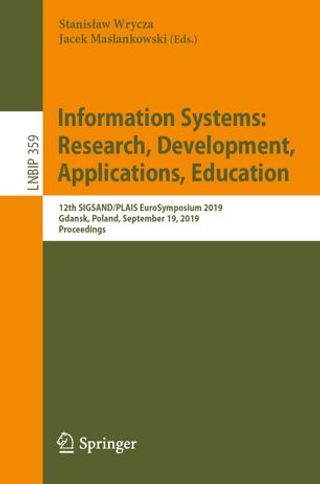
Vol. 359. , Springer, 2019.
Ulitin, B., Babkin, E., Babkina, T. et al., , in: Model-Driven Organizational and Business Agility: Second International Workshop, MOBA 2022, Leuven, Belgium, June 6–7, 2022, Revised Selected PapersIssue 457: Model-Driven Organizational and Business Agility. MOBA 2022.: Switzerland: Springer, 2022. P. 84–99.
Added: October 25, 2022
Aseeva N., Babkin E., Malyzhenkov P. V., , in: Digital Transformation and New Challenges: Changes in Business and Society in the Digital Era.: Switzerland: Springer, 2021. Ch. 2 P. 17–29.
Added: November 22, 2021
Switzerland: Springer, 2021.
This book constitutes the thoroughly refereed proceedings of the international workshops associated with the 33rd International Conference on Advanced Information Systems Engineering, CAiSE 2021, which was held during June 28-July 2, 2021. The conference was planned to take place in Melbourne, Australia, but changed to an online format due to the COVID-19 pandemic.
The workshops included ...
Added: June 16, 2021
Skobtsov A., Kalenkova A. A., , in: 2019 IEEE 23rd International Enterprise Distributed Object Computing Workshop (EDOCW).: IEEE, 2019. P. 85–91.
Goal modeling is widely used to align stakeholders requirements with architectural models. In contrast to goal models which are usually defined by stakeholders, architectural models are not always defined explicitly, or systems may not be used as they were designed. To understand the real behavior of a system, process mining techniques can be applied. These ...
Added: October 13, 2019
Kirill Artamonov, Irina Lomazova, , in: 21st IEEE Conference on Business Informatics (CBI).: IEEE Computer Society, 2019. P. 551–558.
Checking conformance between a process model and an event log, which records information about a current process behavior, is a widely used technique for business process audit. It allows discovering changes in the behavior represented by the model. There are several methods to perform conformance checking: most of them are based on 'token replay' and ...
Added: August 28, 2019
Babkin E., Malyzhenkov P. V., , in: Advances in Enterprise Engineering XIIVol. 334.: Springer, 2019. Ch. 10 P. 159–167.
Value co-creation is a new notion in contemporary business practice, which is now also becoming one of the key marketing concepts. The success of the value co-creation strategy is based on the DART (dialogue, access, risk-benefits and transparency) concept which is emerging as the basis for interaction between the consumer and the firm. Still, the ...
Added: February 3, 2019
Kalenkova A. A., Burattin A., de Leoni M. et al., Business Process Management Journal 2019 Vol. 25 No. 5 P. 995–1019
Purpose – The purpose of this paper is to demonstrate that process mining techniques can help to discover
process models from event logs, using conventional high-level process modeling languages, such as Business
Process Model and Notation (BPMN), leveraging their representational bias.
Design/methodology/approach – The integrated discovery approach presented in this work is aimed
to mine: control, data and resource ...
Added: October 15, 2018
Kalenkova A. A., TU/e Eindhoven, 2018.
Information systems in different domains, such as healthcare, tourism, banking, government and others, record operational behavior in the form of event logs. The process mining discipline offers dozens of techniques to discover, analyze, and visualize processes running in information systems, based on their event logs. The representational bias (the language for processes representation) plays an ...
Added: June 14, 2018
Kalenkova A. A., Агеев А. А., Lomazova I. A. et al., , in: BPM 2017 International Workshops, Barcelona, Spain, September 10-11, 2017, Revised PapersVol. 308.: Springer, 2018. P. 484–496.
E-government web services are becoming increasingly popular among citizens of various countries. Usually, to receive a service, the user has to perform a sequence of steps. This sequence of steps forms a service rendering process. Using process mining techniques this process can be discovered from the information system’s event logs. A discovered process model of ...
Added: October 11, 2017
Babkin E., Malyzhenkov P. V., Rossi F., , in: Advances in Enterprise Engineering XI, 7th Enterprise Engineering Working Conference, EEWC 2017, Antwerp, Belgium, May 8-12, 2017, ProceedingsVol. 284.: Springer, 2017. Ch. 4 P. 66–73.
The Committee of Sponsoring Organizations of the Treadway Commission (COSO) Framework is one of the most diffused internal audit (IA) tools. According to some sources 82% of companies use it realizing the IA procedures as their reference framework. Still, it presents some limitations, especially in the field of risk assessment linked to the weak formal ...
Added: May 12, 2017
Babkin E., Radzinskaia O., Business Informatics 2016 Vol. 37 No. 3 P. 15–29
This research paper explores the most developed methodologies used for multifaceted modeling of organizational structures. It is asserted that the existing methodologies (DEMO – Design and Engineering Methodology for Organizations, BORM – Business Object Relation Modeling and OntoUML) provide tools for analysis of the organization and its business processes through diff erent ways. They lead ...
Added: November 25, 2016
Mitsyuk A. A., Shugurov I., Kalenkova A. A. et al., Simulation Modelling Practice and Theory 2017 Vol. 74 P. 1–16
Business Process Model and Notation (BPMN) is a de-facto standard for practitioners working in the Business Process Management (BPM) field. The BPMN standard [1] offers high-level modeling constructs, such as subprocesses, events, data and message flows, lanes, and is widely used to model processes in various domains. Recently several BPMN-based process mining techniques [2, 3, ...
Added: October 13, 2016
Kalenkova A. A., van der Aalst W., Lomazova I. A. et al., , in: MODELS '16 Proceedings of the ACM/IEEE 19th International Conference on Model Driven Engineering Languages and Systems.: NY: ACM, 2016. P. 123–123.
Process mining is an emerging discipline incorporating methods and tools for the analysis of system/process executions captured in the form of event logs. Traditionally process mining can be divided into three research areas: discovery (construction of process models from event logs), conformance checking (finding log and model deviations), and enhancement of existing process models with ...
Added: October 8, 2016
Shutov A. A., Laryushina J., Radzinskaia O. et al., , in: Information Systems Development and Applications.: Sopot: Faculty of Management University of Gdańsk, 2015. P. 91–104.
The paper presents an ontological modelling tool that may serve as a visual editor for the DEMO methodology and simulator of business-processes. The main goal of the study is to develop an instrumental tool that would enable business analysts to describe business processes at ontological level and analyse their performance. In the paper all stages ...
Added: February 14, 2016
Sopot: Faculty of Management University of Gdańsk, 2015.
This monograph is the collection of the selected papers from Gdańsk EuroSymposium 2015 on SAND – Systems Analysis and Design. SAND is the classical field of research and education in the area of management information systems (MIS) or, as it is called more frequently in Europe – Business Informatics, almost from its origins. The objective ...
Added: February 14, 2016
Ivanov S. Y., Kalenkova A. A., Proceedings of the Institute for System Programming of the RAS 2015 Vol. 27 No. 3 P. 255–266
Comparing business process models is one of the most significant challenges for business and systems analysts. The complexity of the problem is explained by the fact there is a lack of tools that can be used for comparing business process models. Also there is no universally accepted standard for modeling them. EPC, YAWL, BPEL, XPDL ...
Added: September 17, 2015
Sergeev A., Babkin E., Lecture Notes in Business Information Processing 2015 Vol. 211 P. 34–46
While knowledge of competence is of particular value to the enterprise, and notion of competence is being actively used in enterprise engineering field of research, there is a lack of practical usage of competences while restructuring enterprises. This paper presents a modelling framework for competencebased enterprise restructuring using ontologies, which is based on DEMO’s ATD ...
Added: September 8, 2015
Ivanov S. Y., Kalenkova A. A., van der Aalst W., , in: Proceedings of the BPM Demo Session 2015. Co-located with the 13th International Conference on Business Process Management (BPM 2015)Vol. 1418.: Innsbruck: CEUR-WS.org, 2015. Ch. 8 P. 35–39.
Automatic comparison of business processes plays an important role
in their analysis and optimization. In this paper we present the web-based tool
BPMNDiffViz, that finds business processes discrepancies and visualizes them.
BPMN (Business Process Model and Notation) 2.0 - one of the most commonly
used notations for process modeling was chosen as a representation. This tool
implements a structural graph-based ...
Added: August 12, 2015
Kalenkova A. A., van der Aalst W., Lomazova I. A. et al., Software and Systems Modeling 2017 Vol. 16 No. 4 P. 1019–1048
Process-aware information systems (PAIS) are systems relying on processes, which involve human and software resources to achieve concrete goals. There is a need to develop approaches for modeling, analysis, improvement and monitoring processes within PAIS. These approaches include process mining techniques used to discover process models from event logs, find log and model deviations, and ...
Added: June 11, 2015
Ivanov S. Y., Kalenkova A. A., , in: Preliminary Proceedings of the 9th Spring/Summer Young Researchers' Colloquium on Software Engineering (SYRCoSE 2015).: M.: [б.и.], 2015. P. 144–148.
Comparing business process models is one of the most significant challenges for business and systems analysts. The complexity of the problem is explained by the fact there is a lack of tools that can be used for comparing business process models. Also there is no universally accepted standard for modeling them. EPC, YAWL, BPEL, XPDL ...
Added: June 11, 2015