• A
  • A
  • A
  • АБВ
  • АБВ
  • АБВ
  • A
  • A
  • A
  • A
  • A
Обычная версия сайта
  • RU
  • EN
  • HSE University
  • Publications
  • Books
  • History & Mathematics: Big History Aspects
  • RU
  • EN
Расширенный поиск
Высшая школа экономики
Национальный исследовательский университет
Priority areas
  • business informatics
  • economics
  • engineering science
  • humanitarian
  • IT and mathematics
  • law
  • management
  • mathematics
  • sociology
  • state and public administration
by year
  • 2028
  • 2027
  • 2026
  • 2025
  • 2024
  • 2023
  • 2022
  • 2021
  • 2020
  • 2019
  • 2018
  • 2017
  • 2016
  • 2015
  • 2014
  • 2013
  • 2012
  • 2011
  • 2010
  • 2009
  • 2008
  • 2007
  • 2006
  • 2005
  • 2004
  • 2003
  • 2002
  • 2001
  • 2000
  • 1999
  • 1998
  • 1997
  • 1996
  • 1995
  • 1994
  • 1993
  • 1992
  • 1991
  • 1990
  • 1989
  • 1988
  • 1987
  • 1986
  • 1985
  • 1984
  • 1983
  • 1982
  • 1981
  • 1980
  • 1979
  • 1978
  • 1977
  • 1976
  • 1975
  • 1974
  • 1973
  • 1972
  • 1971
  • 1970
  • 1969
  • 1968
  • 1967
  • 1966
  • 1965
  • 1964
  • 1963
  • 1958
  • More
Subject
News
September 25, 2026
AI Users Earn Up to 41.8% More Than Non-Users
Research conducted by economists at HSE University has revealed a significant correlation between the regular use of GenAI in the workplace and higher pay among Russian employees. The study found that individuals who frequently use GenAI in their professional activities earn notably more than those who reject these new tools or resort to them occasionally. The salary premium for highly qualified specialists reaches 41.8%. The article was published in the Voprosy Ekonomiki journal.
September 24, 2026
‘Feedback and Constructive Criticism Are Essential in Our Profession
Vincent Fardeau, Associate Professor at HSE ICEF, has reached a major career milestone: he recently published his paper ‘Asymmetric Thin Markets’ in the Journal of Financial Economics, successfully passed his major academic review, and received tenure. In this interview, Vincent discusses the story behind the paper, explains the concept of asymmetric thin markets, and shares his advice for young scholars aiming to publish in top-tier journals.
September 22, 2026
Personal Interest in Doctoral Thesis Topic Most Important for Confidence in Successful Defence
A researcher at HSE University analysed data on 1,539 doctoral students from 161 Russian universities to identify which features of a thesis topic are associated with academic success and engagement. The most important factor was found to be personal interest in the research topic, which was associated with almost all key aspects of doctoral programme experience—from engaging with the academic supervisor to research activity and confidence about successfully defending the thesis. The findings have been published in Higher Education.


Have you spotted a typo?
Highlight it, click Ctrl+Enter and send us a message. Thank you for your help!

Publications
  • Books
  • Articles
  • Chapters of books
  • Working papers
  • Report a publication
  • Research at HSE

?

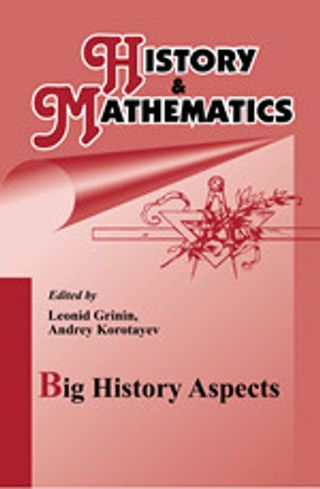
History & Mathematics: Big History Aspects

Volgograd : ‘Uchitel’ Publishing House, 2019.
Under the general editorship: Grinin L. E., Korotayev A.

Our Yearbook ‘History and Mathematics’ has already celebrated its 10th anniversary and has confidently entered its second decade. The common feature of all our Yearbooks, including the present volume, is the usage of formal methods and social studies methods in their synthesis to analyze different historical phenomena.

The present Yearbook (which is the seventh in the series) is subtitled ‘Big History Aspects’. This issue is devoted to the problems of evolutionary development of the world. In no way will it be a digression from the direction which we have initially defined for our Yearbook, but just an extension of the scope of the research. The matter is that there are two kinds of history: the history of nature (or more exactly the Universe and the Earth) and the history of humans and mankind. It is not surprising that the idea of historicism penetrated almost every scientific field. At the same time the search for common foundations of this endless in its diversity world has intensified. One of the directions of this interdisciplinary search for the unity of the world in its diversity is Universal Evolutionism (Big History). Mathematical and formal methods help to understand much deeply both natural and human history.

This issue of the Yearbook consists of four main sections: (I) Patterns of Big History; (II) Hypotheses of Deep Big History; (III) Biological Aspects; (IV) History and Future of Social Systems.

We hope that this issue will be interesting and useful both for historians and mathematicians, as well as for all those dealing with various social and natural sciences
Chapters
Introduction. From the History of Humankind to Big History
Grinin L. E., Korotayev A., , in: History & Mathematics: Big History Aspects.: Volgograd: ‘Uchitel’ Publishing House, 2019. P. 5–13.
Our Yearbook ‘History and Mathematics’ has already celebrated its 10th anniversary and has confidently entered its second decade. In this regard it will be quite reasonable to try to extend the scope of its research field. Therefore, this issue is designed in an unusual manner while still preserving the relevance for our approach (see about ...
Added: November 14, 2019
Technological Dimension of Big History and the Cybernetic Revolution
Grinin L. E., Гринин А., , in: History & Mathematics: Big History Aspects.: Volgograd: ‘Uchitel’ Publishing House, 2019. P. 250–277.
The present paper analyzes the evolution of technology from the beginning of the human history. We introduce a new paradigm to analyze the causes and trends of the global evolution. We also describe the direction of technological transformations, discuss and explain the present and forthcoming technological changes. Our analysis of technological evolution mainly focuses on the ...
Added: November 14, 2019
Priority areas: humanitarian
Language: English
Text on another site
Keywords: evolutioncomplexityBig Historycurrent trends of development
History & Mathematics: Big History Aspects
Similar publications
Vague stimulating ideas, images and metaphors in scientific thinking: researchers' work with horizons of unclear knowledge
Poddiakov A., / Series Social Science Research Network "Social Science Research Network". 2026. No. 7437658.
Clarity of knowledge and reasoning is necessary in many cases. Yet vagueness in scientific thinking related to surprise, curiosity, "ability to engage with not-knowing" (de Freitas) and abductive reasoning is also a crucially important source of scientific creativity which supplements combinatorial logic when dealing with the already known. Starting from studies by C. S. Peirce ...
Added: September 15, 2026
Reasoning from hypotheses in *-continuous action lattices
Kuznetsov S., Pshenitsyn T., Speranski S. O., Journal of Symbolic Logic 2025 Article jsl.2025.16
The class of all ∗-continuous Kleene algebras, whose description includes an infinitary condition on the iteration operator, plays an important role in computer science. The complexity of reasoning in such algebras — ranging from the equational theory to the Horn one, with restricted fragments of the latter in between — was analyzed by Kozen (2002). This ...
Added: August 12, 2026
О замыкающих ординалах инфинитарных вероятностных исчислений
Speranski S. O., Математические заметки 2026 Т. 120 № 3 С. 470–483
We show that, in terms of closure ordinals, many infinitary calculi for ‘first-order’ logics of probability (i.e., for languages similar to those in [Abadi & Halpern 1994]) are as hard as possible: the corresponding closure ordinals coincide with the least non-constructive ordinal, denoted by $\omega_1^{\mathrm{CK}}$. ...
Added: August 12, 2026
On the complexity of first-order logics of probability
Speranski S. O., Grefenshtein A., Izvestiya. Mathematics 2026 Vol. 90 No. 4 P. 754–775
The article is concerned with Halpern's first-order logics of probability, which we denote by L_1 and L_2 – the first of these deals with probability distributions on the domain, while the second employs distributions on external sets of possible worlds. The proofs of [Abadi & Halpern 1994] of the complexity lower bound results for L_1 and L_2 ...
Added: August 12, 2026
A Big History Perspective on Complexity in Universal Evolution: Conclusions
David J. L., Leonid Grinin, Korotayev A., , in: Complexity in Universal Evolution. A Big History Perspective.: Springer, 2026. Ch. 22 P. 585–608.
This collective monograph explores focus on complexity aspects in Big History against the background of complexity growth in the Universe, on our planet, and in biological, social, and cultural systems. Complexity growth is regarded as the connecting thread of evolutionary development and as a leading trend of Big History. The cosmic development chapters examine symmetries ...
Added: August 10, 2026
Human Evolution in the Complexity Growth Perspective: Toward Periodization of the Big History Biosocial Era
Korotayev A., , in: Complexity in Universal Evolution. A Big History Perspective.: Springer, 2026. Ch. 13 P. 359–409.
We have undertaken an attempt to propose a periodization of the Big History Biosocial (Anthropogenesis) Era on the basis of the most recent scientific data. This periodization is complexity-based, that is, the boundaries of the identified epochs are marked with complexity jumps, that is, in our case, such phase transitions that result in significant increases ...
Added: August 10, 2026
Biological and Social Phases of Big History and Complexity Growth
Leonid Grinin, Alexander M., Korotayev A., , in: Complexity in Universal Evolution. A Big History Perspective.: Springer, 2026. Ch. 12 P. 283–355.
In the first half of this chapter, Grinin et al. survey general similarities and differences between biological and social macroevolution. They undertake a systematic comparison between biological and social evolution at different levels of analysis and in various aspects, formulating a considerable number of general principles and rules of evolution, and working to develop a ...
Added: August 10, 2026
Introduction to Complexity Theory for Big History
David J. L., Grinin L. E., Korotayev A., , in: Complexity in Universal Evolution. A Big History Perspective.: Springer, 2026. Ch. 2 P. 29–90.
This chapter explores the role of complexity dynamics in Big History through an integrative theoretical framework that spans physical, chemical, biological, social, cognitive, and civilizational domains. Building on foundational work in systemstheory,thermodynamics,andevolutionarytheory,thechapterarguesthat complexity can serve as a conceptual bridge across disciplines. By examining how complexity emerges, is sustained, and transforms across thresholds, as well as ...
Added: August 10, 2026
The Evolution of Complexity in the Stelliferous Era: Observations and Patterns
Korotayev A., LePoire D., , in: Complexity in Universal Evolution. A Big History Perspective.: Springer, 2026. Ch. 5 P. 151–171.
A previous study compared the symmetries of the cooling after the Big Bang and thedevelopment oflife, humans,and civilization on Earth. Asimple model ofthe relative rates of change depicts two cones joined at their bases representing the Big Bang expansion and the acceleration of complexity development on Earth through life evolution, human evolution, and civilization development. ...
Added: August 10, 2026
Complexity in Universal Evolution: A Big History Perspective—An Introduction
David J. L., Leonid Grinin, Korotayev A., , in: Complexity in Universal Evolution. A Big History Perspective.: Springer, 2026. Ch. 1 P. 1–25.
Complexity is widely acknowledged as a foundational and pivotal concept in Big History, offering a unifying lens through which to examine the emergence and development of systems—from particles and galaxies to life, civilizations, and beyond. Yet, despite its centrality, major gaps remain in how we define, measure, and interpret complexity across different phases and scales. ...
Added: August 10, 2026
Complexity in Universal Evolution. A Big History Perspective
David J. L., Leonid Grinin, Korotayev A., Springer, 2026.
Complexity is widely acknowledged as a foundational and pivotal concept in Big History, offering a unifying lens through which to examine the emergence and development of systems—from particles and galaxies to life, civilizations, and beyond. Yet, despite its centrality, major gaps remain in how we define, measure, and interpret complexity across different phases and scales. ...
Added: August 7, 2026
Vietnam and the RCEP: a Digital Perspective
Evgeny A. Kanaev, Berezhnaya A., Southeast Asia: Actual Problems of Development 2026 Vol. 2 No. 2(71) P. 175–187
The article examines the significance and the place of the digital tools developed by the Regional Comprehensive Economic Partnership (RCEP) in the priorities of the Socialist Republic of Vietnam (SRV). On tracing the RCEP’s origins, evolution, and interim outcomes obtained to date, the article proceeds with assessing the efficiency of the RCEP’s digital tools to ...
Added: July 30, 2026
Does the pedicle exist in craniiform brachiopods?
Plandin F., Temereva E., Zoological Journal of the Linnean Society 2025 Vol. 205 No. 2 Article zlaf139
Although Brachiopoda represent a relatively small phylum, they exhibit significant morphological diversity. One of the central issues in understanding the evolution of the ancestral brachiopod body plan pertains to the homologies among body compartments across the different brachiopod subphyla: Craniiformea, Linguliformea, and Rhynchonelliformea. In this context, the pedicle stands out as one of the most ...
Added: June 15, 2026
Система синтаксических инвариантов текстовой деятельности: статистические дескрипторы, семантическая структура и диагностические профили
Kudriavtseva E., / РЦИС. Серия № 0148-756-286. 2026.
The content of the work is the system is a system for identifying four types of written speech structures. A set of 11 calculated parameters, statistical standards, and semantic characteristics allows for the identification of a text's structure as the result of a specific cognitive schema (scene, event, story, evaluation). The method has been verified ...
Added: June 2, 2026
Почему растущие доходы не делают людей счастливее: эмоциональное объяснение парадокса Истерлина (Why Growing Incomes Do Not Make People Happier: an Emotional Explanation of the Easterlin Paradox)
Vorchik A., / SSRN. Серия Social Science Research Network "Social Science Research Network". 2026.
This work is devoted to a theoretical explanation of the Easterlin paradox, according to which long-term economic growth does not make average level of people's happiness increasing. By happiness, we mean the intensity of emotions people experience while comparing their new income with its expected value, or the target income with its original value. In the first case, ...
Added: May 31, 2026
Эволюция управления цепями поставок: от бизнес-логистики до SCM 4.0
Dybskaya V., Sergeyev V., РИСК: Ресурсы, информация, снабжение, конкуренция 2025 № 2 С. 11–17
The origins and importance of supply chain management (SCM) in the modern economy are analyzed. It is shown that the USP is a continuation and development of the concept of integrated business logistics. The evolution of logistics from the 1960s to the 2000s is presented. The main functionality of the ADC for business organizations is ...
Added: April 28, 2026
Школьный литературный канон эмиграции 1918–1939 гг.
Strizhkova D., / Институт русской литературы (Пушкинский Дом) РАН. Серия B001 "Репозиторий открытых данных по русской литературе и фольклору". 2026.
В базе данных представлена роспись русскоязычных литературных произведений и отрывков, напечатанных в учебниках по словесности, хрестоматиях, книгах для чтения, сборниках стихотворений и рассказов, выходивших во Франции, Германии, Латвии, Эстонии, Болгарии, Сербии в период первой волны русской эмиграции с 1918 по 1939 гг. Датасет представляет интерес для исследователей школьного литературного канона, эмиграции и детского чтения ...
Added: April 22, 2026
Современная российская мультипликация как инструмент воспитания традиционных духовно-нравственных ценностей
Жигунов А. Ю., / Basic Research Programme. Серия HUM "Humanities". 2026. № 1.
The article attempts to describe the features of the educational potential of Russian animation programmes in aspect of the representation of traditional spiritual and moral values. Based on media and semiotic analysis, the method of cultural and historical interpretation, animated Russian projects created from 2000 to the 2025, which were translated on television channels or streaming ...
Added: April 19, 2026
Relative Chaoticity of Natural Languages
Yerbolova A. S., Tomashchuk K., Kogan A. et al., Complexity 2026 Vol. 2026 No. 1 Article 5519690
Tis paper presents a novel approach to analyzing and grouping natural languages based on the degree of their chaoticity. It clusters 52 languages from 18 language families, according to the value of the entropy–complexity pair, to reveal the chaotic properties of semantic trajectories. Te obtained clusters appear to be closely correlated with the family of ...
Added: February 16, 2026
Complexity for probability logic with quantifiers over propositions
Speranski S. O., Journal of Logic and Computation 2013 Vol. 23 No. 5 P. 1035–1055
In the present article, the quantifiers over propositions are first introduced into the language for reasoning about probability, then the complexity issues for validity problems dealing with the corresponding hierarchy of probabilistic sentences are investigated. We prove, among other things, the $\Pi^1_1$-completeness for the general validity and also indicate the least level in the hierarchy ...
Added: December 27, 2025
Some new results in monadic second-order arithmetic
Speranski S. O., Computability 2015 Vol. 4 No. 2 P. 159–174
Added: December 27, 2025
Notes on the computational aspects of Kripke’s theory of truth
Speranski S. O., Studia Logica 2017 Vol. 105 No. 2 P. 407–429
The paper contains a survey on the complexity of various truth hierarchies arising in Kripke’s theory. I present some new arguments, and use them to obtain a number of interesting generalisations of known results. These arguments are both relatively simple, involving only the basic machinery of constructive ordinals, and very general. ...
Added: December 26, 2025
Infinitary action logic with exponentiation
Kuznetsov S., Speranski S. O., Annals of Pure and Applied Logic 2022 Vol. 173 No. 2 Article 103057
We introduce infinitary action logic with exponentiation — that is, the multiplicative-additive Lambek calculus extended with Kleene star and with a family of subexponential modalities, which allow some of the structural rules (contraction, weakening, permutation). The logic is presented in the form of an infinitary sequent calculus. We prove cut elimination and, in the case ...
Added: December 26, 2025
Политическая аккомодация культурных различий в индустриально развитых обществах (Political Accommodation of Cultural Differences in Industrialized Societies)
Малахов В. С., Симон М. Е., Летняков Д. Э. et al., / SSRN. Серия Social Science Research Network "Social Science Research Network". 2020.
The  notion  of  “political  accommodation” applied  to the  theory  and  practice  of managing cultural diversity could enrich the Russian academic dictionary. Liberal democratic states invented specific mechanisms for political accommodation of cultural differences. Thanks to these mechanisms, the part of the population of a democratic state that is not ready to dissolve into the ethnocultural ...
Added: September 26, 2025
  • About
  • About
  • Key Figures & Facts
  • Sustainability at HSE University
  • Faculties & Departments
  • International Partnerships
  • Faculty & Staff
  • HSE Buildings
  • HSE University for Persons with Disabilities
  • Public Enquiries
  • Studies
  • Admissions
  • Programme Catalogue
  • Undergraduate
  • Graduate
  • Exchange Programmes
  • Summer University
  • Summer Schools
  • Semester in Moscow
  • Business Internship
  • Research
  • International Laboratories
  • Research Centres
  • Research Projects
  • Monitoring Studies
  • Conferences & Seminars
  • Academic Jobs
  • Yasin (April) International Academic Conference on Economic and Social Development
  • Media & Resources
  • Publications by staff
  • HSE Journals
  • Publishing House
  • iq.hse.ru: commentary by HSE experts
  • Library
  • Economic & Social Data Archive
  • Video
  • HSE Repository of Socio-Economic Information
  • HSE1993–2026
  • Contacts
  • Copyright
  • Privacy Policy
  • Site Map
Edit