• A
  • A
  • A
  • АБВ
  • АБВ
  • АБВ
  • A
  • A
  • A
  • A
  • A
Обычная версия сайта
  • RU
  • EN
  • HSE University
  • Publications
  • Book chapter
  • The Rise of New Institutions
  • RU
  • EN
Расширенный поиск
Высшая школа экономики
Национальный исследовательский университет
Priority areas
  • business informatics
  • economics
  • engineering science
  • humanitarian
  • IT and mathematics
  • law
  • management
  • mathematics
  • sociology
  • state and public administration
by year
  • 2027
  • 2026
  • 2025
  • 2024
  • 2023
  • 2022
  • 2021
  • 2020
  • 2019
  • 2018
  • 2017
  • 2016
  • 2015
  • 2014
  • 2013
  • 2012
  • 2011
  • 2010
  • 2009
  • 2008
  • 2007
  • 2006
  • 2005
  • 2004
  • 2003
  • 2002
  • 2001
  • 2000
  • 1999
  • 1998
  • 1997
  • 1996
  • 1995
  • 1994
  • 1993
  • 1992
  • 1991
  • 1990
  • 1989
  • 1988
  • 1987
  • 1986
  • 1985
  • 1984
  • 1983
  • 1982
  • 1981
  • 1980
  • 1979
  • 1978
  • 1977
  • 1976
  • 1975
  • 1974
  • 1973
  • 1972
  • 1971
  • 1970
  • 1969
  • 1968
  • 1967
  • 1966
  • 1965
  • 1964
  • 1963
  • 1958
  • More
Subject
News
July 24, 2026
‘I Like Self-Fulfilling Prophecies
Andrey Vorchik studies happiness, delivers popular science lectures, and believes that science should address social issues as well. In an interview for the Young Scientists of HSE University project, he spoke about how emotions influence decision-making, the Bermuda Triangle formed by the bathroom, refrigerator, and bed, and the ideal formula for education.
July 24, 2026
'Physics Is What the World Is Literally Built On'
Physicist Nina Dzhanayeva, recipient of a Vladimir Potanin Foundation scholarship, focuses her research on nanophotonics. In this interview for the HSE Young Scientists project, she discusses nanowells, scientific intuition, and how physics can help in making frangipane cream puffs.
July 20, 2026
Scientists Create Open Dataset for Studying Concentration
A team of Russian researchers, including scientists from HSE University–St Petersburg, has developed the first open multimodal dataset containing recordings of brain activity, heart function, and video observations to help researchers understand what happens in the human brain during deep concentration. In the future, the dataset could accelerate the development of neural interfaces, rehabilitation technologies, and AI systems. The article has been published in Scientific Data.


Have you spotted a typo?
Highlight it, click Ctrl+Enter and send us a message. Thank you for your help!

Publications
  • Books
  • Articles
  • Chapters of books
  • Working papers
  • Report a publication
  • Research at HSE

?

The Rise of New Institutions

Ch. 1. P. 3–19.
Larionova M. V.

The past decades have witnessed dramatic changes in the world. The bipolar world order has vanished, the unipolar period has passed and a new multipolar world order is emerging.
In this “unraveling” globalized world, geopolitical, economic, environmental, societal and technological challenges are tightly interconnected (Haass 2014). They “transcend borders and spheres of influence and require stakeholders to work together, yet these risks also threaten to undermine the trust and collaboration needed to adapt to the challenges of the new global context” (World Economic Forum 2015). The challenges and their perceptions have been driving shifts in international cooperation. One major trend is “the proliferation and diversification of actors, forums, and their arrangements to address global challenges,” leading to a presumed fragmentation of global governance (Egel 2015, 4–5). However, fragmentation is also often perceived positively as “contested multilateralism,” because institutional diversity can produce better outcomes than “stalled cooperation through existing venues” struggling to respond to persisting and emerging challenges (Egel 2015, 5).
With multipolarity rising as countries outside the old core become economically more powerful, and clusters of countries gravitate to form new poles, the demand for multilateralism becomes more pronounced (Wade 2011). Multilateralism can be defined simply as the practice of coordinating policies in groups of states through ad hoc arrangements or institutions (Keohane 1990). Different modes of multilateralism and participation in coordinating mechanisms exist: the entry of new states into apex governing forums, the increased voting power of emerging states in international organizations, and new agreements and institutions established to coordinate and contribute to regional or global governance.
In spite of an increasing number of international actors, including nonstate actors, both formal and informal organizations as well as governments remain key players. 

Language: English
Keywords: глобальное управлениеBRICSБРИКСglobal governance

In book

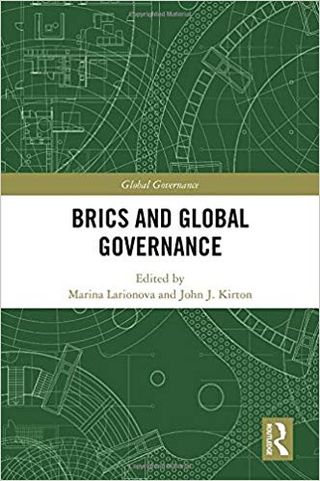
BRICS and Global Governance
Larionova M. V., Kirton J., Shelepov A. V., Freire M. R., Morozkina A., Khmelevskaya N., Panova V., Duggan N., Kahn M., Toloraya G., Niu H., Shubin V., Deych T. Routledge, 2018.
Similar publications
ЕС – БРИКС: политэкономические аспекты взаимодействия
Izotov V., В кн.: Европейский союз в мировой экономике: фактор БРИКС.: Федеральное государственное бюджетное учреждение науки Институт Европы Российской академии наук, 2026. С. 115–133.
Одна из важнейших линий мировой экономики – отношения БРИКС и ЕС. Это не просто двусторонняя страновая повестка для Брюсселя, но важнейшая линия сотрудничества и конкуренции одновременно, формирующая планетарную политэкономическую динамику на десятилетия вперёд. Теоретические исследования здесь очень важны. И это не дескриптивные работы или академические «дискуссии ради дискуссий». От правильной классификации отношений ЕС – БРИКС, ...
Added: July 30, 2026
Европейский союз в мировой экономике: фактор БРИКС
Федеральное государственное бюджетное учреждение науки Институт Европы Российской академии наук, 2026.
This edited volume examines the place of the European Union in the global economy during the first quarter of the twenty-first century against the backdrop of an emerging global economic order in which BRICS countries are playing an increasingly important role. Particular attention is paid to the evolution of the EU’s integration strategy – its ...
Added: July 30, 2026
Научно-технологический потенциал стран Африки и Ближнего Востока в рамках БРИКС: возможности и интересы России
Kharina O., Strelnikova I., Шаталин К. С., Ученые записки Института Африки РАН 2026 Т. 12 № 2 С. 94–109
В работе рассматривается научно-технологический потенциал стран Африки и Ближнего Востока, вошедших в состав БРИКС в результате расширения объединения в 2024 г., а также анализируются возможности и интересы России в сотрудничестве с новыми членами БРИКС в рамках формата БРИКС+. Особое внимание уделяется дифференциации уровней научно-технологического развития стран региона, включая государства Залива, страны Северо-Восточной Африки и Южной ...
Added: July 15, 2026
От фермы к фьючерсам: конкуренция, финансиализация и цифровизация в глобальных цепочках создания стоимости зерна. Экспертно-аналитический доклад
Ivanov A., Kotova D., Bovt S. et al., М.: Издательский дом НИУ ВШЭ, 2026.
This report presents the first comprehensive competition analysis of global grain value chains. It examines the market power of ABCD+ traders (ADM, Bunge, Cargill, Louis Dreyfus, et al.), financialization of grain trade, and the anticompetitive effects of digitalization. The report offers recommendations for BRICS competition authorities, including design principles for a BRICS Grain Exchange. ...
Added: June 22, 2026
Дискурсивная поляризация аналитических центров Бразилии, Китая, Индии и ЮАР относительно Группы двадцати и БРИКС
Voitov S., Анализ и прогноз. Журнал ИМЭМО РАН 2026 № 1 С. 70–82
The article explores the discursive differences among think tanks from Brazil, China, India, and South Africa regarding two key informal forums of global governance — BRICS and the Group of Twenty (G20). The decision to take think tanks from these countries is justified by their participation in both forums, which enables to assess how their ...
Added: June 22, 2026
Роль Арктического совета в региональной структуре международного сотрудничества в контексте кризиса «арктической исключительности»
Strelnikova I., Агафонов Д. И., Вестник международных организаций: образование, наука, новая экономика 2026 Т. 21 № 1 С. 67–91
Арктический регион, на протяжении более чем десяти лет занимая особое положение в дискурсе международно-политической науки, поэтапно приобретал различные и зачастую диаметрально противоположные образы на страницах как англо-, так и русскоязычных исследований. Длительное время своеобразным «барометром» состояния «исключительности» транснациональных отношений в регионе был Арктический совет – центральный межправительственный форум, призванный де-юре содействовать международному сотрудничеству и поддержанию ...
Added: June 14, 2026
Theorizing BRICS
Alexander Sergunin, , in: International Trade and Economic Development in BRICS.: Singapore: Springer, 2026. Ch. 1 P. 1–18.
This study examines how the main IR and IPE theories interpret the BRICS phenomenon. The goal is not only to evaluate the advantages and disadvantages of these theories, but also to identify their heuristic potential for studying such a complex phenomenon as the BRICS. ...
Added: June 8, 2026
International Trade and Economic Development in BRICS
Sergunin A. A., Singapore: Springer, 2026.
The central thesis of this work is that the long-term viability and coherence of BRICS will be determined not by the mere fact of its economic aggregation, but by its capacity to manage the profound tensions between its centripetal objectives and its centrifugal internal dynamics. ...
Added: June 8, 2026
Сектор НКО в России
Klimov I., В кн.: Некоммерческие организации в странах БРИКС: структура сектора и особенности развития.: BRICS Expert Council-Russia, 2026. Гл. 10 С. 193–228.
The text systematizes research, data, and analytics on the Russian nonprofit sector. The economic characteristics and their dynamics, the structure of sector financing, the specifics of interaction with the state, priority areas of activity, participation in the implementation of public policy and involvement in national projects and programs are given. It also describes the difficulties ...
Added: June 5, 2026
Некоммерческие организации в странах БРИКС: структура сектора и особенности развития
Gavrilov K., Zabolotsky A., Kartasheva A. et al., BRICS Expert Council-Russia, 2026.
This study was prepared on the initiative of the BRICS Civil Society Council with the aim of a systematic analysis of the sector of non-profit organizations (NPOs) in the countries of the association. As of February 2025, the BRICS includes ten states: Brazil, Egypt, India, Indonesia, Iran, China, UAE, Russia, Ethiopia, South Africa. Within the framework ...
Added: June 5, 2026
The non-profit sector in the BRICS countries: current structure and development trends. Executive Summary
Klimov I., Chepeleva M., Gavrilov K. et al., Civil BRICS Council, 2026.
This research study was conducted at the initiative of the Civil BRICS Council for the purpose of performing a systemic analysis of the non-profit sector (hereinafter, the ‘NPO sector’), encompassing both non-profit organizations (NPOs) and non-governmental organizations (NGOs), in each of the constituent member countries of BRICS. Since February 2025, BRICS has consisted of 10 member states: Brazil, China, ...
Added: June 5, 2026
The evolution of identity politics in Bangladesh: historical roots, contemporary challenges, and implications for civil society
Kundu S., Tomsk State University Journal of Philosophy, Sociology and Political Science 2026 No. 89 P. 198–205
This study investigates the evolution of identity politics in Bangladesh, tracing its origins from colonial legacies to contemporary challenges under the lens of neocolonialism theory. It examines how religious, ethnic, and linguistic identities have shaped political dynamics, fostering both mobilization and societal division. The research highlights historical roots, including British divide-and-rule policies and the 1947 ...
Added: May 27, 2026
Эволюция нарративов о международной системе во внешнеполитическом дискурсе Си Цзиньпина в 2013−2024 годах
Милькова А. А., Вестник Пермского университета. Серия: Политология 2026 Т. 20 № 1 С. 104–114
The article is devoted to strategic narratives about the international system in the foreign policy dis-course of the President of the People's Republic of China Xi Jinping. An analysis of their evolution revealed the growing influence of Chinese political thought in shaping the modern world order, which is a topic of great academic and practical ...
Added: May 6, 2026
Международные организации и внешняя политика государств Африки южнее Сахары: концептуализация ролей и взаимозависимостей
Panin N., Ученые записки Института Африки РАН 2025 Т. 11 № 4 (73) С. 45–64
The study of international organizations (IOs) has emerged as a sub-discipline in International Relations, with academic debate revolving around areas as different as decision-making, performance and service delivery, agency and reform, autonomy and bureaucracies, peacekeeping and access to leadership positions. Not as much focus has been placed on the complexity of roles that IOs could ...
Added: April 19, 2026
Африканский вектор БРИКС
Panin N., В кн.: Перспективы и задачи российско-африканского сотрудничества.: М.: Фонд развития и поддержки Международного дискуссионного клуба «Валдай», 2024. С. 19–22.
Африканская повестка стала неотъемлемой частью каждой декларации, принимаемой БРИКС по итогам саммитов. Несмотря на некоторые изменения в смысловых акцентах, фокус на Африку во многом уникален, поскольку такого внимания в документах объединения не получает ни один регион. ...
Added: April 19, 2026
Роль международных организаций во внешней политике Нигерии после перехода к гражданскому правлению (1999-2025)
Panin N., Сравнительная политика 2025 Т. 16 № 2 С. 185–215
В статье рассматривается сотрудничество с международными организациями как самостоятельный вектор внешней политики Нигерии с учетом основных задач, которые Абуджа стремится решить участием в ООН, Содружестве наций, Движении неприсоединения, ОПЕК, ФАО, а также ОИС на современном этапе (с 1999 г.). Кроме того, анализируется изменение позиции Нигерии в отношении ключевых неформальных институтов (БРИКС и G20) после прихода ...
Added: April 19, 2026
  • About
  • About
  • Key Figures & Facts
  • Sustainability at HSE University
  • Faculties & Departments
  • International Partnerships
  • Faculty & Staff
  • HSE Buildings
  • HSE University for Persons with Disabilities
  • Public Enquiries
  • Studies
  • Admissions
  • Programme Catalogue
  • Undergraduate
  • Graduate
  • Exchange Programmes
  • Summer University
  • Summer Schools
  • Semester in Moscow
  • Business Internship
  • Research
  • International Laboratories
  • Research Centres
  • Research Projects
  • Monitoring Studies
  • Conferences & Seminars
  • Academic Jobs
  • Yasin (April) International Academic Conference on Economic and Social Development
  • Media & Resources
  • Publications by staff
  • HSE Journals
  • Publishing House
  • iq.hse.ru: commentary by HSE experts
  • Library
  • Economic & Social Data Archive
  • Video
  • HSE Repository of Socio-Economic Information
  • HSE1993–2026
  • Contacts
  • Copyright
  • Privacy Policy
  • Site Map
Edit