• A
  • A
  • A
  • АБВ
  • АБВ
  • АБВ
  • A
  • A
  • A
  • A
  • A
Обычная версия сайта
  • RU
  • EN
  • HSE University
  • Publications
  • Book chapter
  • From quantitative to semantic analysis: Russian constructions with dative subjects in diachrony
  • RU
  • EN
Расширенный поиск
Высшая школа экономики
Национальный исследовательский университет
Priority areas
  • business informatics
  • economics
  • engineering science
  • humanitarian
  • IT and mathematics
  • law
  • management
  • mathematics
  • sociology
  • state and public administration
by year
  • 2028
  • 2027
  • 2026
  • 2025
  • 2024
  • 2023
  • 2022
  • 2021
  • 2020
  • 2019
  • 2018
  • 2017
  • 2016
  • 2015
  • 2014
  • 2013
  • 2012
  • 2011
  • 2010
  • 2009
  • 2008
  • 2007
  • 2006
  • 2005
  • 2004
  • 2003
  • 2002
  • 2001
  • 2000
  • 1999
  • 1998
  • 1997
  • 1996
  • 1995
  • 1994
  • 1993
  • 1992
  • 1991
  • 1990
  • 1989
  • 1988
  • 1987
  • 1986
  • 1985
  • 1984
  • 1983
  • 1982
  • 1981
  • 1980
  • 1979
  • 1978
  • 1977
  • 1976
  • 1975
  • 1974
  • 1973
  • 1972
  • 1971
  • 1970
  • 1969
  • 1968
  • 1967
  • 1966
  • 1965
  • 1964
  • 1963
  • 1958
  • More
Subject
News
September 11, 2026
How to Assess Students Knowledge in the Age of AI
A researcher at HSE University has proposed a flowchart to help lecturers decide how to assess students who use artificial intelligence. It shows where the use of AI should be restricted and where it can be incorporated into the learning process. The article has been published in IT Professional.
September 9, 2026
‘Balkan Hospitality Opens Doors: Studying Dialects on the Verge of Extinction
You cannot study spoken dialects from books. Instead, you need to go to a village, seek out its elders, and earn the trust of local residents before you can record hours of spontaneous stories. This is how Natalia Muravleva, Associate Professor at the Faculty of Humanities, conducts her research. Her internship in Serbia continued her long-standing study of dialects spoken by Macedonian settlers. In this interview, she discusses how diaspora cultural centres help researchers reach informants, why native speakers need to be interviewed only in their own language (otherwise, as she puts it, they may 'break'), and how a single field season helped her finalise her monograph. She also shares warm memories of autumn in Belgrade and of colleagues with whom grammar can be discussed in three languages at once.
September 9, 2026
Scientists Train Neural Network to Generate Process Plans from 3D Models
Researchers at the HSE FCS AI and Digital Science Institute have developed CAD2TechSpec, a framework that converts 3D models of mechanical parts into machining process plans—step-by-step instructions for machine tools. The solution aims to reduce the time required for the design and preparation of technical process documentation in mechanical engineering, aircraft manufacturing, and other high-tech industries. The study findings have been published in PeerJ Computer Science.


Have you spotted a typo?
Highlight it, click Ctrl+Enter and send us a message. Thank you for your help!

Publications
  • Books
  • Articles
  • Chapters of books
  • Working papers
  • Report a publication
  • Research at HSE

?

From quantitative to semantic analysis: Russian constructions with dative subjects in diachrony

Ch. 8. P. 158–174.
Anastasia Bonch-Osmolovskaya

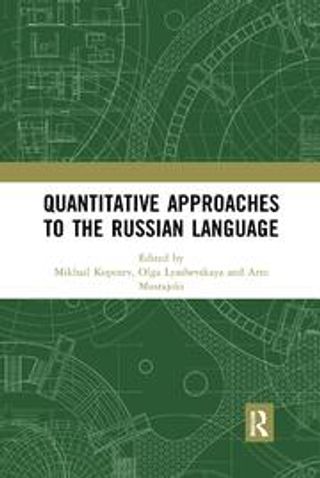
The chapter demonstrates how quantitative corpus methods used in linguistics research may help to rank different realizations of the same phenomena: the use of dative subjects in predicative and adjective constructions. The core idea of the research is to study the distribution of dative subject constructions with predicative and adjective forms that potentially can be used in such constructions, i.e., the tendency of the construction to be used in explication or omitting the dative subject. While usually the predicates are classified on the basis of whether they can potentially be used with a dative subject, the author studied the trends for explicit use of the dative (or prepositional beneficiary arguments) among the “dative subject predicates.” The chapter shows that the frequency rates of the real use of dative subjects can be very different with different predicates. Finally, data from the eighteenth and twenty-first centuries are compared and hierarchical clustering used to reveal diachronic trends.
Language: English
Full text
DOI
Keywords: corpus analysisdiachronic approach hierarchical clusteringdative subject

In book

Quantitative approaches to the Russian language
Abingdon: Routledge, 2018.
Similar publications
СЕМАНТИКО-ПРАГМАТИЧЕСКИЕ ОСОБЕННОСТИ КОГНИТИВНЫХ ТЕРМИНОВ В МЕДИА: КОРПУСНЫЙ АНАЛИЗ ОЦЕНОЧНОСТИ
Куликова В. А., Гусев А. Д., Токунова П. В., Коммуникативные исследования 2026 Т. 13 № 2 С. 355–369
The article examines the semantic and pragmatic features of cognitive terms functioning in modern Russian-language media texts. The study aims to describe the specifics of using cognitive terminology in contexts aimed at expressing evaluation. The relevance of the work is driven by the active processes of mediatization and determinologization, as a result of which scientific ...
Added: September 14, 2026
Анализ согласованности голосования стран ЕАЭС и ОДКБ в ГА ООН с помощью иерархической кластеризации
Вохминцев И. В., Вестник международных организаций: образование, наука, новая экономика 2026 Т. 21 № 2
The EAEU and the CSTO are Russia’s principal regional international organisations. Understanding, assessing, and analysing the foreign-policy positions of the countries that belong to them is a matter of the state’s national interests. This determines the purpose of the study: to identify the level and the form of cohesion in the voting of EAEU and ...
Added: September 7, 2026
A high-dimensional lexical structure of personality: a hierarchical cluster analysis in the Russian context
Shchebetenko S., Vitko Y., Kalugin A. et al., Current Psychology 2026 Vol. 45 Article 688
This study examines the high-dimensional lexical structure of personality within the Russian language, extending beyond traditional frameworks such as the Big Five and HEXACO. Using hierarchical cluster analysis on self-reported data from 773 Russian-speaking participants, we extracted 57 distinct personality clusters derived from 1,253 lexical descrip tors. These clusters were classified within one of three subtypes: as nested ...
Added: March 14, 2026
A genre-based model of rhetorical structure in scoping review introductions
Elena V. Tikhonova, Kosycheva M. A., Training, Language and Culture 2025 Vol. 9 No. 4 P. 35–55
As genre modelling advances, describing research articles rhetorical structures becomes crucial. Though secondary to empirical studies, scoping reviews shape scholarly communication by framing analysis and setting epistemological benchmarks. Their introductions act as conceptual lenses, defining interpretive frameworks. However, most rhetorical models, designed for empirical articles, appear to be inadequate for scoping reviews. We propose a ...
Added: February 9, 2026
BUNCH: A Hierarchical Filtering Algorithm for Identifying Persistent Entities in Interactive Particle Systems
Martinez-Saito M., Algorithms 2025 Vol. 18 No. 12 Article 741
Detecting trajectories of hierarchical structures in a dynamical system of multiple interacting particles is an open problem that is typically addressed by imposing strong constraints on the structures to be found. Here, we describe BUNCH, a dynamical filtering algorithm that can efficiently and on-the-fly fit dynamical trajectories of multiple particles to a tree structure of ...
Added: December 1, 2025
Репрезентация фрейма ГОРОД в текстах почтовой переписки: корпусное исследование
Куликова В. А., Человек: образ и сущность. Гуманитарные аспекты 2026 № 1 С. 64–81
The verbal representation of a city is studied using the material of 993 contexts containing a description of a city in postcards of the pre-revolutionary, Soviet and post-Soviet periods. The object of the analysis is the frame-structure CITY, whilst the subject of the analysis is the features of its verbalization in the corpus of postal ...
Added: November 2, 2025
Teaching Russian Through STEM: Contexts, Tools, and Approaches
L.: Routledge, 2024.
Routledge Russian Language Pedagogy and Research features edited volumes and monographs on the advances in the research and pedagogy of teaching the Russian language. Written by experts from across the world, the series brings together diverse schools of thought and serves as an inclusive discussion forum showcasing state-of-the-art advances in teaching and researching Russian. ...
Added: November 8, 2024
Academic English melting pot: Reconsidering the use of lexical bundles in academic writing
Gritsenko E.S, Kamou O.M., Russian Journal of Linguistics 2024 Vol. 28 No. 3 P. 615–632
Many studies addressing the differences in the use of lexical bundles in academic English by L1 and L2 writers interpret these differences as a deficiency or deviation that L2 writers need to eliminate. In this paper, we argue that this “deviant” use is not essentially the product of insufficient knowledge of English and/or Anglophone norms ...
Added: October 31, 2024
Hedges in Written Academic Discourse: A Corpus Analysis of L2 Students’ Project Proposals
Nuriiat Omarovna Omarova, , in: The Youth in Science: Challenges and Prospects.: [б.и.], 2024. P. 64–72.
Hedges, expressions of doubt used in writing to tone down claims, are crucial in academic discourse, as they weaken assertions and make texts less categorical. Even though hedging in academic writing has attracted scholars’ attention, the number of works focusing on disciplinary variation in the use of hedges in L2 learners’ texts remains relatively scarce. ...
Added: October 30, 2024
Оценочная лексика в почтовой коммуникации: динамический аспект
Куликова В. А., В кн.: Динамика коммуникативных практик в почтовой переписке (на материале корпуса «Пишу тебе»).: М.: Издательство РОИФН, 2024. Гл. 3 С. 92–130.
В главе 3 «Оценочная лексика в почтовой коммуникации: динамический аспект» (В.А. Куликова) изучается динамика на примере отдельной лексической подсистемы – качественных прилагательных  с оценочной семантикой. Изучено функционирование оценочных прилагательных и их дериватов в текстах дореволюционных, советских, постсоветских открыток: вхождение оценочных лексем в списки ключевых слов и уникальных слов, изменения в частотности и функционировании оценочных лексем. ...
Added: October 28, 2024
Словами героев русского рассказа: речевая картина XX века
Kirina M., Лукьянчикова А. С., В кн.: Русская и зарубежная филология в диалоге культур : материалы Всероссийской научно-практической конференции с международным участием (г. Ростов-на-Дону, 19–21 октября 2023 г.).: Издательство Южного федерального университета, 2024. С. 16–20.
Added: December 10, 2023
Data-driven unsupervised EEG clustering on tantric meditation data
Mikhaylets E., Razorenova A., Chernyshev V. L. et al., International Journal of Psychophysiology 2023 Vol. 188 P. 78–78
We present an unsupervised method that detects change-points in EEG time-series. The method was designed to reveal functional traces of consequent meditation stages within lasting tantric meditation recorded in Tibetan Buddhist monks. We propose a robust statistical approach for brain functional states detection tested on real and synthetic data. ...
Added: November 22, 2023
Изражавања ауторског става у уводницима и онлајн коментарима на руском језику
Trnavac R., Зборник Матице српске за филологију и лингвистику 2020 Vol. 63 No. 2 P. 139–153
AUTHORIAL STANCE EXPRESSED WITH GRAMMATICAL STRUCTURES IN EDITORIALS AND ONLINE COMMENTS IN RUSSIAN S u m m a r y This paper describes major patterns of register variation between editorials and online news comments based on the use of a wide range of lexico-grammatical structures that express stance in Russian. While applying the methodology of ...
Added: December 28, 2022
Clausal complexity of expert and student writing: a corpus-based analysis of papers in social sciences
Smirnova E. A., Language Learning in Higher Education 2022 Vol. 12 No. 2 P. 453–475
Syntactic complexity has been extensively approached in the fields of corpus linguistics and academic discourse studies. However, works focusing on disciplinary variation in terms of linguistic complexity and comparison of professional and novice academic writing are scarce. Addressing these issues is likely to have important implications for EAP/ESP practitioners in terms of selection of target ...
Added: December 7, 2022
Disciplinary Variation in Syntactic Complexity: A Corpus Analysis of Professional Academic Writing
Perez-Guerra J., Smirnova E. A., , in: CEUR Workshop Proceedings. Proceedings of the International Conference "Internet and Modern Society" (IMS-2021), St. Petersburg, 24 - 26 June 2021.: CEUR Workshop Proceedings, 2021. P. 291–296.
This study deals with the analysis of syntactic complexity in professional academic writing and is based on a corpus of so-called ‘hard’ and ‘soft’ papers published in leading international journals. We aim at describing the main complexity features of academic discourse and testing the hypothesis that there is considerable disciplinary variation in linguistic complexity. We ...
Added: March 14, 2022
  • About
  • About
  • Key Figures & Facts
  • Sustainability at HSE University
  • Faculties & Departments
  • International Partnerships
  • Faculty & Staff
  • HSE Buildings
  • HSE University for Persons with Disabilities
  • Public Enquiries
  • Studies
  • Admissions
  • Programme Catalogue
  • Undergraduate
  • Graduate
  • Exchange Programmes
  • Summer University
  • Summer Schools
  • Semester in Moscow
  • Business Internship
  • Research
  • International Laboratories
  • Research Centres
  • Research Projects
  • Monitoring Studies
  • Conferences & Seminars
  • Academic Jobs
  • Yasin (April) International Academic Conference on Economic and Social Development
  • Media & Resources
  • Publications by staff
  • HSE Journals
  • Publishing House
  • iq.hse.ru: commentary by HSE experts
  • Library
  • Economic & Social Data Archive
  • Video
  • HSE Repository of Socio-Economic Information
  • HSE1993–2026
  • Contacts
  • Copyright
  • Privacy Policy
  • Site Map
Edit