?
La diversificación lingüística de español en México.
P. 155–165.
Karpina E. V.
Article analyzes a variety of forms of Spanish in the territory of Mexico from the linguistic and culturological point of view. The status and distinctive features of Spanish on the peninsula Yucatan is separately underlined.
In book
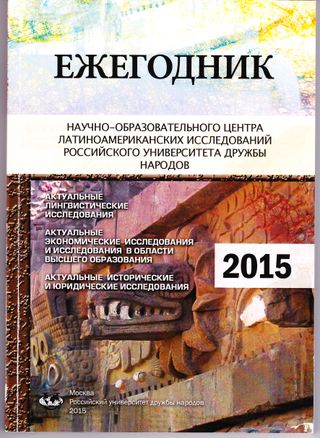
М.: Российский университет дружбы народов, 2015.
Демирчян Л. С., Urait, 2026.
This special course is aimed at introducing and developing the basic vocabulary of the Spanish language necessary for conducting conversations on tourism topics.Each lesson contains texts on tourism and the hotel industry, along with exercises to reinforce vocabulary, translation skills, and conversational practice. This publication is designed for university students studying in the hotel and ...
Added: February 3, 2026
Демирчян Л. С., Мерзликина О. В., KnoRus, 2023.
Представлен начальный этап курса изучения испанского языка на уровне А1А2 и для индустрии гостеприимства и туризма. Состоит из 12 тематических уроков и включает в себя базовую грамматику и лексику, а также лексику профессионального общения.
Грамматическая часть включает в себя правила с объяснениями и примерами и серию разнообразных упражнений. Большинство текстов являются адаптированными оригинальными текстами, подобранными из ...
Added: January 29, 2026
Yakovleva A., Kosheliuk N., Moroz G., International Journal of Bilingualism 2025 P. 1–19
Aims and Research Questions: In this paper, we present a corpus-based study of preposition drop (p-drop) in the speech of Mari-Russian and Beserman-Russian bilinguals compared to the speech of Russian monolinguals. Based on data from spoken corpora, we demonstrate that the prepositions v ‘in’, k ‘to’, s ‘with’ are omitted in the speech of bilinguals ...
Added: November 26, 2025
Savelyev A., Вопросы языкового родства 2025 № 23/1-2 С. 137–167
This article represents the first part of a two-part study devoted to the analysis of Turkic loanwords of the Bulghar-Chuvash type in the Permic languages. In this part, general criteria are proposed for distinguishing Bulgharic borrowings within the corpus of Udmurt and Komi words of Turkic origin. In addition, a “core” layer of Bulghar-Chuvash loanwords ...
Added: October 28, 2025
Kolchugina N., Домбровская Т. Е., Иностранные языки в школе 2022 № 6 С. 80–87
The article discusses the challenges of teaching writing in a language class and suggests possible ways to solve them using the example of a Spanish lesson. The writing skills necessary for the e ective learning of a foreign language can be improved with the help of a specially developed method, presented in the form of ...
Added: September 14, 2025
Shvedova E., Koryakov Y., Elizaveta Zabelina, Journal of Language Relationship 2025 Vol. 23 No. 3–4 P. 207–275
This study documents and analyzes lexical data from four Christian North-Eastern Neo-Aramaic varieties: Mahmudi, Nudiz, Verin Dvin Urmi, and Urmia Urmi, focusing on the previously undescribed Mahmudi and Nudiz. We provide correspondences from these lects for an extended 226-item basic vocabulary list collected for this study with etymologies, cognates from earlier Aramaic, and loanword sources. ...
Added: September 4, 2025
Grishanova A., Russian linguistics 2025 Vol. 49 Article 10
The purpose of this study is to present a summary of morphosyntactic variation and a detailed analysis of the phenomenon of preposition drop in the Russian speech of Chuvash bilinguals. Specifically, I investigate what underlying factors might condition the variation. I conduct a qualitative analysis of the data extracted from the corpus of Russian spoken ...
Added: July 10, 2025
Khachaturyan M., Moroz G., Mamy P., Journal of Sociolinguistics 2025 Vol. 29 No. 4 P. 268–284
This paper contributes to research on the awareness of grammatical variability through a study of variation in reflexivity marking in Mano under the influence of Kpelle, both indigenous languages of Guinea. The speakers of these languages are found to be sensitive to contact-induced grammatical variation in reflexivity, which manifests via variation in comprehension patterns and, ...
Added: June 3, 2025
Naccarato C., Moroz G., International Journal of Bilingualism 2026 Vol. 30 No. 2 P. 358–379
Aims and Research Questions: The paper investigates variation in numeral constructions in the L2 Russian speech of bilinguals from different regions of Russia. The main research questions are the following: What factors prompt variation in this domain of grammar? Can we argue that non-standard marking is motivated by contact?
Methodology: We conduct a corpus-based study ...
Added: January 24, 2025
Khachaturyan M., Moroz G., Vydrin V. et al., Studies in Language 2025 Vol. 49 No. 4 P. 823–857
In this paper, we address valency patterns in seven Mande languages with various degrees of genealogical proximity. Our study is based on the BivalTyp questionnaire focusing on 130 two-place predicates (Say 2020). While belonging to two distinct genetic groupings, two languages of the set, i.e. Mano (Southern Mande) and Kpelle (Southwestern Mande), are in intense ...
Added: August 27, 2024
Bocharov Y., Блок-Принт, 2024.
A textbook on the subjunctive mood in Spanish. It is intended for students of higher educational institutions who continue to master the subjunctive. The textbook consists of five topics and an appendix in the form of original texts by famous Spanish writers. Convenient navigation is provided by the color scheme - each theme has its ...
Added: August 21, 2024
Khachaturyan M., Moroz G., Mamy P., Linguistics 2024 Vol. 62 No. 5 P. 1225–1250
This paper explores variation in the patterns of reflexivity marking in the Mano language and possible influence from the Kpelle language by using an experimental design with a picture questionnaire. While Kpelle does not have a morphological distinction between reflexive and basic pronouns, the Mano variety spoken by Mano-dominant individuals does possess such a distinction ...
Added: April 30, 2024
Karpina E. V., Керо Хервилья Э. Ф., Selivanova I., Flinta, 2024.
This textbook on regional studies of Spain is intended not only to develop linguistic competence, but also to expand the professional horizons of students studying Spanish of linguistic and non-linguistic universities (level B1-B2). The main objectives are to introduce students to the sociocultural realities of Spain, to teach them to work with both adapted and non-adapted ...
Added: February 2, 2024
Häberl C. G., Kashintseva K., Loesov S., , in: Language Diversity in Iran: New Texts and Perspectives from Non-Iranian Languages.: De Gruyter, 2024. Ch. 8 P. 285–358.
This survey offers a brief grammatical description of the Turoyo language spoken in the southeast of Turkey. Ṭuroyo is a largely unwritten Eastern Neo-Aramaic language, which derives its name from the Tur Abdin region. The Tur Abdin region, the ancient home of Ṭuroyo and the last remaining stronghold of Aramaic in the Republic of Türkiye, ...
Added: November 5, 2023
De Gruyter, 2024.
The current companion will offer a survey of the Afroasiatic, Dravidian, Indo-Aryan, and Turkic languages in contact with Iranian languages. Comparatively few of Iran's minority languages are well-documented or even widely known outside of a small cadre of specialists. A volume that organizes sketches of the non-Iranian languages of Iran offers a unique perspective on ...
Added: November 5, 2023
Ter-Avanesova A., Daniel M., Linguistic Variation 2023 No. 1 P. 28–74
In this paper, we provide a survey of the diachronic development of the Russian second genitive (Gen2). As endpoints of this development, we consider data from Russian dialects representing different dialect groups. Assumedly, the expansion of Gen2 started off as ‘recycling’ of the genitive of a declension type that became obsolete already in the pre-written ...
Added: September 8, 2023
Zakirova A., Родной язык: лингвистический журнал 2022 № 1 С. 5–49
This paper provides a survey of number agreement in the East Caucasian languages and languages of other language families in contact with East Caucasian. For a sample of 59 idioms I considered number agreement strategies of adjectives in the attributive position and established what factors license agreement in these idioms. Besides, I assessed the weight ...
Added: August 29, 2023
Maisak T., Journal of Endangered Languages 2023 Vol. 13 No. 22 P. 55–72
The paper presents an overview of Udi, a Nakh-Daghestanian language of the Lezgic branch and an indigenous language of Azerbaijan. After a general introduction about the Udi people and their language, I focus on the history of the study of Udi and Caucasian Albanian, on the development of modern writing systems for Udi, as well ...
Added: August 20, 2023