?
Конституционные ориентиры экономической политики
Гл. 10. С. 448–466.
This Chapter examines the constitutional basis of the economic system of Russia, the main stages of its development are highlighted and are characterized by the constitutional-legal institutions of economic regulation; analyzed the ratio of the constitutional and economic institutions
In book
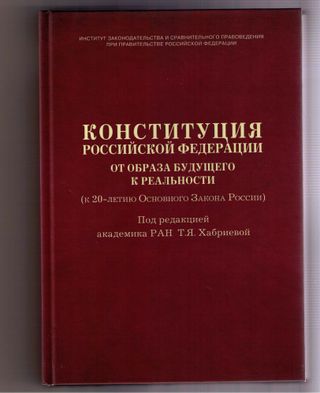
М.: Юриспруденция, 2013.
Avdeeva D., Veselov D. A., Вопросы экономики 2025 № 8 С. 102–120
Economic theory and empirical research link economic growth with education, a key component of human capital. Yet high levels of education do not guarantee economic growth if a weak institutional environment hinders the productive use of knowledge and skills. By studying the nexus between institutions and education in different countries, we conclude that weak institutions ...
Added: August 15, 2025
Natkhov T., Alexeev M., Polishchuk L., Journal of Comparative Economics 2024 Vol. 52 No. 1 P. 271–296
Strong institutions attract talent to productive activities, whereas weak ones raise the appeal of rent seeking. We propose a theory that describes the impact of institutions on occupational choices over a range of abilities, and predicts that the sensitivity of such choices to the quality of institutions rises in talent when the latter increases from ...
Added: January 12, 2024
Popov E. V., Sandler D. G., Popova N. G. et al., , in: Proceedings of the 18th European Conference on Knowledge Management ECKM 2017.: Academic Conferences and Publishing International Limited, 2017. P. 808–818.
The institution of the university comprises one of the most important actors within national, regional or metropolitan economic systems. Typically, metropolitan universities are seen in terms of components of the respective national economic system. However, the object of our research is the institution of the regional university, which is defined in terms of a regional ...
Added: November 1, 2019
Соболева Е. А., Правоведение 2013 № 1 С. 246–264
В обзоре представленны тезисы доклада Л.Б.Ескиной, посвященного становлению института конституционно- правовой ответственности. В них, в частности, отмечено, что с теоретической точки зрения ожно говорить о появлении нового отраслевого видаюридической ответственности и нового правового института в рамках отрасли конституционного права. ...
Added: October 20, 2017
Scherbak A. N., Общественные науки и современность 2017 Т. 5 С. 147–162
The paper aims to criticize one of the key argument of neoinstitutional theory – the “accidental” nature of institutional choice. The most consistently this idea is represented in Acemoglu and Robinson’s seminal book “Why nations fail”. According to their approach, the initial institutional choice is influenced by accidental, random historical circumstances. I disagree with this ...
Added: October 10, 2017
Zukhba E. N., Экономика Крыма 2012 No. 4(41) P. 147–150
There is analyzed impact of the Institute of Ethics on household’s economic decisions. It is shown economic decisions of households have changed with the evolution of ethical views, which in turn were determined development of external socio-economic conditions of the economy. ...
Added: March 16, 2015
Rochliz M., Political Studies Review 2015 Vol. 13 No. 1 P. 59–68
In 2013, Russia's economy entered a phase of stagnation, with a rate of gross domestic product (GDP) growth much lower than that of other emerging economies. This article argues that economic stagnation is linked to the dysfunctional system of informal institutions that permeates every level of political decision making in the country. By discussing four ...
Added: November 10, 2014
Dzmitryieva A., Chetverikova I., Titaev K. D., Вопросы экономики 2014 № 6 С. 40–62
This article seeks to answer the question whether Russian Arbitrazh
(Commercial) courts tend to decide cases in favor of defendant versus plaintiff
or state versus business. It was found that courts favors business entities in civil
cases, while in administrative cases courts take decisions in favor of governmental
bodies other things being equal. In addition, the plaintiff bias persists ...
Added: June 26, 2014
Ananyin O. I., Федерализм 2013 № 1 С. 75–100
The paper summarizes economists' attempts to deal with ontological knowledge, and its crucial role in economic methodology is discussed. As an example ontological nature and assumptions of integration of institutions into economic theory are analyzed. ...
Added: November 19, 2013
Nureev R., Латов Ю. В., Общественные науки и современность 2006 № 2 С. 118–129
В статье исследуется, каким образом в институциональной сфере проявляются такие феномены, как QWERTY-эффекты и path dependence (зависимость от предшествующего развития). Рассматриваются парадоксы конкуренции институтов как в экономической истории, так и в современности. Связанное с зависимостью от предшествующего развития направление – «новая экономическая история» анализируется как альтернатива неоклассическому направлению экономической мысли; сопоставляются path dependence и теория ...
Added: April 3, 2013
Kapeliushnikov R., Kuznetsov A., Demina N. et al., Journal of Comparative Economics 2013 Vol. 41 No. 1 P. 245–264
Effective property rights protection plays a fundamental role in promoting economic performance. Yet measurement problems make the relationship between property rights and entrepreneurship an ambiguous issue. As an advancement on previous research in this paper we propose a new approach to the evaluation of the security of property rights based on direct measures that overcomes ...
Added: February 12, 2013
М.: Институт экономики Российской академии наук, 2011.
Хотя современная экономическая наука состоит из различных школ и направлений, её терминологический аппарат в значительной своей части остаётся единым. Означает ли это общность также и понятийных структур конкурирующих экономических теорий? Тематический сборник «Тенденции эволюции экономической теории. Онтологический аспект» содержит результаты первого этапа исследовательского проекта сектора философии и методологии экономической науки ИЭ РАН по исследованию базовых ...
Added: February 2, 2013
Mazaev V. D., В кн.: Вопросы современного права.: М.: Институт бизнеса и политики, 2012. С. 103–110.
В работе рассматривается вопросы развития междисциплинарных приемов анализа конституционно-правового регулирования в сфере экономических отношений. Дается представление об общих моделях взаимоотношения правовых и экономических институтов, проводится анализ взаимовлияния конституционно-правовых и экономических явлений, проводится оценка перспективным направлениям междисциплинарного анализа взаимодействия конституционно-правовых и экономических институтов. ...
Added: January 29, 2013
Entov R., Радыгин А. Д., Вопросы экономики 2008 № 8 С. 4–27
Added: January 27, 2013
М.: Издательский дом НИУ ВШЭ, 2011.
Сборник составлен по итогам XI Международной научной конференции по проблемам развития экономики и общества, организованной Государственным университетом — Высшей школой экономики при участии Всемирного банка и Международного валютного фонда и проходившей 6–8 апреля 2010 г. в Москве. Рассматриваются проблемы экономики здравоохранения, социологии и образования, экономических институтов, корпоративной социальной ответственности и социальной политики, вопросы мировой экономики ...
Added: January 16, 2013
Rozmainsky I. V., Журнал институциональных исследований 2012 Т. 4 № 3 С. 43–48
The author presents a review of the book «The Economic Institutions of the Old Believers». The study is at the crossroads of economic history, economic sociology, economic theory (in the first place, the new institutionalism) and maybe even religious studies. The author tries to understand the mysterious phenomenon of Old Believe entrepreneurship, played a very ...
Added: December 13, 2012
Polishchuk L., , in: The Oxford Handbook of the Russian Economy.: Oxford: Oxford University Press, 2013. P. 189–220.
The chapter discusses evolution and performance of Russia’s economic institutions. Outcomes and driving forces of institutional change in the country throughout its postcommunist history are analyzed and related to exogenous factors such as culture, resource abundance, and economic inequality. A failure to establish market-supporting institutions, including secure property rights, as a spontaneous outcome of economic ...
Added: October 23, 2012