?
Tsar and Pretender: Samozvanchestvo or Royal Imposture in Russia as a Cultural-Historical Phenomenon
P. 113–152.
The psychology of royal imposture in Russia is directly connected with the question of the attitude to the Tsar, i. e. the special way in which royal power was understood. Pretenders made their appearance in Russia only after there were Tsars, and this is connected with the sacralization of the Tsar. The notion that the royal power was established by God accounts for the distinction (actual in Russia) between "righteous" and "unrighteous" Tsars. Hence the most striking pretenders crop up precisely at those moments when the natural order of succession has been broken and when the actual occupier of the throne could in fact be regarded as a pretender.
In book
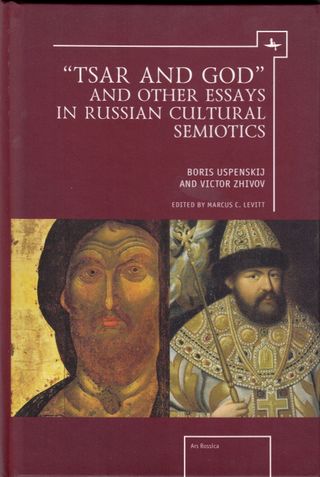
Uspensky B. A., Zhivov V. M. Boston: Academic Studies Press, 2012.
Лавренова О. А., Springer, 2019.
The introduction raises the problem of relationships between culture and
space, here we prove the usage of semiotic concept of the culture as a basic concept
of the research. That part of semiosphere, were the characters are the geographical
locations and their respective names as well as names of water objects, is denoted as
the goal of the study. ...
Added: June 21, 2025
Zhukova O., Вопросы философии 2023 № 12 С. 203–211
This article is an analysis of Yu.M. Lotman’s legacy and academic Lotman studies in the current scientific humanitarian discourse following the results of the jubilee year. The 100th anniversary of the birth of the outstanding scientist was widely celebrated in the international scientific community in 2022. The final event was the large-scale international conference “Thinking ...
Added: December 10, 2023
М.: КнигИздат, 2022.
В сборнике помещены материалы научной международной конференции, посвященной анализу наследия Ю.В. Рождественского, заслуженного профессора МГУ, академика Академии педагогических наук СССР и академика Российской академии образования, заведующего кафедрой общего и сравнительно-исторического языкознания филологического факультета МГУ имени М.В. Ломоносова, – вопросов общего языкознания в современном информационном обществе, риторики, образования и педагогики, взаимосвязи языка и культуры. Конференция прошла ...
Added: December 1, 2023
Zaporozhtseva L., , in: Signs of Europe: discourses, mythologies, politics of representation. Selected Proceedings from the 12th International Conference of the Hellenic Semiotics Society.: Thessaloniki: The Hellenic Semiotics Society, 2023. P. 46–57.
The paper presents the results of a recent cultural-semiotic study. The author makes an attempt to build a meta-model of cultural analysis based on the notion of semiosphere by Lotman, and of interpretive codes by Williams. The model becomes a basis for the following case study of communicative strategies of femininity in Russian mass media. ...
Added: September 23, 2023
Изд-во РГГУ, 2020.
Альманах «In Umbra: Демонология как семиотическая система» объединяет работы, посвященные мифологическим персонажам – амбивалентным и вредоносным духам, «низшим» божествам, демонам. Представления о незримых врагах-искусителях, вредителях, агентах болезней играют важную роль в культуре разных народов. С их помощью объясняются многие бедствия и катаклизмы, от личностных до глобальных. В традиционных обществах духи воспринимаются как естественные соседи человека, ...
Added: July 8, 2021
Zaporozhtseva L., Concepts for Semiotics. Tartu Semiotics Library. 2016 No. 16 P. 27–48
Added: November 20, 2020
Mostovaya V., Аристей. Aristeas: Вестник классической филологии и античной истории 2020 № 22 С. 323–330
‘Philosopher’, ‘philologist’, ‘cultural historian’ – these names are separated by commas in the title of the present paper, suggesting that philosophical treatises and works on philology and cultural history pertain each to its own domain and can be analyzed separately. This is not completely true, or even not true, at all. In particular, when speaking ...
Added: October 30, 2020
Kalinin I., Новое литературное обозрение 2020 Т. 166 № 6 С. 534–561
The political tradition of imposture has a rich history
and permeates Russian culture, beginning with the
Time of Troubles, after which the Tsardom of Muscovy,
expanding its borders to the Kazan and Ast ra khan Khanates, Siberia, and part of Livonia, was
faced not only with an internal state crisis, but also
with the culture of the Other. The entanglement ...
Added: September 30, 2020
Zaporozhtseva L., University of Tartu Press, 2019.
SUMMARY
Our culture represents the whole of the integrity of the 40-thousands-years-old human semiosis. Generally speaking, the human world is meaningful by definition. Mass culture is a form of cultural development appearing together especially with industrial society. Despite it having appeared more than a century ago, it maintains its relevance nowadays and becomes a basis for ...
Added: February 25, 2020
Ширма «Солнце, Луна и пять пиков» (Ирволь обон пён) как символ монаршей власти в средневековой Корее
Chesnokova N., Вестник Санкт-Петербургского университета. Востоковедение и африканистика 2019 Т. 11 № 3 С. 379–390
The paper focuses on the one of the Kingship symbols in Korea in the Joseon period namely “The Screen of the Sun, the Moon and the Five Peaks” (Irworobongdo). The Screen was one of the obligatory attributes of the ruler, it symbolized his presence and connection with the universe. According to the modern South Korean ...
Added: October 18, 2019
М.: Индрик, 2018.
This issue of is devoted to researches of deception in history: usurpers (fake men and women), fake heraldry and genealogy, fake documents. ...
Added: October 26, 2018
М.: Изд-во РГГУ, 2017.
В сборник входят статьи, подготовленные по итогам 22-х Лотмановских чтений (2014), посвященных активно разрабатываемому сейчас проблемному полю "литературного поведения" и поведения в литературе. Рассмотрен целый ряд феноменов, от специфических приемов формирования авторской личности до стратегий позиционирования и монетизации собственных дарований. ...
Added: October 23, 2017
Bessmertnaya O., В кн.: Казанское исламоведение / Kazan Islamic ReviewТ. 1. Вып. 1.: Каз.: [б.и.], 2015. С. 162–200.
The paper reconstructs, in the context of actual problems of Russian historical memory and basing on archives of various provenance and the then publications, a biography of M.-B. Hadjetlaché (aka Yu. Kazi-Bek Akhmetukov, G. Ettinger, etc., ca 1868–1929) – a Circassian writer, Muslim journalist, Russian adventurist and double-dealer; the arguments for his being born Jewish ...
Added: October 11, 2017
Bessmertnaya O., В кн.: Ya evaṃ veda.. Кто так знает... Памяти Владимира Николаевича РомановаТ. LXI: Orientalia et Classica.: М.: Изд-во РГГУ, 2016. С. 135–190.
Who was M.-B. Hadjetlaché after All, or the Need for Deceit Based on various archival and published primary sources, the paper reconstructs, in counterpoint to the common interpretations and some academic ones permeated with political and emotional conflicts of collective memory, a biography of M.-B. Hadjetlaché (a.k.a. Y. Kazi-Bek Akhmetukov, a.k.a. G. Ettinger, etc.; ca. ...
Added: October 10, 2017
М.: Новое литературное обозрение, 2018.
Сборник статей, подготовленных филологами и историками, связанными с кафедрой славистики Хельсинкского университета, раскрывает тематику культурных и интеллектуальных трансферов в России имперского и советского периодов. ...
Added: June 22, 2017