• A
  • A
  • A
  • АБВ
  • АБВ
  • АБВ
  • A
  • A
  • A
  • A
  • A
Обычная версия сайта
  • RU
  • EN
  • HSE University
  • Publications
  • Book chapter
  • Enthronment in the Russian and Byzantine Traditions
  • RU
  • EN
Расширенный поиск
Высшая школа экономики
Национальный исследовательский университет
Priority areas
  • business informatics
  • economics
  • engineering science
  • humanitarian
  • IT and mathematics
  • law
  • management
  • mathematics
  • sociology
  • state and public administration
by year
  • 2027
  • 2026
  • 2025
  • 2024
  • 2023
  • 2022
  • 2021
  • 2020
  • 2019
  • 2018
  • 2017
  • 2016
  • 2015
  • 2014
  • 2013
  • 2012
  • 2011
  • 2010
  • 2009
  • 2008
  • 2007
  • 2006
  • 2005
  • 2004
  • 2003
  • 2002
  • 2001
  • 2000
  • 1999
  • 1998
  • 1997
  • 1996
  • 1995
  • 1994
  • 1993
  • 1992
  • 1991
  • 1990
  • 1989
  • 1988
  • 1987
  • 1986
  • 1985
  • 1984
  • 1983
  • 1982
  • 1981
  • 1980
  • 1979
  • 1978
  • 1977
  • 1976
  • 1975
  • 1974
  • 1973
  • 1972
  • 1971
  • 1970
  • 1969
  • 1968
  • 1967
  • 1966
  • 1965
  • 1964
  • 1963
  • 1958
  • More
Subject
News
May 22, 2026
HSE Graduates AI Project Wins at TECH & AI Awards
Daria Davydova, graduate of the HSE Graduate School of Business and Head of the AI Implementation Unit at the Artificial Intelligence Department of Alfa-Bank, received a prize at the TECH & AI Awards. She was awarded for the best AI solution for optimising business processes. The winners were determined as part of the VII Russian Summit and Awards on Digital Transformation (CDO/CDTO Summit & Awards).
May 20, 2026
HSE University Opens First Representative Office of Satellite Laboratory in Brazil
HSE University-St Petersburg opened a representative office of the Satellite Laboratory on Social Entrepreneurship at the University of Campinas in Brazil. The platform is going to unite research and educational projects in the spheres of sustainable development, communications and social innovations.
May 18, 2026
The 'Second Shift' Is Not Why Women Avoid News
Women are more likely than men to avoid political and economic news, but the reasons for this behaviour are linked less to structural inequality or family-related stress than to personal attitudes and the emotional perception of news content. This conclusion was reached by HSE researchers after analysing data from a large-scale survey of more than 10,000 residents across 61 regions of Russia. The study findings have been published in Woman in Russian Society.


Have you spotted a typo?
Highlight it, click Ctrl+Enter and send us a message. Thank you for your help!

Publications
  • Books
  • Articles
  • Chapters of books
  • Working papers
  • Report a publication
  • Research at HSE

?

Enthronment in the Russian and Byzantine Traditions

P. 153–174.
Uspensky B. A.
Translator: M. Levitt

After the fall of Byzantium a restoration of the Byzantine Empire was enacted in the Muscovite state.  Thus originated the tsardom of Muscovy, which subsequently became the Russian Empire.  This tsardom was modelled as a theocratic one: Moscow was conceived as the New Constantinople and the Third Rome. In conformity with this conception, there appeared in Moscow, as in a New Constantinople, a tsar, that is, basileus or emperor (the Byzantine emperor was called “tsar” in Russia) and subsequently a patriarch. Clearly it was stipulated by the orientation towards Byzantium; however Byzantium had been long gone by that time. What is more, long after the fall of Byzantium, contacts between Moscow and Constantinople remained severed.  Thus the Russians modelled themselves not on a tradition that actually existed, but on a certain notion of theocratic state in which ideology played a far greater role than real facts. This is especially evident in the rite of enthronement and royal anointment: the Russian rite differs drastically from the Byzantine one. The special Russian custom of royal anointment contributed to the idea of sacralization of the tsar.

Language: English
Full text
Keywords: семиотика историиSemiotics of historysacralization of monarchсакрализация монархаenthronementroyal anointmentвенчание на царствопомазание царя

In book

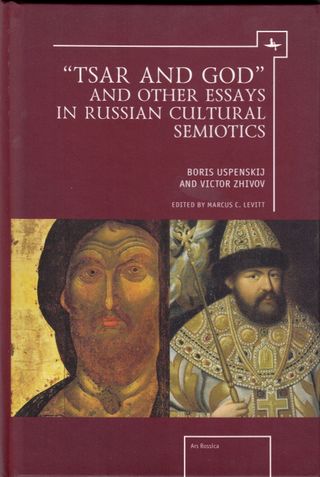
“Tsar and God” and Other Essays in Russian Cultural Semiotics
Uspensky B. A., Zhivov V. M. Boston: Academic Studies Press, 2012.
Similar publications
Отчич и дедич в титуле русских государей
Uspensky B. A., Шаги/Steps 2021 Т. 7 № 3 С. 238–286
Статья посвящена выражению отчич и дедич (отчичь и дѣдичь) в титуле русских государей (московских великих князей и царей). Это выражение, западнорусское по своему происхождению, в середине XV в. было усвоено в административном языке Московской Руси. В Западной Руси выражение отчич и дедич означало то же, что каждый компонент этого сочетания. Как отчич, так и дедич ...
Added: August 31, 2021
Ширма «Солнце, Луна и пять пиков» (Ирволь обон пён) как символ монаршей власти в средневековой Корее
Chesnokova N., Вестник Санкт-Петербургского университета. Востоковедение и африканистика 2019 Т. 11 № 3 С. 379–390
The paper focuses on the one of the Kingship symbols in Korea in the Joseon period namely “The Screen of the Sun, the Moon and the Five Peaks” (Irworobongdo). The Screen was one of the obligatory attributes of the ruler, it symbolized his presence and connection with the universe. According to the modern South Korean ...
Added: October 18, 2019
Помазание на царство: от Саула до Штауфенов и далее
Boytsov M., В кн.: Образ и символ в иудейской, христианской и мусульманской традиции.: М.: Индрик, 2015. Гл. 9 С. 205–226.
The article examines the process of reception of the Old Testament anointing in the inaugural rites of medieval Christian royal dynasties ...
Added: November 29, 2014
Случалось ли князьям домонгольского времени брать в жены близких свойственниц? Политические выгоды, церковные запреты, прецедент
Litvina A., Uspenskij F., В кн.: Факты и знаки: Исследования по семиотике историиВып. 3.: М., СПб.: Издательство Нестор-История, 2014. Гл. 4 С. 72–105.
Тематическая широта настоящего издания в полной мере определяется семиотическим подходом, когда события прошлого рассматриваются в контексте истории культуры, т. е. меняющегося мировоззрения. Такой подход предполагает реконструкцию системы представлений, обусловливающих как восприятие тех или иных событий в данном обществе, так и реакцию на эти события, являющуюся непосредственным импульсом исторического процесса. Исследователя интересуют в этом случае причинно-следственные связи ...
Added: October 19, 2014
Факты и знаки: Исследования по семиотике истории
Uspensky B. A., Lavrentiev A., Uspenskij F. et al., М., СПб.: Издательство Нестор-История, 2014.
Тематическая широта настоящего издания в полной мере определяется семиотическим подходом, когда события прошлого рассматриваются в контексте истории культуры, т. е. меняющегося мировоззрения. Такой подход предполагает реконструкцию системы представлений, обусловливающих как восприятие тех или иных событий в данном обществе, так и реакцию на эти события, являющуюся непосредственным импульсом исторического процесса. Исследователя интересуют в этом случае причинно-следственные ...
Added: October 18, 2014
Константин Леонтьев на пороге Оптиной пустыни
Besschetnova E., Человек 2014 № 4 С. 151–156
There was one special person in the history of nineteenth centuries thought, the period when all main meanings of Russian mentality were being organized. His name is Konstantin Leontiev .   Leontiev was trying to create his own historiosophical project, which was destined to change the course of the history. Philosopher was  called utopist. He ...
Added: September 8, 2014
Europe as Metaphor and Metonymy (in Relation to the History of Russia)
Uspensky B. A., , in: “Tsar and God” and Other Essays in Russian Cultural Semiotics.: Boston: Academic Studies Press, 2012. P. 175–190.
The diffusion of a name related to a certain cultural-historical center and representing a particular cultural-historical tradition, generally speaking, may be based either on the principle of metonymy or on the principle of metaphor. In the first case we have a natural process of cultural expansion, while in the other we face an artificial process ...
Added: February 17, 2013
Tsar and Pretender: Samozvanchestvo or Royal Imposture in Russia as a Cultural-Historical Phenomenon
Uspensky B. A., , in: “Tsar and God” and Other Essays in Russian Cultural Semiotics.: Boston: Academic Studies Press, 2012. P. 113–152.
The psychology of royal imposture in Russia is directly connected with the question of the attitude to the Tsar, i. e. the special way in which royal power was understood. Pretenders made their appearance in Russia only after there were Tsars, and this is connected with the sacralization of the Tsar. The notion that the ...
Added: February 17, 2013
Tsar and God: Semiotic Aspects of the Sacralization of the Monarch in Russia
Uspensky B. A., Zhivov V. M., , in: “Tsar and God” and Other Essays in Russian Cultural Semiotics.: Boston: Academic Studies Press, 2012. P. 3–112.
The present study simultaneously belongs to literary studies and to social history, including the history of culture and of political ideas.  Indeed it concerns attitudes about the tsar in Russia during various periods of Russian history, and the linguistic - and more generally speaking, semiotic - means in which these attitudes were manifested.  Obviously, this ...
Added: February 17, 2013
“Tsar and God” and Other Essays in Russian Cultural Semiotics
Uspensky B. A., Zhivov V. M., Boston: Academic Studies Press, 2012.
This is a collection of essays on the semiotics of history, a product of the 30 years collaboration of the two co-authors. All the articles are devoted to the history of the Russian culture, treating it not as an isolated phenomenon, but as an integral part of the world culture. Semiotic analysis of various fonts ...
Added: February 17, 2013
Емельян Пугачев и папа римский
Uspensky B. A., В кн.: Venok. Studia Slavica Stefano Garzonio sexagenario oblata* 1. Vol. 40.: Stanford: Berkeley Slavic Specialties, 2012. С. 67–74.
Анализируется обряд сидения на церковном престоле, который прослеживается как у Пугачева, так и в традиции папской интронизации. Предлагаются различные (дополняющие друг друга) Пугачев не мог знать о римской традиции, но западный образ сидения на престоле (в алтаре), по-видимому,  отразился в культурном сознании. ...
Added: February 17, 2013
  • About
  • About
  • Key Figures & Facts
  • Sustainability at HSE University
  • Faculties & Departments
  • International Partnerships
  • Faculty & Staff
  • HSE Buildings
  • HSE University for Persons with Disabilities
  • Public Enquiries
  • Studies
  • Admissions
  • Programme Catalogue
  • Undergraduate
  • Graduate
  • Exchange Programmes
  • Summer University
  • Summer Schools
  • Semester in Moscow
  • Business Internship
  • Research
  • International Laboratories
  • Research Centres
  • Research Projects
  • Monitoring Studies
  • Conferences & Seminars
  • Academic Jobs
  • Yasin (April) International Academic Conference on Economic and Social Development
  • Media & Resources
  • Publications by staff
  • HSE Journals
  • Publishing House
  • iq.hse.ru: commentary by HSE experts
  • Library
  • Economic & Social Data Archive
  • Video
  • HSE Repository of Socio-Economic Information
  • HSE1993–2026
  • Contacts
  • Copyright
  • Privacy Policy
  • Site Map
Edit