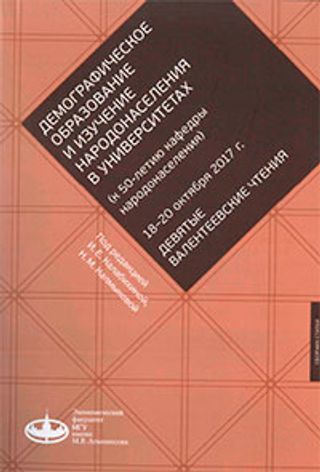
?
Новые методы в изучении этнически смешанных семей
bstract The methods are considered that were developed in the continuing studies of ethnically mixed families. The first results were published in 2014 in Demographic Review and presented at the previous conference in 2015. The main source of information is microdata of the 2010 census of population. The method of geographical decomposition and algorithms of inter-ethnic distance calculation are described. The results of analysis of mixed family formation are presented with the account of population distribution by regions of the country. The model for estimating the chances of mixed family formation is suggested for measuring the influence of non-uniform territorial distribution of different ethnicities. It allows producing decomposition of factors of mixed families into “geographical” and pure “ethnic” components. The results of calculation of the conditional “adjusted” incidence of mixed families are presented. This indicator eliminates the influence of inhomogeneity of ethnicity distribution by regions. Estimates are given for the distance between the Russians and 32 ethnicities obtained using revised aggregation algorithm for interethnic distance by sex and application of “geographical” decomposition method. The properties of “strong” mutual closeness for some combinations of ethnicities and its symmetry by sex are illustrated for the Georgians and Moldavians
In book