?
Russian Youth in the Labour Market: Work Attitudes, Career Paths and Regional Disparities
Ch. 9. P. 301–338.
In this chapter of the book, the authors explore the reality of young people’s lives in Russia by reflecting on the situation of youth in the Russian labour market in the context of local and global changes. We are interested in the ‘classical’ but still very crucial research question of how young people enter the labour market in the context of their transition to adulthood, and what resources they have for a more successful transition. Moreover, taking into account the size of the Russian labour market and its heterogeneity, we will pay special attention to the differences young people in the labour market experience in terms of inclusion in various regions of the Russian Federation.
Латов Ю. В., Tikhonova N. E., Социологические исследования 2025 № 11 С. 38–51
The adaptation of young people to the changing realities of modern Russia should be considered taking into account the qualitative differences between different subgroups of young people and long-term trends in the development of the society to which they adapt, reproducing it. The authors have developed and tested on large arrays of empirical data an ...
Added: December 26, 2025
Chebanova D., Семилетова Л. А., В кн.: Парадоксы локальной идентичности: как молодежь ищет место под солнцем.: М.: Издательский дом НИУ ВШЭ, 2025. Гл. 6 С. 178–228.
Монография подготовлена Институтом прикладных политических исследований НИУ ВШЭ по результатам серии экспедиций на тему «Модели локаль ной идентичности и социально-политические практики молодежи» (2022). В фокусе исследования — молодежь в возрасте от 22 до 35 лет четырех регионов России: Псковской области, Карачаево-Черкесской Республики, Челябинской области и Камчатского края. Дизайн исследования разработан с помощью метода «длинного стола» ...
Added: August 7, 2025
Poplavskaya A., Социологический журнал 2025 Т. 31 № 2 С. 79–95
Flexible employment arrangements seem to be an attractive proposition in the modern labor market. Young people are often seen as focused on a flexible schedule, remote work and platform employment. At the same time, sociologists warn about the downsides of flexibility associated with the risks of precarity, deprofessionalization and decreased work efficiency. This study analyzes ...
Added: August 1, 2025
Lukina A., Bochkor A., Социологические исследования 2025 № 3 С. 90–104
The article explores factors that determine engagement of contemporary Russian youth with institutionalized psychological care as both a consequence and evidence of a therapeutic turn in the Russian context. The research is empirically based on a longitudinal cohort study “Trajectories in education and profession” (N=3324). The findings reveal that young people in Russia generally hold ...
Added: May 5, 2025
Karmaeva N., Вологина Д. В., Образование и саморазвитие 2024 Т. 19 № 4 С. 182–196
Despite the expanding opportunities in adult education and learning (ALE) for young people, not all individuals take advantage of them. The paper aims to analyze the relationship between the educational status of young people and their parents, their perseverance (GRIT), with their participation in informal and informal ALE. We analyze whether perseverance enhances participation in ...
Added: January 24, 2025
Andreeva A., Omelchenko E. L., Pavel S. Sorokin, Young 2025 Vol. 33 No. 3 P. 278–295
The article discusses how Russian youth search for resilience strategies, opportunities
for decision-making and meaningful participation in times of uncertainty. Being in a
high-risk political climate, young Russians turn to prefiguration: they embody the
alternatives to the existing regime of neoliberal governmentality via organizing or
engaging in grassroots activist initiatives. Based on the analysis of in-depth interviews
with young St. ...
Added: November 20, 2024
Дейнека О. С., Аверьянова С. А., Maksimenko A., Полис. Политические исследования 2025 № 2 С. 78–95
This study is devoted to analysing perceptions of an ideal (socially approved) governor among
Russian youth by evaluating the effectiveness of his/her activities, personal qualities and communication in blogs. To assess how young people perceive the ideal governor, an online study was conducted of 391
young respondents aged 18 to 35 years in 2022 and 477 in 2024 ...
Added: September 10, 2024
Omelchenko E. L., ИНТЕРакция. ИНТЕРвью. ИНТЕРпретация 2024 Т. 16 № 2 С. 10–28
The conversation about generations reduces to people whose youth coincides with the contemporary times, with a growing interest to the problems and demands of those young people who demonstrate visible differences from the previous ones and cause anxiety or hope in adults. Generation X is from the past, the youth of Russian Xs is from the late 20th, early 21st century, if we focus on the accepted generational chronology. ...
Added: July 1, 2024
Nadya Nartova, Young 2026 Vol. 34 No. 1 P. 75–90
Millennials are being replaced by a 20-year-old group, which is entering an active phase of maturation and generational formation. The study of this process based on Mannheim’s tradition is especially important in Russia, which is undergoing radical social transformation. The focus of this article is the process of constructing generational discourse by Russian youth of ...
Added: December 15, 2023
Tikhonova N. E., В кн.: Молодежь и Россия будущего.: М.: Весь мир, 2023. С. 318–345.
The chapter examines the specific features of Russian youth in comparison with representatives of other generations, as well as the characteristic features of its different subgroups. ...
Added: November 25, 2023
Андреев А. Л., Anikin V. A., Бараш Р. Э. et al., М.: Весь мир, 2023.
The content of this book is based on a comprehensive analysis of the results of the
This book is based on a comprehensive analysis of the results of a unique multidimensional all-Russian sociological survey conducted by RISI and FNISC RAS, which covered 6,000 respondents representing seven age groups of the country's population from 14 to 60+ ...
Added: November 25, 2023
Volkova E., Anna Yu. Akimova, Oksana M. Isaeva, Changing Societies and Personalities 2022 Vol. 6 No. 4 P. 841–857
This article presents the results of a survey of the psychological well-being of Russian youth based on the Russian version of the PERMA-Profiler. The survey was conducted at the beginning of 2021 and covered 11,811 respondents (males = 29.2%, females = 70.8%) aged 18–35 (49.2%, aged 18–22; 22.3%, aged 23–30; and 28.5%, aged 31–35) living ...
Added: February 10, 2023
Murashchenkova N., Социальная психология и общество 2022 Т. 13 № 2 С. 89–108
Objective. In our study we implemented analysis of the COVID-19 fear, the hierarchy of social axioms and the equivalence of the relationships between fear of COVID-19 and social axioms among students-millennials, citizens of post-Soviet States with different strategies for dealing with the pandemic.
Background. The risk of being traumatized by fear of COVID-19 requires monitoring of ...
Added: July 6, 2022
Minina E., Pavlenko E., Journal of Youth Studies 2023 Vol. 26 No. 9 P. 1109–1129
This paper employs the concepts of cultural narrative to examine career choice among post-Soviet Russian teenagers going into higher education. Drawing on insights from cultural sociology more broadly and the cultural autonomy thesis more specifically, we demonstrate how the cultural narrative of a university degree as a ‘must-have at all costs’ subjugates various career decision-making ...
Added: May 14, 2022
Poplavskaya A., Мониторинг общественного мнения: Экономические и социальные перемены 2022 № 2 С. 181–206
The article aims to identify the types of students` work values and differentiate the probability of their prevalence among students with different characteristics. This article uses survey data from the project “Monitoring the Student Experience” collected in eight Russian universities in 2020. The author distinguished seven types of students’ work values based on factor analysis. ...
Added: May 12, 2022
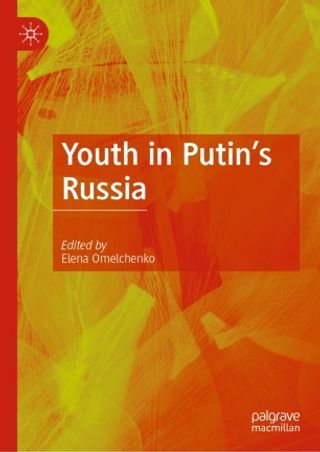
Omelchenko E. L., Palgrave Macmillan, 2021.
This edited volume sheds light on the lives of young people in various central and peripheral regions of Russia, including youth belonging to different ethnic and religious groups and who have differing views on contemporary politics. While the literature continues to grow regarding the inclusion of youth in global contexts, the specific cultural, political, and ...
Added: December 8, 2021
Karavay A., Вестник общественного мнения. Данные. Анализ. Дискуссии 2020 № 1-2(130) С. 130–140
The article is devoted to the analysis of the main types of leisure activity of Russian youth and its limitation factors. Based on a survey carried out by the Institute for Social Analysis and Forecasting of the RANEPA in March 2019, it is shown that an active lifestyle that involves a wide variety of leisure ...
Added: November 5, 2020
Kasamara V., Maximenkova M., Sorokina A., Общественные науки и современность 2020 № 4 С. 20–30
The article analyzes Russian students’ perceptions of justice. Based on the data of a representative quantitative survey (N = 6055) as well as a qualitative research (51 focus groups in 12 regions of the Russian Federation), a conclusion about a paternalistic model of respondents' perceptions of justice is done. The state, according to their opinion, ...
Added: September 11, 2020
Гончарова Н. В., Yasaveev I., Мир России: Социология, этнология 2020 Т. 29 № 1 С. 153–173
This article focuses on the meanings of search work in Russia, i.e. the search for and identification of the unburied remains of Soviet soldiers who perished in WW2. These meanings are constructed not only by the participants of expeditions (or poiskoviki, as they call themselves), but also by the Russian authorities, who actively support this ...
Added: February 26, 2020
Mareeva S., , in: Handbook of the Sociology of Youth in BRICS Countries.: World Scientific Publishing Co. Pte. Ltd, 2018. Ch. 12 P. 233–252.
Russia has been reforming its political, economic and social sectors for more than 20 years now. During this time the social structure has changed significantly as have the institutes and the entire system of social relations. Russian people have changed as well – researchers frequently record processes that show dynamics of their consciousness, norms and ...
Added: July 14, 2018