?
Indo-Uralic and the Origin of Indo-European Ablaut
Ch. 15. P. 219–235.
Following pioneering ideas of Bojan Čop, this paper offers a brief sketch of a theory of the origin of Proto-Indo-European ablaut in the light of Indo-Uralic comparison. Starting from the assumption that Proto-Indo-Uralic phonotactics and morphophonology were essentially preserved in Proto-Uralic, but significantly changed in Proto-Indo-European, we trace the origin of Proto-Indo-European ablaut paradigms (mobile and acrostatic paradigms of root nouns, hysterokinetic, proterokinetic, amphikinetic and acrostatic paradigms of suffixed nouns). Each of these paradigms can be derived by a set of simple rules from the proposed Proto-Indo-Uralic reconstruction that is itself based on the conventional Proto-Uralic reconstruction.
In book
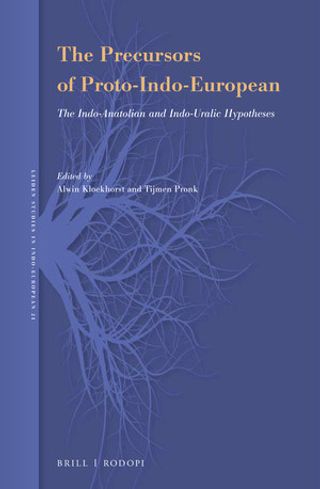
Brill, 2019.
Starchenko A., Toldova S., Типология морфосинтаксических параметров 2023 Т. 6 № 1 С. 130–148
The study focuses on a previously unrecorded model of split agreement in the mirative paradigm in Kazym Khanty. Split agreement is found when comparing active and passive mirative constructions, as well as
in a limited set of uses of non-finite forms. In the passive voice, unlike the active voice, the 3rd person is unmarked and the ...
Added: May 14, 2026
Starchenko A., Kozlov A., Белов П. А., Известия РАН. Серия литературы и языка 2026 Т. 85 № 1 С. 77–97
The article examines the problem of part-speech classification and the terminological description of non-finite forms in Forest Nenets, drawing on new data from the Pur dialect. The study analyzes the system of Forest Nenets non-finite forms, which includes action nouns, participles, the gerund, the conditional form, and the supine. The analysis is carried out within ...
Added: May 4, 2026
Muraviev N., Linguistica Uralica 2025 Vol. 61 No. 2 P. 106–130
This study investigates the morphosyntactic coding of core arguments in Northern Khanty, with a
focus on the use of active/passive voice and subjective/objective conjugation. The goal is to offer a
more detailed understanding of the coding patterns across dialects. To achieve this, I analyze corpus
data from four Northern Khanty dialects: Obdorsk, Shuryshkary, Tegi, and Kazym Khanty, using ...
Added: December 24, 2025
Muraviev N., Voprosy Jazykoznanija 2024 Vol. 5 P. 65–79
The study examines contexts in Northern Khanty where the presence of internal possessors in the noun phrases of the core arguments influences their morphosyntactic coding. Based on the corpus data from the Kazym dialect of Khanty, I investigate contexts in which the presence of a third-person topical possessor in the agent or patient NP leads ...
Added: December 24, 2025
Kassian A., Starostin G., Humanities and Social Sciences Communications 2025 Vol. 12 Article 682
In this paper, we present a brief critical analysis of the data, methodology, and results of the most recent publication on the computational phylogeny of the Indo-European family (Heggarty et al. 2023), comparing them to previous efforts in this area carried out by (roughly) the same team of scholars (informally designated as the “New Zealand ...
Added: June 9, 2025
Удмуртский государственный университет, 2023.
В научном журнале «Многоязычие в образовательном пространстве» представлены статьи, анонсы конференций и рецензии российских и зарубежных ученых на русском, английском, немецком, испанском, французском языках. В статьях освещаются современные тенденции в языковом образовании, даются рекомендации по внедрению инновационных технологий в процессе изучения различных языков. Центральной темой журнала является освещение вопросов многоязычия и многоязычного (мультилингвального) образования. Кроме ...
Added: January 28, 2025
Лапшина К. М., Вопросы языкознания 2025 № 1 С. 95–118
This paper studies the morphosyntactic properties of bound proprietive and privative markers in some Uralic languages using corpus data and grammatical descriptions. Such affixes are predominantly attached to substantive bases and form derivatives with the meaning of ‘possessing X’ and ‘deprived of X’, respectively.
The first part of the study is devoted to the comparison of ...
Added: December 19, 2024
Шерстнева Е. В., В кн.: Двадцать первая конференция по типологии и грамматике для молодых исследователей: тезисы докладов. Санкт-Петербург, 21–23 ноября 2024 г.: ИЛИ РАН, 2024. С. 161–166.
В языках Цель движения часто различает больше топологических значений, чем Источник. Языкам свойственно иметь больше средств для кодирования Цели, а значит, средства, кодирующие Источник, менее специфицированы семантически. Цель работы — определить, обнаруживается ли подобная асимметрия Цели и Источника в уральских языках. Выборка состоит из семи языков уральской семьи: финский, горномарийский, мокшанский, удмуртский, южносаамский, тундровый ненецкий, ...
Added: December 15, 2024
Михайлова Т. А., Volkonskaya M. A., Индоевропейское языкознание и классическая филология 2024 Т. 28 № 2 С. 1136–1151
The paper discusses the semantic and historical-cultural motivations for the gradual loss of the Indo-European designation of man, husband (*u̯ǐro-), which took place independently and in parallel in the Romance and Germanic languages, as well as its partial replacement with the lexeme having a general meaning 'human being.' The loss of Lat. vir during the ...
Added: July 2, 2024
Амелина М. К., Норманская Ю. В., Дыбо А. В. et al., М.: Издательство «Альма Матер», 2022.
I том. Графико-фонетические особенности книг XIX в. ...
Added: May 12, 2024
Кошелюк Н. А., Fedotova I., / OSF Preprints. Серия 0 "Arts and Humanities". 2023.
The paper reviews digital resources on the Uralic languages of Siberia, defining their scope and testing applicability for different tasks in linguistic studies. We focus on the resources featuring at least one Uralic language of Siberia. A short case-study for Nenets outlines applicability of the resources and the types of data that can be obtained ...
Added: May 12, 2024
Zhivlov M., Михайлова Т. А., Орлова М. В. et al., Известия РАН. Серия литературы и языка 2023 Т. 82 № 6 С. 5–15
The present article offers the first section of a collective study devoted to identifying the basic models of des-ignating the notion of “husband, spouse”. The study is based on textual and lexicographical data, as well as that stored in databases of semantic shifts (CLICS and DatSemShift). The paper analyzes synonymous denom-inations of “husband” in different ...
Added: March 29, 2024