• A
  • A
  • A
  • АБВ
  • АБВ
  • АБВ
  • A
  • A
  • A
  • A
  • A
Обычная версия сайта
  • RU
  • EN
  • HSE University
  • Publications
  • Book chapter
  • «Крымская Скифия» и «Позднескифская культура Крыма»
  • RU
  • EN
Расширенный поиск
Высшая школа экономики
Национальный исследовательский университет
Priority areas
  • business informatics
  • economics
  • engineering science
  • humanitarian
  • IT and mathematics
  • law
  • management
  • mathematics
  • sociology
  • state and public administration
by year
  • 2027
  • 2026
  • 2025
  • 2024
  • 2023
  • 2022
  • 2021
  • 2020
  • 2019
  • 2018
  • 2017
  • 2016
  • 2015
  • 2014
  • 2013
  • 2012
  • 2011
  • 2010
  • 2009
  • 2008
  • 2007
  • 2006
  • 2005
  • 2004
  • 2003
  • 2002
  • 2001
  • 2000
  • 1999
  • 1998
  • 1997
  • 1996
  • 1995
  • 1994
  • 1993
  • 1992
  • 1991
  • 1990
  • 1989
  • 1988
  • 1987
  • 1986
  • 1985
  • 1984
  • 1983
  • 1982
  • 1981
  • 1980
  • 1979
  • 1978
  • 1977
  • 1976
  • 1975
  • 1974
  • 1973
  • 1972
  • 1971
  • 1970
  • 1969
  • 1968
  • 1967
  • 1966
  • 1965
  • 1964
  • 1963
  • 1958
  • More
Subject
News
May 20, 2026
HSE University Opens First Representative Office of Satellite Laboratory in Brazil
HSE University-St Petersburg opened a representative office of the Satellite Laboratory on Social Entrepreneurship at the University of Campinas in Brazil. The platform is going to unite research and educational projects in the spheres of sustainable development, communications and social innovations.
May 18, 2026
The 'Second Shift' Is Not Why Women Avoid News
Women are more likely than men to avoid political and economic news, but the reasons for this behaviour are linked less to structural inequality or family-related stress than to personal attitudes and the emotional perception of news content. This conclusion was reached by HSE researchers after analysing data from a large-scale survey of more than 10,000 residents across 61 regions of Russia. The study findings have been published in Woman in Russian Society.
May 15, 2026
Preserving Rationality in a Period of Turbulence
The HSE International Laboratory for Logic, Linguistics and Formal Philosophy studies logic and rationality in a transformed world characterised by a diversity of logical systems and rational agents. The laboratory supports and develops academic ties with Russian and international partners. The HSE News Service spoke with the head of the laboratory, Prof. Elena Dragalina-Chernaya, about its work.


Have you spotted a typo?
Highlight it, click Ctrl+Enter and send us a message. Thank you for your help!

Publications
  • Books
  • Articles
  • Chapters of books
  • Working papers
  • Report a publication
  • Research at HSE

?

«Крымская Скифия» и «Позднескифская культура Крыма»

С. 15–33.
Mordvintseva V.

The terms “Crimean Scythia” and “Late Scythian Culture of the Crimea” are modern concepts reflecting an interpretation model formed by the study of written and epigraphic sources. The term “Late-Scythian Culture” appeared rather late in comparison with other culture-terms known in the Northern Black Sea Region, after 1946, in the frame of the work of the Tauro-Scythian expedition headed by Pavel Schulz. It is formed according to the ethno-chronological principle for the designation of the material culture of the “Scythians” supposedly superseded by the “Sarmatians” from most of the territory occupied by the “Great Scythia” of the 6th till the 4th BCE, and formed two enclaves – the Crimean-Dnieper and the Thracian, both known from Strabo as the “Scythia Minor” (Strabo, Geogr. VII.4.5).

The term “Crimean Scythia” for the designation of the Crimean part of the Strabo’s Scythia Minor appeared in the late 1980s – early 1990s under conditions of the collapse of the USSR. The continuity between the Scythian kingdom in the Crimea and the Great Scythia was questioned. It seemed that its formation took place in the conditions of the appearance of new ethnic groups in the Crimea, first of all the Sarmatians of Prokhorovka culture. In this sense, the term “Crimean Scythia” reflects the idea of the appearance in the Crimea of a separate new Scythian state and, in fact, represents an expression in historical terms of the concept of the Late Scythian culture of the Crimea.

At the present stage, the phenomenon of the Late Scythian archaeological culture of the Crimea seems to be a reflection of the economic and cultural development of the Barbarian population of the Crimean peninsula in the context of its involvement in the world-system with two geopolitical centers – Rome and Parthian Iran. Their weakening or destruction in the 3rd century AD led to the rupture and reformatting of most of the networking systems – ideological, military, trade and economic. Under these conditions, the idea of transforming the Late-Scythian culture under the influence of “Sarmaticization” seems meaningless. The migrations from the steppe or the Caucasus being very likely, which are confirmed by the data of physical anthropology, had a much lesser effect on the functioning of social networks and the economic and cultural appearance of the Crimean Scythia than the proximity of the ancient cities and geopolitical aspirations of the main hegemonic powers.

Language: Russian
Full text
Text on another site
Keywords: история исследованияКультурно-исторические процессыarchaeological culturehistorical-cultural regionlate Scythians of the Crimeacultural-historical processesnetworks of interactionhistory of researchархеологическая культураисторико-культурная областьпоздние скифы Крымасети взаимодействия

In book

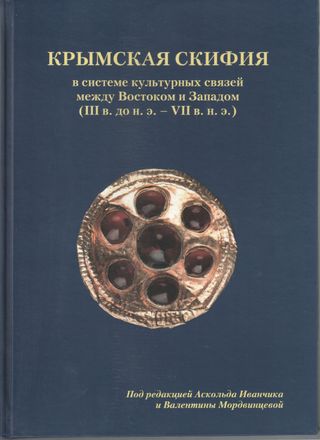
Крымская Скифия в системе культурных связей между Востоком и Западом (III в. до н.э. – VII в.н.э.)
Ivantchik A., Mordvintseva V. Симф.: ИП Зуева Т.В., 2017.
Similar publications
Лики Славы
Filosofova T. G., Ренев В. В., М.: , 2024.
The results of a study of icon painting as a theological phenomenon in its historical development are presented, the concepts of “icon painting canon”, “icon painting tradition”, “innovation” are highlighted. The educational significance of the icon is substantiated.  For historians, teachers, researchers and students studying in the humanities and arts. ...
Added: October 29, 2024
Prestige Goods as Markers of Network Relations of the Volga-Don Élites (from the 3rd c. BC to the Mid-3rd c. AD)
Mordvintseva V., Ancient Civilizations from Scythia to Siberia 2023 Vol. 29 No. 1 P. 38–85
The article concerns the composition and the origin of prestige markers from burial contexts of the Volga-Don region in four chronological groups (3rd–2nd c. BC, 1st c. BC, 1st – mid-2nd c. AD, mid-2nd–mid-3rd c. AD). There was noticed certain ‘core features’ amoung male and female sets of prestige goods, which did not change with ...
Added: October 10, 2023
Карта культурно-археологических ареалов Восточно-Европейской равнины X в. (к постановке проблемы)
Щавелев А. С., Фетисов А. А., Электронный научно-образовательный журнал "История" 2022 Т. 13 № 5(115) Статья S207987840021547-0-1
The paper presents an experimental map of archaeological cultural areas of the East European Plain in the 10th century, each of which represents a set of archaeological cultures and groups of archaeological complexes similar in a number of characteristics. In the paper the necessity of revision of traditional approach to the interpretation of the archaeological date of the ...
Added: September 6, 2022
The beginning and early years of radiocarbon dating in Russia: laboratories and personalities
Kuzmin Y. V., Burova N. D., Zazovskaya E. P. et al., Radiocarbon 2022 Vol. 64 No. 3 P. 589–605
We present an overview of the beginning and early years of radiocarbon dating in Russia. Achievements of several major scholars in this field from Leningrad (St. Petersburg), Moscow and Novosibirsk are briefly described. The existing and closed Russian laboratories are also mentioned. ...
Added: August 11, 2022
‚Iraner‘ und ‚Sarmaten‘ in der Weltsicht Michael Rostovtzeffs.
Mordvintseva V., , in: Ethnic Constructs, Royal Dynasties and Historical Geography around the Black Sea Littoral. Dedicated to the lasting scholarship and singular humanity of Heinz Heinen (14 September 1941 – 21 June 2013).: Stuttgart: Franz Steiner Verlag Stuttgart GmbH, 2021. P. 25–44.
Michael Rostovtzeff designed a model of cultural history of the North Pontic region that span from the Archaic period to the early Middle Ages, covered much of the Eurasian territory and tried to integrate the literary, epigraphic, numismatic and archaeological sources available in the early-20th century. In essence, he reduces the cultural development of the 1st ...
Added: February 11, 2021
Non-Urban Societies of the Crimea and Their Response to Changes in the External World (Based on the Basis of Élites from the 3rd Century BC to the mid-3rd Century AD)
Valentina Mordvintseva, Ancient Civilizations from Scythia to Siberia 2020 No. 26.1 P. 26–82
The paper presents a comparative analysis of burial assemblages of ‘barbarian’ élites located on the territory of the Crimea between Chersonesos Taurica and the Bosporan kingdom dating from the 3rd century BC to the 3rd century AD. The main goal of the research is to define indications of self-identities of the Crimean non-urban societies represented by their ...
Added: June 12, 2020
"Варварские культуры" Северного Причерноморья сарматской эпохи и методы, использованные при их изучении
Mordvintseva V., В кн.: Вестник ТанаисаТ. 2. Вып. 5.: Ростов н/Д: Альтаир, 2019. Гл. 6 С. 60–72.
Author critically analyzes approaches which until recently have been used for research of archaeological cultures of Sarmatian era. These research methods were applied inconsistently, their logic was broken. It is necessary to radically rethink the existing scientific tradition (in ontological, epistemological and methodological terms), which requires changing the way and style of scientific thinking. It is most promising ...
Added: May 30, 2020
Археологические культуры "варваров" Северного Причерноморья в III в. до н.э. - III в.н.э.: критика этнической объяснительной модели
Mordvintseva V., В кн.: Археология как жизнь. Памяти Евгения Павловича Мыськова.: Волгоград: Сфера, 2019. Гл. 12 С. 93–98.
Conclusions about the cultural and historical processes in the barbarian world of the North Black Sea region of the Early Iron Age, which were made according to the archaeological material, add little new to the historical picture obtained from written and epigraphic sources. The universal model of permanent «Sarmaticization» of the regional Barbaricum, which still ...
Added: February 20, 2020
Возможности изучения культурно-исторических процессов на археологическом материале
Mordvintseva V., В кн.: Причерноморье в античное и раннесредневековое время. Сборник научных трудов, посвященный 70-летию профессора В.П. КопыловаВып. 2: Сборник научных трудов, посвященный 70-летию профессора В.П. Копылова.: Ростов н/Д: ИП Истратов С.В., 2018. Гл. 48 С. 577–583.
The author defines the term “cultural-historical process” and discusses approaches by means of which such processes might be researched using archaeological sources. ...
Added: October 31, 2019
The Scythian Kingdom in the Crimea in the 2nd century BC and its relations with the Greek states in the North Pontic region
Ivantchik A., Ancient Civilizations from Scythia to Siberia 2019 Vol. 25 No. 2 P. 220–254
The new data that have become available in the last two decades show that the Scythian Kingdom with its capital in Neapolis Scythica, which existed in the Crimea in the 2nd century BC, was much closer to Hellenistic states ruled by barbarian dynasties than to nomadic kingdom of the Scythians of the 4th century BC. ...
Added: October 31, 2019
Крымская Скифия III – II вв. до н.э. и ее отношения с греческими государствами Северного Причерноморья
Ivantchik A., В кн.: Крымская Скифия в системе культурных связей между Востоком и Западом (III в. до н.э. – VII в.н.э.).: Симф.: ИП Зуева Т.В., 2017. С. 34–55.
he new data that has become available in the last two decades show that the Scythian kingdom with the capital in Neapolis Scythica which existed in the Crimea in the 2nd c. BC, was much closer to Hellenistic states ruled by Barbarian dynasties than to the nomadic kingdom of the Scythians of the 4th c. BC. At ...
Added: October 29, 2019
Scholarly Traditions in the Studies of the 'Late Scythian Culture of the Crimea' and 'Crimean Scythia'
Mordvintseva V., , in: Advances in Ancient Black Sea Studies: Historiography, Archaeology and Religion. The Proceedings of the International Symposium, Constanţa, August 20-24, 2018.: Cluj-Napoca: Mega Publishing House, 2019. Ch. 8 P. 179–198.
The expressions ‘Late Scythian culture’ and ‘Crimean Scythia’ are modern concepts. The first term appeared soon after 1946, and it was intended to designate the material culture of the Scythians, supposedly superseded by the Sarmatians in the 3rd century BC and later replaced by the Slavs, thus making a direct historical bridge from Scythians to ...
Added: September 18, 2019
  • About
  • About
  • Key Figures & Facts
  • Sustainability at HSE University
  • Faculties & Departments
  • International Partnerships
  • Faculty & Staff
  • HSE Buildings
  • HSE University for Persons with Disabilities
  • Public Enquiries
  • Studies
  • Admissions
  • Programme Catalogue
  • Undergraduate
  • Graduate
  • Exchange Programmes
  • Summer University
  • Summer Schools
  • Semester in Moscow
  • Business Internship
  • Research
  • International Laboratories
  • Research Centres
  • Research Projects
  • Monitoring Studies
  • Conferences & Seminars
  • Academic Jobs
  • Yasin (April) International Academic Conference on Economic and Social Development
  • Media & Resources
  • Publications by staff
  • HSE Journals
  • Publishing House
  • iq.hse.ru: commentary by HSE experts
  • Library
  • Economic & Social Data Archive
  • Video
  • HSE Repository of Socio-Economic Information
  • HSE1993–2026
  • Contacts
  • Copyright
  • Privacy Policy
  • Site Map
Edit