• A
  • A
  • A
  • АБВ
  • АБВ
  • АБВ
  • A
  • A
  • A
  • A
  • A
Обычная версия сайта
  • RU
  • EN
  • HSE University
  • Publications
  • Book chapter
  • Segerberg squares of modal logics and theories of relation algebras
  • RU
  • EN
Расширенный поиск
Высшая школа экономики
Национальный исследовательский университет
Priority areas
  • business informatics
  • economics
  • engineering science
  • humanitarian
  • IT and mathematics
  • law
  • management
  • mathematics
  • sociology
  • state and public administration
by year
  • 2027
  • 2026
  • 2025
  • 2024
  • 2023
  • 2022
  • 2021
  • 2020
  • 2019
  • 2018
  • 2017
  • 2016
  • 2015
  • 2014
  • 2013
  • 2012
  • 2011
  • 2010
  • 2009
  • 2008
  • 2007
  • 2006
  • 2005
  • 2004
  • 2003
  • 2002
  • 2001
  • 2000
  • 1999
  • 1998
  • 1997
  • 1996
  • 1995
  • 1994
  • 1993
  • 1992
  • 1991
  • 1990
  • 1989
  • 1988
  • 1987
  • 1986
  • 1985
  • 1984
  • 1983
  • 1982
  • 1981
  • 1980
  • 1979
  • 1978
  • 1977
  • 1976
  • 1975
  • 1974
  • 1973
  • 1972
  • 1971
  • 1970
  • 1969
  • 1968
  • 1967
  • 1966
  • 1965
  • 1964
  • 1963
  • 1958
  • More
Subject
News
August 13, 2026
‘Working with AI Solves a Wide Range of Engineering Problems
Artificial intelligence is a working tool based on a balanced combination of algorithms and engineering. Experts and doctoral students from the HSE Moscow Institute of Electronics and Mathematics explain how AI technologies can improve an application, device, or system, and what engineering tasks are solved in the process.
August 12, 2026
‘I Would Like My Research to Help Make the World a Calmer and Better Place
Whatever task Saraa Ali, Junior Research Fellow at the Laboratory of Methods for Big Data Analysis (LAMBDA) of the AI and Digital Science Institute (HSE Faculty of Computer Science), is working on, she thinks about how it can benefit people. She told the Young Scientists of HSE University project about her large family, diagnosing three-phase motors, and her dream of building a children’s home in her native country.
August 11, 2026
‘The Peak of Stupidity and ‘The Valley of Despair: HSE Economists Propose an Explanation for the Dunning–Kruger Effect
The Dunning–Kruger effect, which describes a sharp surge in self-confidence among beginners followed by an equally rapid decline as they gain experience, can be explained by the nature of the learning process and the acquisition of new knowledge. This conclusion was reached by Andrey Vorchik of the HSE Faculty of Economic Sciences together with independent researcher Murat Mamyshev. They developed a mathematical model of learning and demonstrated how subjective confidence is formed and changes as knowledge accumulates, as well as how teachers can reduce the ‘valley of despair’ experienced by learners.


Have you spotted a typo?
Highlight it, click Ctrl+Enter and send us a message. Thank you for your help!

Publications
  • Books
  • Articles
  • Chapters of books
  • Working papers
  • Report a publication
  • Research at HSE

?

Segerberg squares of modal logics and theories of relation algebras

P. 245–296.
Shehtman V. B.

We establish a natural translation from word rewriting systems to strictly positive polymodal logics. Thereby, the latter can be considered as a generalization of the former. As a corollary we obtain examples of undecidable finitely axiomatizable strictly positive normal modal logics. The translation has its counterpart on the level of proofs: we formulate a natural deep inference proof system for strictly positive logics generalizing derivations in word rewriting systems. We also make some observations and formulate open questions related to the theory of modal companions of superintuitionistic logics that was initiated by L.L. Maksimova and V.V. Rybakov.
Language: English
DOI
Text on another site
Keywords: classical predicate logiccompletenessfinite model propertymodal logicsegerberg squarerelation algebrabisimulation game

In book

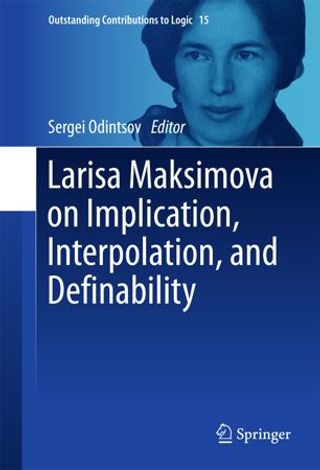
Larisa Maksimova on Implication, Interpolation, and Definability
Cham: Springer, 2018.
Similar publications
Modal Products and Around
Shehtman V. B., Gagarin A., , in: Graph Games and Logic Design. Recent Developments and Further Directions. (TREN, volume 66)Vol. 66.: Springer, 2026. Ch. 17 P. 419–450.
The chapter contains an overview of results on products of propositional modal logics and related constructions: semiproducts, Segerberg squares, and others. We focus mainly on axiomatizations, finite model property, and decidability; we also sketch connections with classical and modal predicate logics. In some cases we give ideas of proofs, especially of those using games. ...
Added: June 30, 2026
Graph Games and Logic Design. Recent Developments and Further Directions. (TREN, volume 66)
Springer, 2026.
This book presents established and new research on the close connections between graph games and systems of logic, particularly existing and newly designed modal logics. The volume utilizes two graph games – the sabotage game and the hide-and-seek game – to demonstrate the natural interplay between designing new graph games and exploring new kinds of ...
Added: June 30, 2026
Отмеченное субординатное натуральное исчисление для базовой интуиционистской кондициональной логики
Zaitsev I., Логические исследования 2025 Т. 31 № 2 С. 143–168
This article presents a labeled Fitch-style natural deduction system, 𝓕IntCK, for the basic propositional intuitionistic conditional logic IntCK introduced by G.K. Olkhovikov. The logic IntCK serves as a correct intuitionistic counterpart to Chellas' minimal conditional logic CK, designed to accommodate Lewis' strong and weak counterfactual conditionals within a single framework. In order to do this, IntCK features two independent logical connectives, namely □→ and ◇→, ...
Added: November 23, 2025
Two Types of Filtrations for wK4 and Its Relatives
Kudinov A., Shapirovsky I., Studia Logica 2025 P. 1–25
We study the finite model property of subframe logics with expressible transitive reflexive closure modality. For m > 0, let Lm be the logic defined by axiom ♦^{m+1}p → ♦p ∨ p. We construct quotient filtrations for the logics Lm, which implies that these logics and their tense counterparts have the finite model property. Then, we construct selective filtrations ...
Added: October 14, 2025
Polynomial completeness and completeness of finite n-quasigroups
Chaplygina S., Alexy V. Galatenko, Quasigroups and Related Systems 2024 Vol. 32 No. 2 P. 207–223
Finite quasigroups and n-quasigroups are currently extensively utilized to implement various cryptographic functions. Cryptographic requirements lead to constraints imposed on quasigroups and n-quasigroups. In particular, V. A. Artamonov proposed using polynomially complete quasigroups. Polynomial completeness can be decided with the help of a criterion of J. Hagemann and C. Herrmann: a quasigroup is polynomially complete ...
Added: December 29, 2024
Advances in Modal Logic 2024. Short Papers
[б.и.], 2024.
The book contains short papers presented at AiML 2024. ...
Added: August 15, 2024
Advances in Modal Logic
College Publications, 2024.
Advances in Modal Logic (AiML) is an initiative founded in 1995 and aimed at presenting an up-to-date picture of the state of the art in modal logic and its many applications. It consists of a conference series together with volumes based on the conferences. The conference series is the main international forum at which research ...
Added: August 14, 2024
Variations on the Kripke trick
Rybakov M., Shkatov D., Studia Logica 2025 Vol. 113 P. 1–48
In the early 1960s, to prove undecidability of monadic fragments of sublogics of the predicate modal logic QS5 that include the classical predicate logic QCl, Saul Kripke showed how a classical atomic formula with a binary predicate letter can be simulated by a monadic modal formula. We consider adaptations of Kripke's simulation, which we call the Kripke trick, to various modal ...
Added: December 2, 2023
Algorithmic properties of modal and superintuitionistic logics of monadic predicates over finite Kripke frames
Rybakov M., Shkatov D., Journal of Logic and Computation 2025 Vol. 35 No. 2 Article exad078
We show that the monadic modal logic of a single Kripke frame with finitely many possible worlds, but possibly infinite domains, is decidable. This holds true even for monadic multimodal logics with equality, both if equality interpreted as identity and if equality interpreted as congruence. ...
Added: November 3, 2023
Complexity function and complexity of validity of modal and superintuitionistic propositional logics
Rybakov M., Shkatov D., Journal of Logic and Computation 2023 Vol. 33 No. 7 P. 1566–1595
We consider the relationship between the algorithmic properties of the validity problem for a modal or superintuitionistic propositional logic and the size of the smallest Kripke countermodels for non-theorems of the logic. We establish the existence, for every degree of unsolvability, of a propositional logic whose validity problem belongs to the degree and whose every ...
Added: January 6, 2023
On Strictly Positive Fragments of Modal Logics with Confluence
Kikot S., Kudinov A., Mathematics 2022 Vol. 10 No. 19 Article 3701
We axiomatize strictly positive fragments of modal logics with the confluence axiom. We consider unimodal logics such as K.2, D.2, D4.2 and S4.2 with unimodal confluence $\Diamond\Box p \to \Box\Diamond p$  as well as the products of modal logics in the set {K, D,  T, D4, S4}, which contain bimodal confluence $\Diamond_1\Box_2 p \to \Box_2\Diamond_1 p$.  We show that the impact ...
Added: October 10, 2022
Correction to: Undecidability of First-Order Modal and Intuitionistic Logics with Two Variables and One Monadic Predicate Letter
Rybakov M., Shkatov D., Studia Logica 2021
Added: January 24, 2022
Раскрытие и предоставление информации эмитентами ценных бумаг в условиях санкций
Якушева Е. Е., Lex Russica (Русский закон) 2021 № 8 С. 110–117
The paper is devoted to the transformation of information transparency of Russian securities issuers after the implementation of sanctions by foreign states and international organizations against a significant number of Russian companies. In response to foreign policy pressure, the Russian state quite naturally took a number of steps to protect domestic companies affected by sanctions, ...
Added: October 29, 2021
Nāgārjunian-Yogācārian Modal Logic versus Aristotelian Modal Logic
Шуман А. Н., Journal of Indian Philosophy 2021 Vol. 49 P. 467–498
There are two different modal logics: the logic T assuming contingency and the logic K = assuming logical determinism. In the paper, I show that the Aristotelian treatise On Interpretation (Περί ερμηνείας, De Interpretatione) has introduced some modal-logical relationships which correspond to T. In this logic, it is supposed that there are contingent events. The Nāgārjunian treatise Īśvara-kartṛtva-nirākṛtiḥ-viṣṇoḥ-ekakartṛtva-nirākaraṇa has introduced some modal-logical relationships which correspond ...
Added: July 21, 2021
Modal logics with transitive closure: Completeness, decidability, filtration
Kikot S., Shapirovsky I., Zolin E., , in: Advances in Modal LogicVol. 13.: College Publications, 2020. P. 369–388.
We give a sufficient condition for Kripke completeness of modal logics that have the transitive closure modality. More precisely, we show that if a modal logic admits what we call definable filtration, then its enrichment with the transitive closure modality (and the corresponding axioms) is Kripke complete; in addition, the resulting logic has the finite ...
Added: December 2, 2020
On existence of recursively-enumerable Kripke-complete first-order modal logics that are not Kripke complete with respect to a first-order definable class of frames
Rybakov M., Shkatov D., , in: Десятые Смирновские чтения: материалы Междунар. науч. конф., Москва, 15–17 июня 2017 г.: М.: Современные тетради, 2017. P. 45–45.
We discuss an example of recursively-enumerable Kripke-complete first-order modal logics that are not Kripke complete with respect to a first-order definable class of frames. ...
Added: October 7, 2019
Semeiotic completeness in the theory of signs
Pietarinen A., Semiotica 2019 Vol. 228 P. 237–257
Peirce aspired for the completeness of his logic cum the theory of signs in his 1903 Lowell Lectures and other late manuscripts. Semeiotic completeness states that everything that is a consequence in logical critic is derivable in speculative grammar. The present paper exposes the reasons why Peirce would fall short of establishing semeiotic completeness and ...
Added: May 9, 2019
Larisa Maksimova on Implication, Interpolation, and Definability
Cham: Springer, 2018.
This edited volume focuses on the work of Professor Larisa Maksimova, providing a comprehensive account of her outstanding contributions to different branches of non-classical logic. The book covers themes ranging from rigorous implication, relevance and algebraic logic, to interpolation, definability and recognizability in superintuitionistic and modal logics. It features both her scientific autobiography and original ...
Added: September 20, 2018
Local tabularity without transitivity
Shehtman V. B., Shapirovsky I., , in: Advances in Modal LogicVol. 11.: L.: College Publications, 2016. P. 520–534.
According to the classical result by Segerberg and Maksimova, a modal logic containing K4 is locally tabular iff it is of finite height. The notion of finite height can also be defined for logics, in which the master modality is expressible (‘pretransitive’ logics). We observe that any locally tabular logic is pretransitive of finite height. Then we prove some ...
Added: September 20, 2018
Filtration Safe Operations on Frames
Kikot S., Shapirovsky I., Zolin E., , in: Advances in Modal Logic. Volume 10.: College Publications, 2014. P. 333–352.
Filtration is a standard tool for establishing the finite model property of modal logics. We consider logics and classes of frames that admit filtration, and identify some operations on them that preserve this property. In particular, the operation of adding the inverse or the transitive closure of a relation is shown to be safe in ...
Added: June 14, 2018
  • About
  • About
  • Key Figures & Facts
  • Sustainability at HSE University
  • Faculties & Departments
  • International Partnerships
  • Faculty & Staff
  • HSE Buildings
  • HSE University for Persons with Disabilities
  • Public Enquiries
  • Studies
  • Admissions
  • Programme Catalogue
  • Undergraduate
  • Graduate
  • Exchange Programmes
  • Summer University
  • Summer Schools
  • Semester in Moscow
  • Business Internship
  • Research
  • International Laboratories
  • Research Centres
  • Research Projects
  • Monitoring Studies
  • Conferences & Seminars
  • Academic Jobs
  • Yasin (April) International Academic Conference on Economic and Social Development
  • Media & Resources
  • Publications by staff
  • HSE Journals
  • Publishing House
  • iq.hse.ru: commentary by HSE experts
  • Library
  • Economic & Social Data Archive
  • Video
  • HSE Repository of Socio-Economic Information
  • HSE1993–2026
  • Contacts
  • Copyright
  • Privacy Policy
  • Site Map
Edit