• A
  • A
  • A
  • АБВ
  • АБВ
  • АБВ
  • A
  • A
  • A
  • A
  • A
Обычная версия сайта
  • RU
  • EN
  • HSE University
  • Publications
  • Books
  • Экономическая история России (опыт институционального анализа). Второе изд.
  • RU
  • EN
Расширенный поиск
Высшая школа экономики
Национальный исследовательский университет
Priority areas
  • business informatics
  • economics
  • engineering science
  • humanitarian
  • IT and mathematics
  • law
  • management
  • mathematics
  • sociology
  • state and public administration
by year
  • 2028
  • 2027
  • 2026
  • 2025
  • 2024
  • 2023
  • 2022
  • 2021
  • 2020
  • 2019
  • 2018
  • 2017
  • 2016
  • 2015
  • 2014
  • 2013
  • 2012
  • 2011
  • 2010
  • 2009
  • 2008
  • 2007
  • 2006
  • 2005
  • 2004
  • 2003
  • 2002
  • 2001
  • 2000
  • 1999
  • 1998
  • 1997
  • 1996
  • 1995
  • 1994
  • 1993
  • 1992
  • 1991
  • 1990
  • 1989
  • 1988
  • 1987
  • 1986
  • 1985
  • 1984
  • 1983
  • 1982
  • 1981
  • 1980
  • 1979
  • 1978
  • 1977
  • 1976
  • 1975
  • 1974
  • 1973
  • 1972
  • 1971
  • 1970
  • 1969
  • 1968
  • 1967
  • 1966
  • 1965
  • 1964
  • 1963
  • 1958
  • More
Subject
News
September 22, 2026
Personal Interest in Doctoral Thesis Topic Most Important for Confidence in Successful Defence
A researcher at HSE University analysed data on 1,539 doctoral students from 161 Russian universities to identify which features of a thesis topic are associated with academic success and engagement. The most important factor was found to be personal interest in the research topic, which was associated with almost all key aspects of doctoral programme experience—from engaging with the academic supervisor to research activity and confidence about successfully defending the thesis. The findings have been published in Higher Education.
September 21, 2026
Researchers Develop Methodology to Assess the Quality of Legal Representation in Criminal Proceedings
Having a good defence attorney in criminal proceedings can largely determine whether a defendant retains their freedom, health and good name. Researchers at HSE University propose a method for predicting an attorney’s performance based on the outcomes of their previous cases. The methodology takes into account the severity of the charges, the complexity of the cases, and the most likely outcome, drawing on judicial statistics.
September 21, 2026
Algebra, Geometry, and AI: Russian and Vietnamese Mathematicians Discuss Current Research
A delegation of scientists from Hanoi visited the HSE Faculty of Computer Science and then took part in a Russian-Vietnamese conference in St Petersburg. The events were part of the three-year project ‘Flexibility and Computational Methods.’ Over the course of the project, the researchers have prepared joint publications and obtained new mathematical results.


Have you spotted a typo?
Highlight it, click Ctrl+Enter and send us a message. Thank you for your help!

Publications
  • Books
  • Articles
  • Chapters of books
  • Working papers
  • Report a publication
  • Research at HSE

?

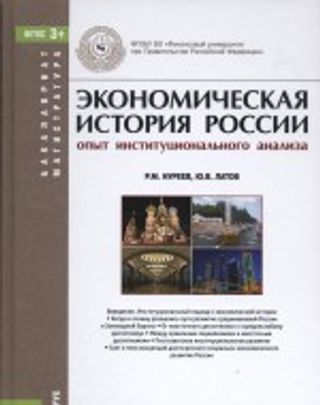
Экономическая история России (опыт институционального анализа). Второе изд.

M. : KnoRus, 2017.
Nureev R., Латов Ю. В.
Leading author: Nureev R.
Academic editor: Nureev R., Латов Ю. В.
Editor-in-chief: Nureev R.
Under the general editorship: Nureev R., Латов Ю. В.

1. When and why did development ways of Russia and Western Europe parted (the approach from the institutional economic history perspective).

Russian civilization lies between the civilizations of the West (based on the institution of private property) and East (based on power-ownership). It combines the contradictory features of backward Europe and advanced Asia. The development of Russian civilization (IX-XXIth centuries) can be described as a fluctuation between the pro-eastern (stronger) and the pro-Western vector of development. The permanent confrontation between these trends was reflected in continuous conflicts with external aggressors as well as between the Russian states. The successive domination of eastern institutions can, apparently, be explained by the compatibility of oriental despotism with the constant the need to cope with external aggression, which has been threatening the very existence of Russian civilization throughout its development. In the initial phase of its development (IX-XVIst centuries) the Russian civilization was being shaped under the influence of institutional export from the politically powerful states such as East (Byzantium, the Golden Horde, Turkey). The export of institutions from western countries only began with the XVII century. Such export was always complicated by the path dependency phenomenon, because throughout the course of its formation Russia has been developing its identity in opposition to the West rather than the East. The development of Russian civilization can be disassembled into 6 steps:

- Kievan Rus (IX-XIII cc.) regarded by some contemporary authors as a European state (which is particularly reflected in the facts of early dynastic marriages between the Ruriks and the families of the European rulers);

- a split of Russian civilization during the Tatar conquest (XIII-XVth cc.): the eastern lands subservient to the Golden Horde (Moscow princedom) becomes more orientalized, while the western domain (the Grand Duchy of Lithuania and Novgorod the Great) remains as the periphery of Europe;

- the formation of Moscow kingdom (XVI-XVII cc.), which is a period of active confrontation between four models of the Russian State (Moscow, Novgorod, Lithuanian and Cossack), which ends with complete victory of the East-oriented Moscow and the gradual fading of alternative models;

- Russian Empire (XVIII-XIX cc.), which is a clear example of catch-up development with selective imports of Western institutions and gradual reduction of the gap between Russia and Europe; however, even by the end of St. Petersburg period Russia could not be considered a fully European country;

- the Soviet era (XXth century), a period of counter-modernization and attempts to eliminate the technological backwardness of Soviet Russia; the party leadership deliberately revives the institutions of power-ownership in order to ensure the dynamic construction of communist society;

- the post-Soviet Russian civilization splits into three independent states (Russia, Ukraine and Belarus), each of which demonstrates a particular combination of dynamic pro-Eastern and pro-Western trend of institutional development, but none of them can still be considered as having completely adopted a sustainable development path for their national economies.

The Russian transformation into a part of Western civilization is highly unlikely. The active spreading of Western European institutions has always caused the resentment among Russian people, which is why the history of Russia can be described as a series of constant shifts. i.e. in-flows and out-flows of europeanization. However, in the XXIst century the europeanization policy for Russia is even less attractive, since at present the Western civilization is gradually losing its role of a world leader, while the Confucian and Islamic civilizations seek to reclaim such role. The best option for Russia is to reconstruct its identity as a unique civilization. While being geographically located on the outskirts of Europe, it is rather a different Europe, an alternative Europe.


2. From "Oriental Despotism" to "Average – weak Capitalism":

Ragged Path of Institutional Development of the Imperial Russia.

          The history of Russia from the start of the Troubles in the XVII, up to the early Twentieth century. is the period of accelerated modernization can be regarded as a prime example of catch-up development of the second "eshelon" of the development of capitalism. Russian civilization was trying to compete with Western civilization to import the most advanced institutions, while at the same time their identity. As a result, overtaking development took the form of fluctuations between the strengthening of the institutions of private property and the preservation of a transformed Power-property  institutions.

The initial institutional reform was to be the "liberation" of the noble elite of the state. Only at the end of the XVIII century Russia in the economic freedom of the ruling class was about the same as the age of the mature Western European institutions of feudalism, the landowners were "normal" right of private ownership of land and the peasants. However, the state in imperial Russia remained the main agent of modernization of the economy up to 1917
A study conducted in 1861 "liberation" of peasants eliminated the feudal institutions of serfdom and corvee labor, but retained the "Asian" institutions depending on the peasants from the community and the state. Stolypin's reforms were an important step towards the formation of peasant private property, but do not have time to cause irreversible "farm development ". When V.I. Lenin at the end of the XIX century, draw conclusions about the differentiation of the peasants on the bourgeoisie and the proletariat, it is strongly "running ahead". Much closer to understanding the very moderate degree of modernization of agricultural production areas was A. Chaianov already in 1920. formulated the concept of a non-capitalist (labor) farm.

The release of industrial production of the "Asian" institutions going too slowly. During the XVIII-XIX centuries. a large share of Russian entrepreneurs were representatives of ethnic and religious minorities trade - Old Believers, Jews, Armenians, Germans, etc. In this regard, one can speak of a very long dominance in the business of the institutions' traditional capitalism "- enterprise system, where competition is mostly off-market (rent-seeking) character. Although at the beginning of the Twentieth century began to develop a "big business", Russian "state monopoly capitalism" is very dependent on state patronage and in many respects was like "antediluvian forms of capital."

It should generally agree with Lenin's definition of Russian capitalism of the early twentieth century. as "average-weak". Russia of the early Twentieth century. really should be weak among the middle - Japan upgraded slightly worse, but significantly better than Turkey. The results of more than two centuries of conscious experience catch-up were not very expressive and, most importantly, reversible. Achievements partially successful imperial modernization were largely thwarted fatally unsuccessful Russian participation in the First World War.


3. Between “Real Socialism” and “Oriental Despotism”: Labyrinths of Institutional Economic Development of Soviet Russia

Authors proposed the institutional approach to the analysis of socio-economic development of Russian civilization in the Soviet period, based on its interpretation as a particular example of catch- study which to engage in the development economics. In 1917-1991 years Russia carried out in counter-modernization, which tried to solve the same problem faced by all emerging economies “Third world”, but fundamentally different methods to gain power-property institutions. Communist ideology played in choosing these methods very important, but not decisive role, on the contrary, the practice of counter- modernization led to “fit” the ideology of a real opportunity.

Throughout Soviet history several times observed bifurcation situations in which it was necessary to qualitatively change the “rules of the game”. First bifurcation's period - the time of the Civil War, when the confrontation of three socio-economic systems (“Red” Military Communism , “White” Military Capitalism and “Green” models) completed their common defeat. Mixed economy NEP could solve the problem of the recovery period, but could not provide a “Big push”. In the second period bifurcation end of the 1920s ideas of the five main paradigms of development economics in Soviet Russia were expressed at least partially at - changed in one way or another everything. Eventually realized peculiar mixture of neoclassical and traditional institutional approaches to the solution of tasks catching national development. Anticipating neoclassical ideas 1950-1960-ies, organized the party leadership in 1930 overflow of resources from traditional agriculture to modern industry, actively using methods noneconomic coercion. Administrative-command system (created during the “Great Break”) could effectively, albeit with low efficiency, complete industrialization of the economy. However, post-industrial modernization implementation should be monitored as part of the Soviet command economy was fundamentally impossible, it required more workers available and less rigid guide. Third bifurcation period was a collision of three variants of the “rules of the game” - a model of self- sufficient command economy (post-Stalinist course) , mixed economy (rate Kosygin reforms) and the command economy as “raw materials appendage” capitalist world-economy (course “stagnant” Brezhnev regime) .

Over the 1950-1960-ies in the USSR attempted economic reforms aimed at introducing market elements “game rules”, but these are torture were unsuccessful. The failure of the reform should be linked with the development of various forms of rent-seeking - with the active development of oil and gas fields for export (extraction of natural resource rents) and with increasing privileges of statehood bureaucracy (removing bureaucratic rent). In the last decades of the Soviet economy of its distinctive features are transformed into institutional traps: incomplete balanced development leads to the substitution of short- term goals, nomenclature power-property alienates citizens from power and property. Misunderstanding of the Soviet political elite need to transition to a post-industrial economy and strengthening the independence nomenklatura finally led to the decline and collapse of the Soviet economic model. The author's concept based on a generalization of the works of domestic and foreign social scientists 1990-2010-ies (G. Hanin, R. Allen, G. Popov, A. Markiewicz, Yu. Ol'sevich, P. Gregory, etc.).


4. Institutional Development in Post-Soviet Russia: in Search for an Escape from the Path-dependence of ‘Power-Ownership'

In the analysis of socio-economic development of Russia 1990–2010s stresses that many institutions of “Asiatic mode of production” continue to develop even after the foundations of a market economy. It is connected with the fact that the radical economic reforms of the early 1990s. carried out the revolution “from above”, aimed primarily at consolidating the new political regime. As a result of privatization – key economic reforms – adopted the nomenclature and is accompanied by the erosion of property rights rather than their further specification.

Already in the late 1990s “Russian Drama” is labeled: even after all originally planned major economic reforms and political stability Russia can not provide one hundred-stably high rates and the quality of economic growth. Although there is an explanation of the “Russian drama” with the positions of all the paradigms of economic-development theory, the authors focus on institutional and regional approach and track the changes in the “rules of the game” in the behavior of all three actors of the Russian economy.

The post-Soviet households have gone from survival in the 1990s to develop in 2000–2010's, but in the last decade, they retain a strong dependence on the state. This is manifested, in particular, that the contradiction between the “people and the government” during the opinion polls, Russians considered to be more relevant than conflicts between employers and employees.

In business, there is also a combination of market progress and “Asian” stagnation. On the one hand, to the beginning of the 2000s. institutions of barter were liquidated and integrated business groups were formed. They are interested in unification and efficiency “rules of the game” .On the other hand, the economy remained largely unproductive entrepreneurship (by W. Baumol): this is manifested not so much in a candid business fraud (as in pyramid schemes), but the predominance of rent seeking activities.

Most clearly dependent on the previous “Asian” development can be seen in the activities of the Russian state, which claims the monopoly in the construction of the Institution. As a result, in the legal economy remains strong relationship between business success and on-relations with the authorities, and in the shadow economy has evolved institutional corruption.

Thus, post-Soviet economic history demonstrates competition institutions of government-owned and private property in the activities of all the actors of economic life. There is a certain analogy between the post-Soviet social and economic development and colonial modernization of modern era: in both cases “the loss of the old world without acquiring a new” (according to Marx) initially observed, and then only “creative work” becomes gradually visible for “heap of ruins”.


5. What will the future bring? (Light and shade concept of long-term socio-economic development of Russia).

The modern concept of modernizing Russia somehow reproduce the history of the theory of innovation. The theory of innovation in its development has gone through a least 3 stages. In the first phase (1910 - first half of the 1940s) to the forefront issues of understanding the nature of innovation and their role in the development of society over time (long, medium and short periods), the relationship of innovation and long cycles conditions. This period is associated with the names of J.A. Schumpeter, M.I. Tugan-Baranovsky and N.D. Kondratieff. The second stage in the development of innovation theory (second half 1940 - first half of the 1970s) is characterized by the increased role of macroeconomic analysis, in turn, he has at least two substages: the first of which was dominated by the ideas of neo-Keynesians, on the second-neoclassical. The third stage of development of the theory of innovation began in the mid-1970s and proldolzhaetsya to the present. It is characterized by an offensive alternative approach to macroeconomic theory. With a certain degree of conditionality is also possible to distinguish two substages. The first (second half of the 1970s - early 1990s) is characterized by the emergence of new ideas drawn from evolutionary theory, institutionalism (the theory of the firm) and management (innovation management). In the second substage (mid 90s) innovations studied by the methods of systems analysis. The authors are increasingly focused on issues of comparative studies: a comparative analysis of innovation policy in different countries, study the ways and means of forming an effective innovation systems. In the report it is critically considered not only the official point of view, but also M. Porter, K. Ketels work “Competitiveness at the Crossroads: Choosing the Future Direction of the Russian Economy”. Also «The forecast of innovative, technological and structural dynamics of Russian economy till 2030» and RAND Corporation report “The Global Technology Revolution 2020: Trends, Drivers, Barriers, and Social Implications” are analyzed. In this paper institutional preconditions and possibilities of application of the concept of social market economy in the 21st century Russia were analyzed. Basic elements of social market economy are personal liberty, social justice, and economic efficiency.
Research target: Economics and Management
Priority areas: economics
Language: Russian
Keywords: economic historyэкономическая история России
Экономическая история России (опыт институционального анализа). Второе изд.
Similar publications
Government Ideology and Bailout Conditionality in the European Financial Crisis
Hermida Rivera H., Genovese F., International Interactions 2022 Vol. 48 No. 5 P. 897–935
The political economy literature on international bailouts has repeatedly shown that the domestic politics of rescued countries influence international bailout compliance. However, we know less about the domestic politics of bailout negotiations, and especially the type of conditions negotiated by governments of more developed countries with strong ties to international lenders. This paper puts forward ...
Added: September 22, 2026
The Implementability of Liberalism
Hermida Rivera H., Public Choice 2025 Vol. 203 P. 493–501
This note shows that under the unrestricted domain, there exists a choice liberal and Nash implementable social choice rule if and only if there are at least three players and the outcome set is at least twice as large as the player set. A social choice rule is choice liberal if and only if for ...
Added: September 22, 2026
Binary Self-Selective Voting Rules
Hermida Rivera H., Kerman T., Journal of Public Economic Theory 2025 Vol. 27 No. 3 P. 1–7
This paper introduces a novel binary stability property for voting rules—called binary self-selectivity—by which a society considering whether to replace its voting rule using itself in pairwise elections will choose not to do so. In Theorem 1, we show that a neutral voting rule is binary self-selective if and only if it is universally self-selective. ...
Added: September 22, 2026
Minimal Stable Voting Rules
Hermida Rivera H., Games and Economic Behavior 2025 Vol. 153 P. 541–553
In this paper, I characterize minimal stable voting rules and minimal self-stable constitutions (i.e., pairs of voting rules) for societies in which only power matters. To do so, I first let players' preference profiles over voting rules satisfy four natural axioms commonly used in the analysis of power: non-dominance, anonymity, null player, and swing player. ...
Added: September 22, 2026
Методика дискретного вейвлет-преобразования и его модификации для построения сводного индекса деловой уверенности
Lola I. S., Asoskov D., ИСИЭЗ НИУ ВШЭ, 2026.
В настоящей работе представлена методика построения сводного индекса деловой уверенности на основе дискретного вейвлет-преобразования, разработанная в рамках индикаторного подхода, реализуемого Центром конъюнктурных исследований ИСИЭЗ НИУ ВШЭ. Методика позволяет выявлять скрытые флуктуации в динамике конъюнктурных показателей — локальные краткосрочные всплески, возникающие в периоды экономических шоков и после структурных преобразований. В ее основе лежит применение максимально смещенного ...
Added: September 22, 2026
Change-Point Detection in Time Series Using Mixed Integer Programming
Prokhorov A., Radchenko P., Semenov A. et al., Journal of Business and Economic Statistics 2026
Added: September 21, 2026
О частноправовых основах комплексного регулирования цифрах прав и цифровых валют, заложенных в основу законопроекта № 1194918-8 "О цифровой валюте и цифровых правах"
Ионцев М. А., Юридическая наука 2026 № 6 С. 522–525
Статья посвящена комплексному анализу правовой природы цифровых прав и цифровых валют в контексте стремительного развития цифровой экономики. Актуальность темы обусловлена масштабным ростом капитализации рынка цифровых активов к 2025 году и их интеграцией в классический финансовый сектор. Автором исследуется проблема отсутствия единого частноправового режима для данных объектов в российском законодательстве. В работе критически оцениваются нормы Гражданского ...
Added: September 21, 2026
О договоре номинального счета в цифровом сегменте финансового рынка
Ионцев М. А., Современная наука: актуальные проблемы теории и практики. Серия: Экономика и право 2025 № 6-2 С. 51–57
В статье рассматривается правовая архитектура цифрового сегмента финансового рынка. Автор иллюстрирует историческую связь между посредническими и банковскими сделками, благодаря которой между субъектами договоров вклада, займа и счета сохраняются фидуциарные элементы отношений, которые ярко проявляются в посреднических договорах, как фактического, так и юридического посредничества (поручения, комиссии). В статье рассматриваются отношения между операторами выпуска ЦФА и пользователями, ...
Added: September 21, 2026
Методические подходы к выбору оптимальных моделей прогнозирования динамики деловой активности на данных конъюнктурных опросов
Lola I. S., Asoskov D., Ursulenko V., ИСИЭЗ НИУ ВШЭ, 2026.
Настоящая работа посвящена сравнению эффективности классических эконометрических моделей и современных алгоритмов машинного и глубокого обучения для кратко- и среднесрочного прогнозирования качественных данных бизнес-опросов деловой активности обрабатывающих производств России. На основе данных за период с января 2010 г. по март 2026 г. было комплексно протестировано 10 различных подходов, включая классические модели ARIMA, VAR, ETS, алгоритм XGBoost ...
Added: September 21, 2026
О принципе технологической нейтральности и своевременности регулирования цифровых инноваций, в частности, децентрализованных финансов и гражданского оборота цифрового имущества
Ионцев М. А., Современная наука: актуальные проблемы теории и практики. Серия: Экономика и право 2025 № 6-2 С. 43–50
В статье рассматривается актуальность и необходимость правового регулирования цифровых инноваций в условиях стремительного развития современного технологического ландшафта. Проблематика цифровых валют, таких как ВТС и ETF, сопровождается неопределённостью правового режима и потенциальными рисками для финансовой стабильности и защиты прав потребителей финансовых услуг. Автор анализирует принцип технологической нейтральности как основной ориентир для создания эффективного правового регулирования, способного ...
Added: September 21, 2026
Климатические риски и уязвимость территорий: научно-методические основы и региональный анализ на примере Астраханской области
Кулясов Н. С., Русайнс, 2025.
Раскрыты ключевые климатические угрозы и уязвимость территорий в аридных условиях Северного Прикаспия. Показано, как изменения температуры, осадков и экстремальных явлений воздействуют на природные комплексы, инфраструктуру и социально-экономические системы Астраханской области. Представлены методы оценки рисков и результаты их пространственной дифференциации, которые могут быть использованы при разработке региональных адаптационных мер. Монография может быть полезной для исследователей, специалистов ...
Added: September 21, 2026
Деловой климат в розничной торговле в I квартале 2026 г
Lola I. S., Семенова М. Т., Усов Н. А., ИСИЭЗ НИУ ВШЭ, 2026.
Центр конъюнктурных исследований Института статистических исследований и экономики знаний НИУ ВШЭ представляет информационно-аналитический материал «Деловой климат в розничной торговле в I квартале 2026 г.», подготовленный в рамках Программы фундаментальных исследований НИУ ВШЭ на основе ежеквартальных конъюнктурных опросов руководителей 3,4 тыс. организаций розничной торговли, проводимых Федеральной службой государственной статистики в 85 субъектах Российской Федерации.  Обследование проводится на ...
Added: September 21, 2026
Потребительские настроения населения в I квартале 2026 г.
Lola I. S., Ostapkovich G. V., Asoskov D. et al., ИСИЭЗ НИУ ВШЭ, 2026.
Центр конъюнктурных исследований Института статистических исследований и экономики знаний НИУ ВШЭ представляет информационно-аналитический материал «Потребительские настроения населения в I квартале 2026 г.», подготовленный в рамках Программы фундаментальных исследований НИУ ВШЭ. В основу обзора положены ежеквартальные опросы более 5 тыс. человек в возрасте от 16 лет и старше. Такие опросы Федеральная служба государственной статистики (Росстат) проводит во всех субъектах ...
Added: September 21, 2026
Экологизация промышленности: инвестиции и технологические тренды в 2025-2026 гг.
Lola I. S., Asoskov D., Семенова М. Т., ИСИЭЗ НИУ ВШЭ, 2026.
Центр конъюнктурных исследований Института статистических исследований и экономики знаний (ЦКИ ИСИЭЗ) НИУ ВШЭ представляет информационный обзор, содержащий отдельные результаты ежегодного конъюнктурного мониторинга цифровой активности промышленных предприятий России, характеризующие актуальные тенденции эко-инвестирования в подотраслях промышленности и отдельных регионах, восприятие респондентов (руководителей/менеджеров промышленных предприятий) различных выгод от внедрения эко-технологий, уровень экосертификации, а также динамику внедрения «зеленых» технологий.  Исследование ...
Added: September 21, 2026
Деловая активность курьерской деятельности (IV квартал 2025 г.)
Lola I. S., Asoskov D., Усов Н. А. et al., ИСИЭЗ НИУ ВШЭ, 2026.
Аналитический обзор деловых тенденций в IV квартале 2025 г. подготовлен экспертами Центра конъюнктурных исследований Института статистических исследований и экономики знаний НИУ ВШЭ. В основу обзора положен первый пул результатов конъюнктурных опросов руководителей организаций, в которых осуществляется деятельность по курьерской доставке различными видами транспорта. Такие опросы Федеральная служба государственной статистики (Росстат) запустила с I кв. 2025 г. и ...
Added: September 21, 2026
Деловая активность организаций, осуществляющих услуги страхования (IV квартал 2025 г.)
Lola I. S., Asoskov D., Ostapkovich G. V. et al., ИСИЭЗ НИУ ВШЭ, 2026.
Центр конъюнктурных исследований (ЦКИ) Института статистических исследований и экономики знаний Национального исследовательского университета «Высшая школа экономики» представляет информационный обзор, характеризующий ключевые тенденции, сложившиеся в экономическом виде деятельности «страхование»  по итогам IV кв. 2025 г. Программа обследования предусматривает выявление мнений руководителей организаций, оказывающих услуги, о сложившемся в исследуемом квартале состоянии и изменениях деятельности возглавляемых ими структур, а также ...
Added: September 21, 2026
Деловая неопределенность в базовых отраслях экономики России (IV квартал 2025 г.)
Lola I. S., Asoskov D., ИСИЭЗ НИУ ВШЭ, 2026.
Центр конъюнктурных исследований Института статистических исследований и экономики знаний НИУ ВШЭ представляет информационный обзор «Деловая неопределенность в базовых отраслях экономики России». Обзор подготовлен на основе широкомасштабных ежеквартальных и ежемесячных конъюнктурных опросов руководителей около 30 тыс. организаций различных видов экономической деятельности (промышленности, строительства, розничной и оптовой торговли, сферы услуг), проводимых Федеральной службой государственной статистики. ...
Added: September 21, 2026
Сравнение инвестиционных затрат возобновляемых и ископаемых источников энергии
Gazman V. D., Финансы и бизнес 2026 № 2 С. 78–88
В статье рассмотрены позиции авторов в ходе дискуссии по теории и практике определения средней приведенной стоимости производства электроэнергии (Levelized Cost of Electricity, далее — LCOE) и усредненной стоимости хранения электроэнергии (Levelized Cost of Storage, далее — LCOS). Предлагается изменить сложившиеся подходы к формированию затрат при проведении сравнительного анализа между угольной генерацией и ветряной энергией и ...
Added: September 21, 2026
Institutions, Normative Expectations, and Harassment Bribery: Evidence from a Three-country Experiment
Zhuravleva T., Afanasev K., Engelmann J. et al., / Series "SSRN Working Paper Series". 2026.
Extortionary ("harassment") bribery can persist even when widely condemned, consistent with a coordination problem sustained by beliefs about what others do and what others consider acceptable. We study whether a minimal institutional featurethe presence of a third-party monitor empowered to punish-shifts (i) normative expectations about extortion and compliance and (ii) empirical expectations about their prevalence. ...
Added: July 22, 2026
Cyclical Fluctuations, Financial Frictions, and Productivity Differences across Firms
Mishin A., Guerrieri L., Kim J., / Series 2026-042 "Finance and Economics Discussion Series (FEDS)". 2026.
Within narrowly defined industries, the most productive firms produce far more than the least productive from the same inputs, and this dispersion widens in downturns. We build a tractable representative-agent model in which financial frictions—adverse selection and moral hazard—make firms sort endogenously into lenders, strategic defaulters, and producers. As credit conditions vary, the resulting misallocation ...
Added: June 28, 2026
Устойчивость на текучей основе: долгосрочная устойчивая цена на нефть
Власов С. А., Nevalennyi M., Сафиулин Р. Р. et al., / Банк России. Серия Аналитическая записка "Материалы Банка России". 2026.
В аналитической записке обсуждается долгосрочно устойчивый уровень цены на российскую нефть. Это тот уровень, к которому цена нефти, вероятнее всего, будет тяготеть в долгосрочной перспективе. Потребность в его определении возникает по нескольким причинам. Во-первых, цена на нефть остается одним из ключевых экономических показателей российской экономики, определяющих экспорт, обменный курс рубля, прибыль, доходы и расходы бюджета, ...
Added: June 27, 2026
Учебная модель малой открытой экономики для анализа денежно-кредитной политики (с примерами из практики Банка России
Глазова А. М., Nevalennyi M., Синяков А. А., / Банк России. Серия Препринты Банка России "Серия докладов об экономических исследованиях". 2025. № 154.
The paper proposes a graphical model of a small open economy. The dynamics of the graphical model is then illustrated using impulse responses from the corresponding formal semi-structural model (QPM model). The authors have several goals in preparing this description of the graphical macroeconomic model. The first goal of the paper is to present an adapted ...
Added: June 27, 2026
A Static Capital Buffer is Hard To Beat
Mishin A., Guerrieri L., Canzoneri M. et al., / Series 2026-042 "Finance and Economics Discussion Series (FEDS)". 2026.
Added: June 27, 2026
Hybrid Competition under Fragmented Demand and Limited Consumer Choice
Bogatyrev R., Sandomirskaia M., / NRU Higher School of Economics. Series EC "Economics". 2026. No. 19(1).
This work develops a tractable model of price competition in fragmented markets where consumers consider both local and distant varieties, with cross-regional purchases subject to stochastic costs. Global competition and full localization emerge as polar cases; hybrid competition is not merely intermediate and exhibits distinctive features such as an endogenous price ceiling and non-monotonic entry ...
Added: June 11, 2026
  • About
  • About
  • Key Figures & Facts
  • Sustainability at HSE University
  • Faculties & Departments
  • International Partnerships
  • Faculty & Staff
  • HSE Buildings
  • HSE University for Persons with Disabilities
  • Public Enquiries
  • Studies
  • Admissions
  • Programme Catalogue
  • Undergraduate
  • Graduate
  • Exchange Programmes
  • Summer University
  • Summer Schools
  • Semester in Moscow
  • Business Internship
  • Research
  • International Laboratories
  • Research Centres
  • Research Projects
  • Monitoring Studies
  • Conferences & Seminars
  • Academic Jobs
  • Yasin (April) International Academic Conference on Economic and Social Development
  • Media & Resources
  • Publications by staff
  • HSE Journals
  • Publishing House
  • iq.hse.ru: commentary by HSE experts
  • Library
  • Economic & Social Data Archive
  • Video
  • HSE Repository of Socio-Economic Information
  • HSE1993–2026
  • Contacts
  • Copyright
  • Privacy Policy
  • Site Map
Edit