?
Biological and Social Phases of Big History: Evolutionary Principles and Mechanisms
P. 158–199.
Keywords: эволюцияevolutionBig HistorymacroevolutionDarwinian evolutionaryмакроэволюцияДарвинбольшая история
Publication based on the results of:
In book
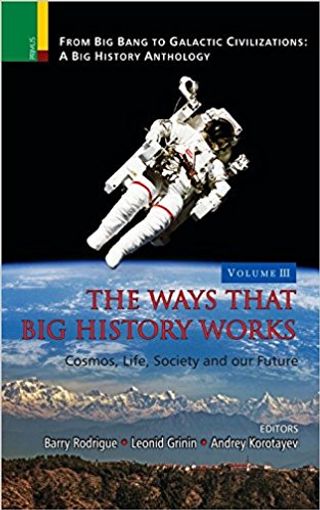
Grinin L. E., Korotayev A., Rodrigue B. Primus Books, 2017.
Korotayev A., , in: Complexity in Universal Evolution. A Big History Perspective.: Springer, 2026. Ch. 13 P. 359–409.
We have undertaken an attempt to propose a periodization of the Big History Biosocial (Anthropogenesis) Era on the basis of the most recent scientific data. This periodization is complexity-based, that is, the boundaries of the identified epochs are marked with complexity jumps, that is, in our case, such phase transitions that result in significant increases ...
Added: August 10, 2026
Leonid Grinin, Alexander M., Korotayev A., , in: Complexity in Universal Evolution. A Big History Perspective.: Springer, 2026. Ch. 12 P. 283–355.
In the first half of this chapter, Grinin et al. survey general similarities and differences between biological and social macroevolution. They undertake a systematic comparison between biological and social evolution at different levels of analysis and in various aspects, formulating a considerable number of general principles and rules of evolution, and working to develop a ...
Added: August 10, 2026
David J. L., Grinin L. E., Korotayev A., , in: Complexity in Universal Evolution. A Big History Perspective.: Springer, 2026. Ch. 2 P. 29–90.
This chapter explores the role of complexity dynamics in Big History through an integrative theoretical framework that spans physical, chemical, biological, social, cognitive, and civilizational domains. Building on foundational work in systemstheory,thermodynamics,andevolutionarytheory,thechapterarguesthat complexity can serve as a conceptual bridge across disciplines. By examining how complexity emerges, is sustained, and transforms across thresholds, as well as ...
Added: August 10, 2026
Korotayev A., LePoire D., , in: Complexity in Universal Evolution. A Big History Perspective.: Springer, 2026. Ch. 5 P. 151–171.
A previous study compared the symmetries of the cooling after the Big Bang and thedevelopment oflife, humans,and civilization on Earth. Asimple model ofthe relative rates of change depicts two cones joined at their bases representing the Big Bang expansion and the acceleration of complexity development on Earth through life evolution, human evolution, and civilization development. ...
Added: August 10, 2026
David J. L., Leonid Grinin, Korotayev A., , in: Complexity in Universal Evolution. A Big History Perspective.: Springer, 2026. Ch. 1 P. 1–25.
Complexity is widely acknowledged as a foundational and pivotal concept in Big History, offering a unifying lens through which to examine the emergence and development of systems—from particles and galaxies to life, civilizations, and beyond. Yet, despite its centrality, major gaps remain in how we define, measure, and interpret complexity across different phases and scales. ...
Added: August 10, 2026
David J. L., Leonid Grinin, Korotayev A., Springer, 2026.
Complexity is widely acknowledged as a foundational and pivotal concept in Big History, offering a unifying lens through which to examine the emergence and development of systems—from particles and galaxies to life, civilizations, and beyond. Yet, despite its centrality, major gaps remain in how we define, measure, and interpret complexity across different phases and scales. ...
Added: August 7, 2026
Evgeny A. Kanaev, Berezhnaya A., Southeast Asia: Actual Problems of Development 2026 Vol. 2 No. 2(71) P. 175–187
The article examines the significance and the place of the digital tools developed by the Regional Comprehensive Economic Partnership (RCEP) in the priorities of the Socialist Republic of Vietnam (SRV). On tracing the RCEP’s origins, evolution, and interim outcomes obtained to date, the article proceeds with assessing the efficiency of the RCEP’s digital tools to ...
Added: July 30, 2026
Kocherov S., Диалог со временем 2026 № 95 С. 5–21
The article presents arguments in defense of free will. It criticizes the approach based on the concept of physicalism, from the position of which rigid incompatibilists reduce human consciousness to the activity of brain neurons, and processes at all levels of being to physical laws. Although physical laws and unconscious brain activity condition human decisions ...
Added: June 23, 2026
Plandin F., Temereva E., Zoological Journal of the Linnean Society 2025 Vol. 205 No. 2 Article zlaf139
Although Brachiopoda represent a relatively small phylum, they exhibit significant morphological diversity. One of the central issues in understanding the evolution of the ancestral brachiopod body plan pertains to the homologies among body compartments across the different brachiopod subphyla: Craniiformea, Linguliformea, and Rhynchonelliformea. In this context, the pedicle stands out as one of the most ...
Added: June 15, 2026
Dybskaya V., Sergeyev V., РИСК: Ресурсы, информация, снабжение, конкуренция 2025 № 2 С. 11–17
The origins and importance of supply chain management (SCM) in the modern economy are analyzed. It is shown that the USP is a continuation and development of the concept of integrated business logistics. The evolution of logistics from the 1960s to the 2000s is presented. The main functionality of the ADC for business organizations is ...
Added: April 28, 2026
Daria Y. Romanova, Moroz L., Frontiers in Immunology 2025 Vol. 15 Article 1529836
~520 million years ago, the long biogeochemical history of our planet Earth resulted in a biodiversity burst. The rapid diversification of animals known as the Cambrian explosion (1); transformed planetary ecosystems with novel habitats and food chains (2, 3). However, this emergence of Paleozoic biodiversity (4) is still mysterious due to limited information about basal metazoans ...
Added: November 15, 2025
LePoire D., Grinin L. E., Korotayev A., Journal of Big History 2025 Vol. 8 No. 3 P. 98–139
Building on foundational work in systems theory, thermodynamics, and evolutionary theory, this paper argues that complexity can serve as a conceptual bridge across disciplines. It explores the role of complexity dynamics in Big History through an integrative theoretical framework that spans physical, chemical, geological, biological, social, cognitive, and civilizational domains. By examining how complexity emerges, ...
Added: November 1, 2025
Leontiev D., Философские науки 2025 Т. 68 № 1 С. 79–91
The paper examines the issue of the humane in the human being in the context of the dialectic between ideals and reality. Reflecting on discussions about human essence leads to the conclusion of its inherent indeterminacy and the multiplicity of potential capabilities within each individual, which develop throughout life. The distinction between ideal and reality ...
Added: September 11, 2025