• A
  • A
  • A
  • АБВ
  • АБВ
  • АБВ
  • A
  • A
  • A
  • A
  • A
Обычная версия сайта
  • RU
  • EN
  • HSE University
  • Publications
  • Book chapter
  • Macrofamilies and agricultural lexicon: problems and perspectives
  • RU
  • EN
Расширенный поиск
Высшая школа экономики
Национальный исследовательский университет
Priority areas
  • business informatics
  • economics
  • engineering science
  • humanitarian
  • IT and mathematics
  • law
  • management
  • mathematics
  • sociology
  • state and public administration
by year
  • 2027
  • 2026
  • 2025
  • 2024
  • 2023
  • 2022
  • 2021
  • 2020
  • 2019
  • 2018
  • 2017
  • 2016
  • 2015
  • 2014
  • 2013
  • 2012
  • 2011
  • 2010
  • 2009
  • 2008
  • 2007
  • 2006
  • 2005
  • 2004
  • 2003
  • 2002
  • 2001
  • 2000
  • 1999
  • 1998
  • 1997
  • 1996
  • 1995
  • 1994
  • 1993
  • 1992
  • 1991
  • 1990
  • 1989
  • 1988
  • 1987
  • 1986
  • 1985
  • 1984
  • 1983
  • 1982
  • 1981
  • 1980
  • 1979
  • 1978
  • 1977
  • 1976
  • 1975
  • 1974
  • 1973
  • 1972
  • 1971
  • 1970
  • 1969
  • 1968
  • 1967
  • 1966
  • 1965
  • 1964
  • 1963
  • 1958
  • More
Subject
News
May 20, 2026
HSE University Opens First Representative Office of Satellite Laboratory in Brazil
HSE University-St Petersburg opened a representative office of the Satellite Laboratory on Social Entrepreneurship at the University of Campinas in Brazil. The platform is going to unite research and educational projects in the spheres of sustainable development, communications and social innovations.
May 18, 2026
The 'Second Shift' Is Not Why Women Avoid News
Women are more likely than men to avoid political and economic news, but the reasons for this behaviour are linked less to structural inequality or family-related stress than to personal attitudes and the emotional perception of news content. This conclusion was reached by HSE researchers after analysing data from a large-scale survey of more than 10,000 residents across 61 regions of Russia. The study findings have been published in Woman in Russian Society.
May 15, 2026
Preserving Rationality in a Period of Turbulence
The HSE International Laboratory for Logic, Linguistics and Formal Philosophy studies logic and rationality in a transformed world characterised by a diversity of logical systems and rational agents. The laboratory supports and develops academic ties with Russian and international partners. The HSE News Service spoke with the head of the laboratory, Prof. Elena Dragalina-Chernaya, about its work.


Have you spotted a typo?
Highlight it, click Ctrl+Enter and send us a message. Thank you for your help!

Publications
  • Books
  • Articles
  • Chapters of books
  • Working papers
  • Report a publication
  • Research at HSE

?

Macrofamilies and agricultural lexicon: problems and perspectives

P. 215–233.
Starostin G.

It is more or less self-evident that the origins of agriculture cannot be directly associated with the ancestral speakers of any of the commonly accepted, non-controversial language families such as Indo-European, Semitic, Dravidian, etc., since these origins go much deeper back in time than any of these ancestral languages. Consequently, in this paper I present a brief overview of some of the most promising, if controversial, hypotheses on deep-level language relationship between various linguistic stocks of Western and Central Eurasia in terms of whether or not there is a chance of reconstructing at least a small amount of agricultural terminology for such hypothetical entities as Proto-Nostratic, Proto-Sino-Caucasian, and Proto-Afroasiatic. The overview leads to the conclusion that some of the most archaic agricultural terminology in the Near East may be associated with the North Caucasian linguistic family and, possibly, also with Basque as its nearest genetic relative; at the same time, evidence of ancient agricultural lexicon in the Afroasiatic stock remains at best circumstantial, whereas evidence from various lineages of “Nostratic” is practically non-existent.


Language: English
Text on another site
Keywords: origins of agriculturemacrofamilieslong-range comparisonпроисхождение земледелиямакросемьидальнее родство языков

In book

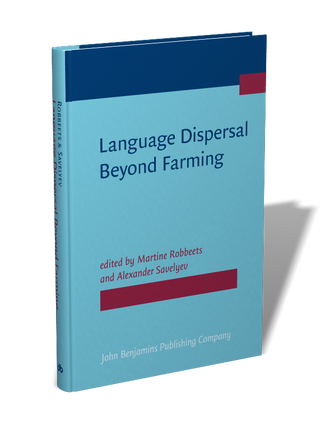
Language Dispersal Beyond Farming
John Benjamins Publishing Company, 2017.
Similar publications
Calibrated weighted permutation test detects ancient language connections in the Circumpolar area (Chukotian-Nivkh and Yukaghir-Samoyedic)
Kassian A., Starostin G., Zhivlov M. et al., Journal of Historical Linguistics 2025 Vol. 15 No. 3 P. 463–481
Relationships between universally recognized language families represent a hotly debated topic in historical linguistics, and the same is true for correlation between signals of genetic and linguistic relatedness. We developed a weighted permutation test which represents the classical permutation tests with weights introduced for individual Swadesh concepts according to their typological stability. Further, the obtained ...
Added: June 17, 2024
Cognate maximization versus cognate minimization: in search of a "golden middle" for Altaic etymology
Starostin G., , in: Siberica et Uralica: In memoriam Eugen Helimski.: Szeged: Szegedi Tudomanyegyetern/University of Szeged, 2022. Ch. 16 P. 277–292.
Added: June 17, 2024
Генезис индоевропейской оппозиции глухих и звонких придыхательных смычных в свете данных внешнего сравнения
Zhivlov M., В кн.: Славянское и балканское языкознание. Балто-славянская компаративистика. Акцентология. Дальнее родство языков. Выпуск 23.: М.: Институт славяноведения РАН, 2023. С. 66–78.
Added: March 28, 2024
Славянское и балканское языкознание. Балто-славянская компаративистика. Акцентология. Дальнее родство языков. Выпуск 23
М.: Институт славяноведения РАН, 2023.
The current volume of the series “Slavic and Balkan Linguistics” contains a monograph titled “Baltoslavic Comparative Studies. Accentology. Distant Language Relations. Vladimir A. Dybo in memoriam” by an international team of authors. The collective monograph's sections are dedicated to discussing the latest research results in the field of Balto‑Slavic accentology and morphology against the Indo‑European ...
Added: March 28, 2024
How we could show that Hadza is Afroasiatic: a response to Militarev’s “Hadza as Afrasian?”
Starostin G., Journal of Language Relationship 2023 Vol. 21 No. 1-2 P. 110–116
In this response to Alexander Militarev’s paper on the Afroasiatic (Afrasian) affiliation of Hadza, I attempt to identify the major theoretical issues with his lexicostatistical analysis of the similarities between Hadza and the various branches of the Afroasiatic family, explaining why this analysis cannot be accepted as conclusive, and suggesting some steps that could be ...
Added: November 15, 2023
Evolution of Eurasian and African Family Systems, Cross-Cultural Research, Comparative Linguistics, and Deep History
Korotayev A., Borinskaya S., Starostin G. et al., Social Evolution & History 2019 Vol. 18 No. 2 P. 286–312
Currently, the main source for the reconstruction of the most ancient history of humankind is archeology, which almost by definition makes it possible to restore only just a few elements of the most ancient human culture (naturally, almost exclusively – material culture). A mere introduction of comparative linguistic data makes it possible to significantly refine ...
Added: November 23, 2019
The “Nostratic” roots of Indo-European: from Illich-Svitych to Dolgopolsky to future horizons
Starostin G., Zhivlov M., Kassian A., Slovo a Slovesnost 2016 Vol. 77 No. 4 P. 392–415
The paper presents a brief assessment of “Nostratic” – the controversial, but promising hypothesis on deeper linguistic connections of the Indo-European family, as envisaged by Vladislav Illich-Svitych and his contemporaries (particularly Aharon Dolgopolsky). We discuss some of the most important developments of the theory since the 1960s, and explain how emphasis on “quantity over quality” ...
Added: October 9, 2018
New trends in European studies on the Altaic problem
Dybo A., Journal of Language Relationship 2016 No. 14/1-2 P. 71–106
The paper discusses several general problems of present-day historical Altaistics, taking as a reference point the critical evaluation of two large monographs by Martine Robbeets — one on the Altaic origins of the Japanese language (Robbeets, Martine. 2005. Is Japanese related to Korean, Tungusic, Mongolic and Turkic? Wiesbaden: Harrassowitz) and another on the evidence that ...
Added: February 3, 2018
  • About
  • About
  • Key Figures & Facts
  • Sustainability at HSE University
  • Faculties & Departments
  • International Partnerships
  • Faculty & Staff
  • HSE Buildings
  • HSE University for Persons with Disabilities
  • Public Enquiries
  • Studies
  • Admissions
  • Programme Catalogue
  • Undergraduate
  • Graduate
  • Exchange Programmes
  • Summer University
  • Summer Schools
  • Semester in Moscow
  • Business Internship
  • Research
  • International Laboratories
  • Research Centres
  • Research Projects
  • Monitoring Studies
  • Conferences & Seminars
  • Academic Jobs
  • Yasin (April) International Academic Conference on Economic and Social Development
  • Media & Resources
  • Publications by staff
  • HSE Journals
  • Publishing House
  • iq.hse.ru: commentary by HSE experts
  • Library
  • Economic & Social Data Archive
  • Video
  • HSE Repository of Socio-Economic Information
  • HSE1993–2026
  • Contacts
  • Copyright
  • Privacy Policy
  • Site Map
Edit