• A
  • A
  • A
  • АБВ
  • АБВ
  • АБВ
  • A
  • A
  • A
  • A
  • A
Обычная версия сайта
  • RU
  • EN
  • HSE University
  • Publications
  • Book chapter
  • Englishization of Russian
  • RU
  • EN
Расширенный поиск
Высшая школа экономики
Национальный исследовательский университет
Priority areas
  • business informatics
  • economics
  • engineering science
  • humanitarian
  • IT and mathematics
  • law
  • management
  • mathematics
  • sociology
  • state and public administration
by year
  • 2027
  • 2026
  • 2025
  • 2024
  • 2023
  • 2022
  • 2021
  • 2020
  • 2019
  • 2018
  • 2017
  • 2016
  • 2015
  • 2014
  • 2013
  • 2012
  • 2011
  • 2010
  • 2009
  • 2008
  • 2007
  • 2006
  • 2005
  • 2004
  • 2003
  • 2002
  • 2001
  • 2000
  • 1999
  • 1998
  • 1997
  • 1996
  • 1995
  • 1994
  • 1993
  • 1992
  • 1991
  • 1990
  • 1989
  • 1988
  • 1987
  • 1986
  • 1985
  • 1984
  • 1983
  • 1982
  • 1981
  • 1980
  • 1979
  • 1978
  • 1977
  • 1976
  • 1975
  • 1974
  • 1973
  • 1972
  • 1971
  • 1970
  • 1969
  • 1968
  • 1967
  • 1966
  • 1965
  • 1964
  • 1963
  • 1958
  • More
Subject
News
May 13, 2026
Immersion in Second Language Environment Influences Bilinguals Perception of Emotions
Researchers at the Cognitive Health and Intelligence Centre at the HSE Institute for Cognitive Neuroscience have discovered how bilingual individuals process emotional words in their native (first) and non-native (second) languages. It was found that the link between word meaning and bodily sensations is weaker in a second language than in a first language. However, the more a person is immersed in a language environment, the smaller this difference becomes. The article has been published in Language, Cognition and Neuroscience.
May 12, 2026
‘Any Real-Economy Company Can Use Our Products
The HSE Centre for Financial Research and Data Analytics combines fundamental and applied work, including in areas unique to Russia such as the connection between sentiment in the media and social networks and financial markets. The HSE News Service spoke with the centre’s director, Professor Tamara Teplova, about its work.
May 7, 2026
Researchers Find More Effective Approach to Revealing Majorana Zero Modes in Superconductors
An international team of researchers, including physicists from HSE MIEM, has demonstrated that nonmagnetic impurities can help more accurately reveal Majorana zero modes—quantum states considered promising building blocks for quantum computing. The researchers found that these impurities shift the energy levels that typically obscure the Majorana signal, while leaving the mode itself largely unaffected, thereby making its spectral peak more distinct. The study has been published in Research.


Have you spotted a typo?
Highlight it, click Ctrl+Enter and send us a message. Thank you for your help!

Publications
  • Books
  • Articles
  • Chapters of books
  • Working papers
  • Report a publication
  • Research at HSE

?

Englishization of Russian

Ch. 3.2. P. 47–55.
Proshina Z., Rivlina A. A.

Chapter 3 deals with the interaction of language and culture that make two facets of Russian English. Section 1, prepared by Zoya Proshina, provides for the comparison between Russian and English. It describes typological characteristics of Russian and English and their common features and distinctions on different language levels, which may have an impact on the features of Russian English. It is known that language contact between English and an indigenous language is usually a two-way process that leads to nativization of English and Englishization of the indigenous language. Englishization of Russian is elucidated by Alexandra Rivlina and Zoya Proshina in section 2. In section 3, Alexandra Rivlina elabo-rates on English and Russian code-mixing and code-switching. She argues that English-Russian hybridization is increasingly widely used in Russian discourse, especially in the form of word play based on code-mixing. Section 4, by Svetlana Ter-Minasova, focuses the discussion on the contemporary changes in Russian mentality and culture caused by the sudden ‘intrusion’ of English into the Russian language, culture, and lifestyle. The impact of English culture via the English language in its various forms (mass media, advertisement, the avalanche borrowing, etc.) on the Russian culture can be seen in different domains: in the business domain, change of attitudes to patronymics; in academic papers, change of style, a great damage inflicted on the Russian linguacultural picture of the world by poor translations from English into Russian. Section 5, by Victor Kabakchi and Elena Beloglazova, characterizes the way English adjusts to expressing Russian culture-loaded concepts.

Language: English
Full text
DOI
Text on another site
Keywords: Englishization of Russian / Russianization of EnglishRussian Englishlanguage contact

In book

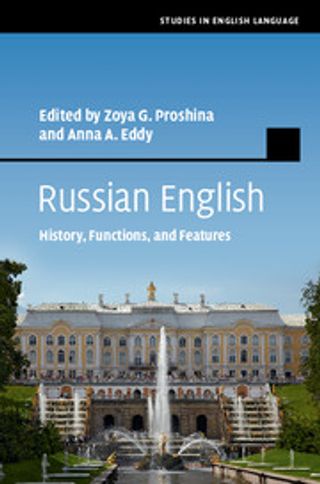
Russian English: History, Functions, and Features
Cambridge: Cambridge University Press, 2016.
Similar publications
Preposition drop in Russian spoken by Mari and Beserman bilinguals
Yakovleva A., Kosheliuk N., Moroz G., International Journal of Bilingualism 2025 P. 1–19
Aims and Research Questions: In this paper, we present a corpus-based study of preposition drop (p-drop) in the speech of Mari-Russian and Beserman-Russian bilinguals compared to the speech of Russian monolinguals. Based on data from spoken corpora, we demonstrate that the prepositions v ‘in’, k ‘to’, s ‘with’ are omitted in the speech of bilinguals ...
Added: November 26, 2025
О критериях выявления и стратификации булгаро-чувашских заимствований в пермских языках I
Savelyev A., Вопросы языкового родства 2025 № 23/1-2 С. 137–167
This article represents the first part of a two-part study devoted to the analysis of Turkic loanwords of the Bulghar-Chuvash type in the Permic languages. In this part, general criteria are proposed for distinguishing Bulgharic borrowings within the corpus of Udmurt and Komi words of Turkic origin. In addition, a “core” layer of Bulghar-Chuvash loanwords ...
Added: October 28, 2025
Quantifying lexical distances among Nudiz, Mahmudi, and Verin Dvin Urmi (North-Eastern Neo-Aramaic)
Shvedova E., Koryakov Y., Elizaveta Zabelina, Journal of Language Relationship 2025 Vol. 23 No. 3–4 P. 207–275
This study documents and analyzes lexical data from four Christian North-Eastern Neo-Aramaic varieties: Mahmudi, Nudiz, Verin Dvin Urmi, and Urmia Urmi, focusing on the previously undescribed Mahmudi and Nudiz. We provide correspondences from these lects for an extended 226-item basic vocabulary list collected for this study with etymologies, cognates from earlier Aramaic, and loanword sources. ...
Added: September 4, 2025
An overview of morphosyntactic variation in the speech of Russian-Chuvash bilinguals: number, gender, case assignment and preposition drop
Grishanova A., Russian linguistics 2025 Vol. 49 Article 10
The purpose of this study is to present a summary of morphosyntactic variation and a detailed analysis of the phenomenon of preposition drop in the Russian speech of Chuvash bilinguals. Specifically, I investigate what underlying factors might condition the variation. I conduct a qualitative analysis of the data extracted from the corpus of Russian spoken ...
Added: July 10, 2025
Awareness of Grammatical Variability in Language Contact: The Case of Mano and Kpelle in Guinea
Khachaturyan M., Moroz G., Mamy P., Journal of Sociolinguistics 2025 Vol. 29 No. 4 P. 268–284
This paper contributes to research on the awareness of grammatical variability through a study of variation in reflexivity marking in Mano under the influence of Kpelle, both indigenous languages of Guinea. The speakers of these languages are found to be sensitive to contact-induced grammatical variation in reflexivity, which manifests via variation in comprehension patterns and, ...
Added: June 3, 2025
Non-standard numeral constructions in L2 Russian: A corpus-based study
Naccarato C., Moroz G., International Journal of Bilingualism 2026 Vol. 30 No. 2 P. 358–379
Aims and Research Questions: The paper investigates variation in numeral constructions in the L2 Russian speech of bilinguals from different regions of Russia. The main research questions are the following: What factors prompt variation in this domain of grammar? Can we argue that non-standard marking is motivated by contact?   Methodology: We conduct a corpus-based study ...
Added: January 24, 2025
Valency patterns in Mande: Contact vs inheritance
Khachaturyan M., Moroz G., Vydrin V. et al., Studies in Language 2025 Vol. 49 No. 4 P. 823–857
In this paper, we address valency patterns in seven Mande languages with various degrees of genealogical proximity. Our study is based on the BivalTyp questionnaire focusing on 130 two-place predicates (Say 2020). While belonging to two distinct genetic groupings, two languages of the set, i.e. Mano (Southern Mande) and Kpelle (Southwestern Mande), are in intense ...
Added: August 27, 2024
Do languages spoken in multilingual communities converge? A case study of reflexivity marking in Mano and Kpelle
Khachaturyan M., Moroz G., Mamy P., Linguistics 2024 Vol. 62 No. 5 P. 1225–1250
This paper explores variation in the patterns of reflexivity marking in the Mano language and possible influence from the Kpelle language by using an experimental design with a picture questionnaire. While Kpelle does not have a morphological distinction between reflexive and basic pronouns, the Mano variety spoken by Mano-dominant individuals does possess such a distinction ...
Added: April 30, 2024
Ṭuroyo
Häberl C. G., Kashintseva K., Loesov S., , in: Language Diversity in Iran: New Texts and Perspectives from Non-Iranian Languages.: De Gruyter, 2024. Ch. 8 P. 285–358.
This survey offers a brief grammatical description of the Turoyo language spoken in the southeast of Turkey. Ṭuroyo is a largely unwritten Eastern Neo-Aramaic language, which derives its name from the Tur Abdin region. The Tur Abdin region, the ancient home of Ṭuroyo and the last remaining stronghold of Aramaic in the Republic of Türkiye, ...
Added: November 5, 2023
Language Diversity in Iran: New Texts and Perspectives from Non-Iranian Languages
De Gruyter, 2024.
The current companion will offer a survey of the Afroasiatic, Dravidian, Indo-Aryan, and Turkic languages in contact with Iranian languages. Comparatively few of Iran's minority languages are well-documented or even widely known outside of a small cadre of specialists. A volume that organizes sketches of the non-Iranian languages of Iran offers a unique perspective on ...
Added: November 5, 2023
The second genitive in the history of Russian and across its dialects
Ter-Avanesova A., Daniel M., Linguistic Variation 2023 No. 1 P. 28–74
In this paper, we provide a survey of the diachronic development of the Russian second genitive (Gen2). As endpoints of this development, we consider data from Russian dialects representing different dialect groups. Assumedly, the expansion of Gen2 started off as ‘recycling’ of the genitive of a declension type that became obsolete already in the pre-written ...
Added: September 8, 2023
Согласование прилагательных по числу в нахско-дагестанских языках: генеалогические и ареальные закономерности
Zakirova A., Родной язык: лингвистический журнал 2022 № 1 С. 5–49
This paper provides a survey of number agreement in the East Caucasian languages and languages of other language families in contact with East Caucasian. For a sample of 59 idioms I considered number agreement strategies of adjectives in the attributive position and established what factors license agreement in these idioms. Besides, I assessed the weight ...
Added: August 29, 2023
The Udi language: Its History and Modern Development
Maisak T., Journal of Endangered Languages 2023 Vol. 13 No. 22 P. 55–72
The paper presents an overview of Udi, a Nakh-Daghestanian language of the Lezgic branch and an indigenous language of Azerbaijan. After a general introduction about the Udi people and their language, I focus on the history of the study of Udi and Caucasian Albanian, on the development of modern writing systems for Udi, as well ...
Added: August 20, 2023
Сериальные конструкции с глаголом parək I в урмийских новоарамейских идиомах
Lyavdansky A., Acta Linguistica Petropolitana. Труды института лингвистических исследований 2023 Т. 19 № 1 С. 193–229
On the basis of field and corpus data, preliminary observations are made about the form and function of serial verb constructions (SVC) in the varieties of Christian Urmi Neo-Aramaic. Serial verb constructions are considered adopting “wide” understanding of this phenomenon, represented by the works of Plungyan, Aikhenvald and Andrason among many others. Big amount of data ...
Added: August 7, 2023
An Aramaic Verb Form in a Neo-Babylonian Letter
Berzon E., Maksim Kalinin, Sergey Koval et al., Journal of Semitic Studies 2023 Vol. 68 No. 2 P. 391–402
This paper offers an interpretation of an insufficiently understood verb form in the Neo-Babylonian letter OIP 114, 17:8, 29, thereby clarifying its contents. The word in question is shown to be an Aramaic verb form. This interpretation is supported by observations on the orthography and phonology of early Neo-Babylonian. It follows from the study that ...
Added: April 6, 2023
Некоторые тенденции в морфосинтаксисе переселенческих штокавских диалектов в Албании (Шияк и Мюзекея) и славяно-албанский языковой контакт
Макарцев М. М., Кикило Н. И., Славянский мир в третьем тысячелетии 2022 Т. 17 № 1-2 С. 120–141
This article puts into academic circulation the materials of the little-described migrational Shtokavian dialects in the Shijak (Durrës) and Myzeqe (Fier, the villages of Rreth Libof-sha, Hamil, etc.) areas collected during a linguistic expedition in July and August 2021. The Sandžak region (Novi Pazar, Tutin and Sjenica, modern Republic of Serbia), where the Shtokavian Novi ...
Added: December 22, 2022
A Modern Western Aramaic Account of the Syrian Civil War
Duntsov A. N., Häberl C., Loesov S., Word 2022 Vol. 68 No. 4 P. 359–394
Modern Western Aramaic is one of the most critically endangered Aramaic languages, and the only extant member of the Western Aramaic sub-family. Its speakers are among the few who have not migrated away from their original territory, but the Syrian Civil War (2011–present) has accelerated its endangerment and resulted in the abandonment of one of ...
Added: November 21, 2022
Испанистика в эпоху цифровизации. El hispanismo en la época de la digitalización : Материалы V Международного Конгресса испанистов России, Восточной Европы и Центральной Азии, 20-22 октября 2021 г.
Ростов н/Д: Издательство Южного федерального университета, 2023.
During the congress, leading scientists, university professors, and young researchers presented the results of their work in the field of the Spanish language and culture, history, economics and political science of Spanish-speaking countries, in the field of teaching Spanish as a foreign language. ...
Added: November 17, 2022
Лингвотекстологические маркеры в позднесредневековых славянских библейских переводах с еврейских оригиналов
Grishchenko A., Studi Slavistici 2022 Т. 19 № 1 С. 285–300
The article raises the question of language items (words or phrases) which could be the markers of a textual relationship between Biblical translations and their originals, on the examples of two East Slavonic texts created presumably in the 15th century in the Ruthenian lands of the Grand Duchy of Lithuania. The article is based on ...
Added: June 7, 2022
  • About
  • About
  • Key Figures & Facts
  • Sustainability at HSE University
  • Faculties & Departments
  • International Partnerships
  • Faculty & Staff
  • HSE Buildings
  • HSE University for Persons with Disabilities
  • Public Enquiries
  • Studies
  • Admissions
  • Programme Catalogue
  • Undergraduate
  • Graduate
  • Exchange Programmes
  • Summer University
  • Summer Schools
  • Semester in Moscow
  • Business Internship
  • Research
  • International Laboratories
  • Research Centres
  • Research Projects
  • Monitoring Studies
  • Conferences & Seminars
  • Academic Jobs
  • Yasin (April) International Academic Conference on Economic and Social Development
  • Media & Resources
  • Publications by staff
  • HSE Journals
  • Publishing House
  • iq.hse.ru: commentary by HSE experts
  • Library
  • Economic & Social Data Archive
  • Video
  • HSE Repository of Socio-Economic Information
  • HSE1993–2026
  • Contacts
  • Copyright
  • Privacy Policy
  • Site Map
Edit