?
Взаимное превращение обыденного и научного в истории создания новой социологии науки в 1970–80-х гг.: модель совмещения социального и рационального объяснений
Гл. 10. С. 310–324.
This paper examines the history of the institutionalization of the new Sociology of Science (STS) both as a Research Program within Sociology of Science and as an intellectual Social Movement. The analysis of the interaction between Social and Rational contexts been made from Internalism vs Externalism points of view. By the intersection of the outer and inner stories in case of Sociology of Science 1970-80th we indicate the reconfiguration of young scholars everyday beliefs about Science and institution of Society in institutional contexts of their methodological developments what made contemporary STS a “Playful” Theory .
Keywords: социология наукиsociology of scienceистория социологииисследования науки и технологий (STS)постпозитивизмнауковедениеhistory of sociologyrelativismрелятивизмscience studiespostpositivism
Publication based on the results of:
In book
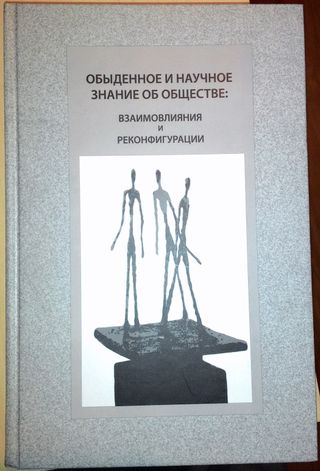
Deviatko I. F., Abramov R., Бруккмайер Карл, Gavrilov K. A., Kozhanov A., Зотов А. А., Катерный И. В., Подвойский Д. Г., Сапов В. В. М.: Прогресс-Традиция, 2015.
Katchanov Y. L., Социологическое обозрение 2026 Т. 25 № 3 С. 36–61
В статье предлагается теоретическая рамка анализа научной элиты, исходящая из понимания производства знания как динамической структуры, формируемой внутренними противоречиями. Научная элита рассматривается не как совокупность выдающихся исследователей, а как структурный эффект производства знания — позиция в пространстве науки, концентрирующая максимальный объем научного капитала и задающая смысловой горизонт для всех агентов. Пространство науки трактуется как многомерное ...
Added: September 30, 2026
Merzenina A., Социологическое обозрение 2026 Т. 25 № 2 С. 206–242
This article examines the transformation of political theology, or political ontotheology, in the era of late capitalism. The author first analyzes the specifics of nihilism as interpreted by Nietzsche and Heidegger, then moves on to a consideration of epistemological, ethical, and political relativism, the general essence of which consists of a nihilistic rejection of a ...
Added: September 20, 2026
Katchanov Y. L., Социологический журнал 2026 Т. 32 № 2 С. 59–77
The concept of the “scientific elite” as a heuristic principle and a framework for sociological analysis carries the implicit assumption of the inherent superiority of a small number of 'outstanding scientists.' This paper introduces the space of science as a multidimensional distribution of agents of knowledge production across relative positions. The space of science is ...
Added: July 18, 2026
Жуматина М.-С. Д., Вопросы философии 2026 № 7 С. 140–154
This article analyzes the proclamation of G.W.F. Hegel as the “father of art history” advanced by the art historian E. Gombrich in his essay of the same name, and investigates the origins and consequences of this gesture. The paper examines Gombrich’s arguments concerning fundamental Hegelian ideas – the five Hegelian “giants” – which, in his ...
Added: July 11, 2026
Kildyushov O., Мир России: Социология, этнология 2026 Т. 35 № 2 С. 6–21
This article examines a heuristic framework for analyzing the significance of Russian themes in Max Weber’s corpus, in connection with the completion of the complete edition of his works as a comprehensive source base. It highlights the ambivalent position of Russian themes in the his legacy: while Russia was never central to his scholarship, the issue ...
Added: May 20, 2026
Грудников Н. С., Социология науки и технологий 2026 Т. 17 № 1 С. 241–255
This article examines the key tenets of the theory of scientific/intellectual movements (SIMs) developed by Scott Frickel and Neil Gross, while demonstrating its connection to the recent interdisciplinary field of Science and Technology Studies (STS). Until recently, sociology lacked a theory with a universal explanatory power for analyzing intellectual movements. The Frickel — Gross framework ...
Added: May 7, 2026
Kazun A. D., ИНТЕРакция. ИНТЕРвью. ИНТЕРпретация 2025 Т. 17 № 3 С. 35–54
This article presents the findings of a study on Russian perceptions of the consequences of fake news. The empirical foundation consists of 119 semi-structured interviews conducted in 2024 with respondents of varying ages and news consumption engagement. Participants problematized the spread of fake news, highlighting a wide range of negative consequences that can be grouped ...
Added: September 30, 2025
Kazun A. D., Полис. Политические исследования 2025 № 6 С. 73–85
This study examines folk theories of fake news within the context of a complex, heterogeneous, and rapidly changing media environment. This article is based on 119 semi-structured interviews exploring perceptions of fake news. Analysis reveals three prevalent folk theories concerning this phenomenon: (1) "Fake news is everywhere," reflecting a relativistic understanding of facts. Informants expressed ...
Added: September 16, 2025
Iudin I., Polyakova V., Мир России: Социология, этнология 2025 Т. 34 № 3 С. 51–78
The development of science and technology is typically considered to be a key prerequisite for socio-economic development. Trust in science plays an important role in the dissemination of knowledge and acceptance of scientific results, support for research and development, etc. The concept of trust, like the concept of science, is a multidimensional one, a fact ...
Added: July 22, 2025
Rumyantseva M., Новое прошлое 2025 № 1 С. 106–120
The author substantiates the hypothesis that presentism is an immanent characteristic of historical knowledge of the 20th–first quarter of the 21st century, and suggests alternatives to its extreme forms in modern historical culture (since the mid- 2000s). The problem of presentism is considered in relation to the concept of historical culture. The relevance of this issue ...
Added: July 4, 2025
Shmatko N., Маркова Ю. В., Социологический журнал 2025 Т. 31 № 1 С. 110–123
The article deals with the history and interpretation of Pierre Bourdieu’s concept of “social space”.
With the help of the concept, Bourdieu described a set of interrelated social phenomena that support
and reflect each other. He defined social space as a multidimensional distribution of agents (individual
or collective) over objective positions determined by the distribution of effective resources ...
Added: May 23, 2025
Zamyatin K., Вестник Пермского университета. Серия: Политология 2023 Т. 17 № 3 С. 75–84
The text reviews the book by analysing the content of the book itself and providing the context of interna-tional scientific research on language and society. The text of the book is analysed sequentially, starting with the introduction and continuing from chapter to chapter. At the end, a conclusion is drawn on the signifi-cance of the ...
Added: April 19, 2025
Popov D., Социология науки и технологий 2025 Т. 16 № 2 С. 176–190
Despite the fact that popular science has been a part of the science world for a long time, it is constantly evolving and adapting to the rapidly changing modern world. New communication methods, such as the Internet, have greatly expanded the ability of scientists to make science accessible to the general public. Popular science films, ...
Added: February 24, 2025