?
Жена Н.Д. Кондратьева – Евгения Давыдовна Дорф: новые биографические данные
С. 272–319.
Klyukin P. N., Шайкин В.
The chapter highlights little-known facts about N.D. Kondratieff family. We present new facts (including historical data and photographic series) about his wife E.D. Kondratieva.
Springer, 2022.
This book examines the interrelations between Russian and European economics from the early 19th century to the present. It analyzes how Western economic thinking, such as classical economics and the marginal revolution, influenced Russian economic thinking and how Western economic ideas were modified and adapted to better reflect the specific Russian circumstances of the time. Moreover, ...
Added: October 21, 2022
Melnik D. V., Russian Journal of Economics 2021 Vol. 7 No. 1 P. 34–49
The article provides an interpretation of Lenin’s earliest contributions (made in 1893–1899) to the study of economic development. In the 1890s, Lenin joined young Marxist intellectuals in their fight against the Narodnik economists, who represented the approach prevalent among the Russian radical intelligentsia in the 1870s–1880s. Lenin elaborated his theoretical interpretation of Marxism as applied ...
Added: April 20, 2021
Klyukin P. N., В кн.: История экономических учений.: М.: Юрайт, 2018. Гл. 16 С. 282–302.
The main stages of the formation of the Russian school of economics and mathematics are revealed.
and the logic of their transition, the names of the main economists-mathematicians of Russia of the pre-revolutionary period, including N.D. Kondratieff ...
Added: October 17, 2018
Klyukin P. N., В кн.: А.И. Чупров и современная Россия: материалы междисциплинарной конференции «А.И. Чупров — великий сын России» (в честь 175-летия со дня рождения А.И. Чупрова).: М.: Экономический факультет МГУ им. М.В. Ломоносова, 2018. С. 39–46.
A comparison of the political and economic views of A.I. Chuprov (1842–1908) and M.I. Tugan-Baranovsky (1865–1919) in the context of recreating the holistic image of Russian economic thought in the period up to 1917 is conducted and analyzed. ...
Added: October 12, 2018
М.: Экономический факультет МГУ им. М.В. Ломоносова, 2018.
The collection contains in abbreviation texts of speeches of participants of the interdisciplinary scientific conference “A. I. Chuprov is the great son of Russia. ” Conference materials are grouped into sections in accordance with its program: topics of the plenary session, sections and round table ...
Added: October 12, 2018
Cham: Palgrave Macmillan, 2018.
This book explores the application of field theory (patterns of interaction) to Russian economic history, and how social and political fields mediate the influences of institutions, structures, discourses and ideologies in the creation and dissemination of economic thinking, theory and practice. Using focused cases on Russia's economy from the mid-nineteenth century to the present, Hass ...
Added: June 23, 2018
Denis Mel'nik, Slavic Review 2017 Vol. 76 No. 3 P. 722–731
By February 1917, the handful of future Bolshevik leaders of Russia were scattered all over the globe. Among the few things they had in common was a peculiar vision of the Russian economy and of global economic trends. That vision guided their revolutionary activity. Whether it was “correct” or not, they succeeded. With their grip ...
Added: October 24, 2017
М.: ИНФРА-М, 2016.
В работе рассматриваются проблемы экономической теории в историческом развитии с точки зрения преподавателей истории экономических учений в ведущих вузах Франции и России. Французские авторы посвятили свои статьи экономической мысли Античности и особенно Средневековья, а также течениям физиократии, сенсуализма, различных этапов классической школы, маржиналистской революции. В статьях российских авторов раскрываются исторический фон экономических теорий, творческие биографии ...
Added: November 8, 2016
Klyukin P. N., Мясоедов Б. А., Экономические стратегии 2015 № 3 (129) С. 88–96
A creative heritage of the Russian economist S.A. Pervushin (1888-1966) is considered ...
Added: March 17, 2016
Klyukin P. N., Мясоедов Б. А., Экономические стратегии 2015 № 2 (128) С. 98–107
A creative heritage of the Russian economist S.A. Pervushin (1888-1966) is considered. ...
Added: March 17, 2016
Klyukin P. N., В кн.: У истоков российской экономической мысли (К 290-летию "Книги о скудости и богатстве" И. Т. Посошкова).: М.: Финансовый университет при Правительстве РФ, 2015. Гл. 12 С. 198–208.
The chapter deals with the problem of demarcation of Russian economic thought. The point of demarcation is 1890 - the year of publication of the M.I. Tugan-Baranovsky' article on the marginal utility of economic goods. ...
Added: March 17, 2016
Nureev R., Gloveli G., Kalmychkova E. N. et al., М.: Финансовый университет при Правительстве РФ, 2015.
The peasant-entrepreneur Ivan Pososhkov (1652–1726) is considered the first Russian economist, as his «Book of Poverty and Wealth» is the earliest works of Russian social thought, especially on the integrated coverage of socio-economic problems – the role of the state in the economy, tax collection, trade, serfdom, regulation of monetary circulation, «rule of law», etc. ...
Added: July 16, 2015
Эвристическое значение метода возвратной традиции (на примере творческого наследия Н.Д. Кондратьева)
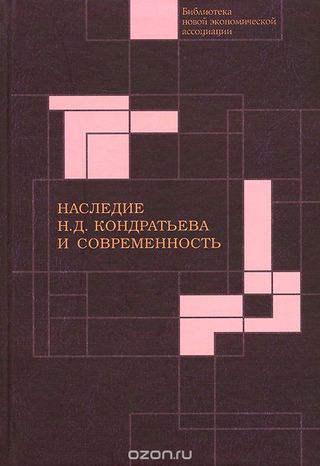
Klyukin P. N., В кн.: Наследие Н.Д. Кондратьева и современность.: М.: Алетейя, 2014. С. 205–253.
This chapter deals with the problems of author's implementation of "reversal tradition" method (via intellectual biography of N.D. Kondratieff) ...
Added: March 29, 2015
Klyukin P. N., В кн.: Наследие Н.Д. Кондратьева и современность.: М.: Алетейя, 2014. С. 8–12.
In the preface to the book reveals the activities Laboratory for the Study of the Russian economists Legacy, as well as the phenomenon of Kondratieff Readings hold in an extraordinary way. ...
Added: March 29, 2015
М.: Алетейя, 2014.
Collection is based on the extraordinary Kondratieff Readings conducted under II Russian Economic Congress, with the addition of new archival data about N.D. Kondratieff' family. ...
Added: March 29, 2015
Vdovin A., Russian Review 2017 Vol. 76 No. 1 (January) P. 53–71
The article investigates how Leo Tolstoy’s economic ideas are embodied in the plot of his short-story “Polikushka” (1863). Research shows that the fluctuation in the name of a sum of money the protagonist Polikey loses can be explained by the “double exchange rate“ of the ruble, i.e the lag between the rate of the silver ...
Added: October 2, 2014
Melnik Denis, Bogomazov G., , in: Sraffa and the Reconstruction of Economic TheoryVol. 3: Sraffa's Legacy: Interpretations and Historical Perspectives.: Houndmills: Palgrave Macmillan, 2013. Ch. 13 P. 281–300.
The chapter presents an overview of the development of economics in the nineteenth- and twentieth-century Russia by focusing on the different interpretations of Ricardo’s theory prevailing over this period. The choice of the reference point will make the overview somewhat selective, but still it is not an arbitrary one. Ricardian theory entered Russia relatively late, ...
Added: March 9, 2014