• A
  • A
  • A
  • АБВ
  • АБВ
  • АБВ
  • A
  • A
  • A
  • A
  • A
Обычная версия сайта
  • RU
  • EN
  • HSE University
  • Publications
  • Book chapter
  • Ricardo’s Writings in Russia: Influence and Interpretations
  • RU
  • EN
Расширенный поиск
Высшая школа экономики
Национальный исследовательский университет
Priority areas
  • business informatics
  • economics
  • engineering science
  • humanitarian
  • IT and mathematics
  • law
  • management
  • mathematics
  • sociology
  • state and public administration
by year
  • 2027
  • 2026
  • 2025
  • 2024
  • 2023
  • 2022
  • 2021
  • 2020
  • 2019
  • 2018
  • 2017
  • 2016
  • 2015
  • 2014
  • 2013
  • 2012
  • 2011
  • 2010
  • 2009
  • 2008
  • 2007
  • 2006
  • 2005
  • 2004
  • 2003
  • 2002
  • 2001
  • 2000
  • 1999
  • 1998
  • 1997
  • 1996
  • 1995
  • 1994
  • 1993
  • 1992
  • 1991
  • 1990
  • 1989
  • 1988
  • 1987
  • 1986
  • 1985
  • 1984
  • 1983
  • 1982
  • 1981
  • 1980
  • 1979
  • 1978
  • 1977
  • 1976
  • 1975
  • 1974
  • 1973
  • 1972
  • 1971
  • 1970
  • 1969
  • 1968
  • 1967
  • 1966
  • 1965
  • 1964
  • 1963
  • 1958
  • More
Subject
News
May 25, 2026
HSE Scientists Train Neural Network to 'Hear' Faults in Electric Motors
Researchers at the AI and Digital Science Institute of the HSE Faculty of Computer Science have developed a new method—the Signature-Guided Data Augmentation (SGDA) framework—that achieves 99% accuracy in motor fault detection and 86% accuracy in fault classification. The application of this approach can reduce industrial equipment repair costs, minimise downtime, and improve production safety. The study results have been published in Engineering Applications of Artificial Intelligence.
May 25, 2026
'The Humanities Serve as a Conscience'
Maria Mizernaia studies Soviet literature and the history of book publishing. In this interview for the HSE Young Scientists project, she discusses plans to publish a novel about besieged Leningrad, AI-provoked reflections on what it means to be human, and how novels can help satisfy our dopamine hunger.
May 25, 2026
Is It Possible to Predict a Citys Life Based on the Shape of Its Neighbourhoods?
Is it possible to predict, based on the configuration of streets and buildings, where a café will open or where traffic congestion will occur? Participants in the Spatial Analysis and Modelling of Urban Processes research and study group use open data and machine learning to identify universal patterns. Alexander Sheludkov and Eduard Somov discuss the purpose of comparing cities, the need for new forms of urban statistics, and how open data is transforming approaches to urban studies.


Have you spotted a typo?
Highlight it, click Ctrl+Enter and send us a message. Thank you for your help!

Publications
  • Books
  • Articles
  • Chapters of books
  • Working papers
  • Report a publication
  • Research at HSE

?

Ricardo’s Writings in Russia: Influence and Interpretations

Ch. 13. P. 281–300.
Melnik Denis, Bogomazov G.

The chapter presents an overview of the development of economics in the nineteenth- and twentieth-century Russia by focusing on the different interpretations of Ricardo’s theory prevailing over this period. The choice of the reference point will make the overview somewhat selective, but still it is not an arbitrary one. Ricardian theory entered Russia relatively late, in the 1870s. By that time it was considered already a part of the history of economics. However the debates between the different approaches in economics led to the confrontation of the corresponding versions of its history. Due to the rigorous style of Ricardo’s writings, their interpretation allowed less space for ideological or political connotations, comparing to the interpretations of Adam Smith or Karl Marx. Hence, the study of the different interpretations of Ricardian theory in the competing theoretical approaches allows to grasp the analytical difference between them.

The chapter is concentrated mainly on the history of pre-revolutionary Russian economics.

Language: English
Full text
Text on another site
Keywords: history of Russian economic thoughtистория российской экономической мыслиD. RicardoД. РикардоН.И. ЗиберЮ.Г. ЖуковскийNikolai SieberYuli Zhukovsky

In book

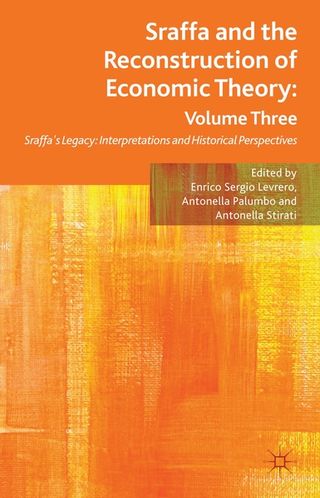
Sraffa and the Reconstruction of Economic Theory
Vol. 3: Sraffa's Legacy: Interpretations and Historical Perspectives. , Houndmills: Palgrave Macmillan, 2013.
Similar publications
Russian and Western Economic Thought: Mutual Influences and Transfer of Ideas
Springer, 2022.
This book examines the interrelations between Russian and European economics from the early 19th century to the present. It analyzes how Western economic thinking, such as classical economics and the marginal revolution, influenced Russian economic thinking and how Western economic ideas were modified and adapted to better reflect the specific Russian circumstances of the time. Moreover, ...
Added: October 21, 2022
Протомаржиналистский подход Юлия Жуковского и его истоки
А.В. Галеев, Д.В. Мельник, Вопросы теоретической экономики 2022 № 3 С. 118–129
The paper is devoted to Yuli Zhukovsky — the Russian 19th-century publicist who represented the economic thought of “thick journals”. Zhukovsky demonstrated both traits that W. S. Jevons attributed to marginalism, namely the use of mathematical apparatus and subjective value theory. On the one hand, believing that he was following “the Smithian approach”, Zhukovsky advocated ...
Added: September 10, 2022
Yuli Zhukovsky's proto-marginalism and its origins
Galeev A., Melnik D. V., / NRU Higher School of Economics. Series WP BRP "Economics/EC". 2022. No. 257/EC/2022.
The paper is devoted to Yuli Zhukovsky — the 19th-century Russian publicist who represented the economic thought of “thick journals”. Zhukovsky demonstrated both traits that W. S. Jevons attributed to marginalism, namely the use of mathematical apparatus and the subjective value theory. Believing that he was following “the Smithian approach”, Zhukovsky advocated for the application ...
Added: August 29, 2022
Yuli Zhukovsky’s contribution to Russian debates on economic development of the 1860s–70s
Galeev A., The European Journal of the History of Economic Thought 2022 Vol. 29 No. 6 P. 1042–1051
This paper is devoted to the debate on economic development in Russia after the abolition of serfdom in 1861 and focuses on the contribution of Yuli Zhukovsky, a self-taught economist. Based on his interpretation of western ideas, he saw material conditions as the crucial factor of economic development and suggested a set of measures that ...
Added: May 23, 2022
Proto-marginalist Approach in Russia: Yuli Zhukovsky’s Interpretation of Ricardo
Galeev A., The Journal of the New Economic Association 2022 No. 3 P. 177–191
The paper focuses on the interpretation of David Ricardo’s theory of value and distribution suggested by Yuli Zhukovsky, a 19th century Russian economist. In his interpretation, Zhukovsky introduced a two-factor production model characterized by decreasing marginal productivity as well as supply-and-demand price mechanism. Zhukovsky’s interpretation of Ricardo was an attempt to deliver a more rigorous ...
Added: February 23, 2022
Lenin as a development economist: A study in application of Marx’s theory in Russia
Melnik D. V., Russian Journal of Economics 2021 Vol. 7 No. 1 P. 34–49
The article provides an interpretation of Lenin’s earliest contributions (made in 1893–1899) to the study of economic development. In the 1890s, Lenin joined young Marxist intellectuals in their fight against the Narodnik economists, who represented the approach prevalent among the Russian radical intelligentsia in the 1870s–1880s. Lenin elaborated his theoretical interpretation of Marxism as applied ...
Added: April 20, 2021
Политико-экономические взгляды А.И. Чупрова и М.И. Туган-Барановского: сравнительный анализ
Klyukin P. N., В кн.: А.И. Чупров и современная Россия: материалы междисциплинарной конференции «А.И. Чупров — великий сын России» (в честь 175-летия со дня рождения А.И. Чупрова).: М.: Экономический факультет МГУ им. М.В. Ломоносова, 2018. С. 39–46.
A comparison of the political and economic views of A.I. Chuprov (1842–1908) and M.I. Tugan-Baranovsky (1865–1919) in the context of recreating the holistic image of Russian economic thought in the period up to 1917 is conducted and analyzed. ...
Added: October 12, 2018
А.И. Чупров и современная Россия: материалы междисциплинарной конференции «А.И. Чупров — великий сын России» (в честь 175-летия со дня рождения А.И. Чупрова)
М.: Экономический факультет МГУ им. М.В. Ломоносова, 2018.
The collection contains in abbreviation texts of speeches of participants of the interdisciplinary scientific conference “A. I. Chuprov is the great son of Russia. ” Conference materials are grouped into sections in accordance with its program: topics of the plenary session, sections and round table ...
Added: October 12, 2018
Re-Examining the History of the Russian Economy. A New Analytic Tool from Field Theory
Cham: Palgrave Macmillan, 2018.
This book explores the application of field theory (patterns of interaction) to Russian economic history, and how social and political fields mediate the influences of institutions, structures, discourses and ideologies in the creation and dissemination of economic thinking, theory and practice. Using focused cases on Russia's economy from the mid-nineteenth century to the present, Hass ...
Added: June 23, 2018
Revolutionary Economic Reasoning in the Context of Revolution: The Origins and Fate of Bolshevik Economics
Denis Mel'nik, Slavic Review 2017 Vol. 76 No. 3 P. 722–731
By February 1917, the handful of future Bolshevik leaders of Russia were scattered all over the globe. Among the few things they had in common was a peculiar vision of the Russian economy and of global economic trends. That vision guided their revolutionary activity. Whether it was “correct” or not, they succeeded. With their grip ...
Added: October 24, 2017
Абсолютная ценность и меновая ценность [август-сентябрь 1823]
Рикардо Д., В кн.: Начала политической экономии и налогового обложения. 2-е издание.: М.: Эксмо, 2016. С. 833–880.
This draft is translated from English, with notes and commentaries. D. Ricardo's manuscript "Absolute value and exchange value"  was written in the last months of his life (aug.-sept. 1823). In it, he continues to search for "an invariable measure of value" and comes to a series of nontrivial ideas that have become (as shown in ...
Added: March 15, 2017
О последней прижизненной рукописи Д. Рикардо (Введение к первому переводу на русский язык)
Klyukin P. N., В кн.: Начала политической экономии и налогового обложения. 2-е издание.: М.: Эксмо, 2016. С. 825–832.
In the preface to the translation of the last manuscript by D. Ricardo, "Absolute value and exchange value" (August-September 1823), an assessment of the historical and economic significance of this text in the corpus of Ricardo's works is given, a variant of rethinking Ricardo's heritage in Russia (the tradition of N. Zieber, on the one ...
Added: March 15, 2017
Начала политической экономии и налогового обложения. 2-е издание
Рикардо Д., М.: Эксмо, 2016.
In the second edition of the works of D. Ricardo (1772-1823) the most important works were published, revealing the multifacetedness, depth and at the same time the integrity of his work. In this edition for the first time the translation of Ricardo's last lifetime manuscript "Absolute Value and Exchange Value" (1823) is published. In it, ...
Added: March 15, 2017
Экономическая теория в историческом развитии: взгляд из Франции и России
М.: ИНФРА-М, 2016.
В работе рассматриваются проблемы экономической теории в историческом развитии с точки зрения преподавателей истории экономических учений в ведущих вузах Франции и России. Французские авторы посвятили свои статьи экономической мысли Античности и особенно Средневековья, а также течениям физиократии, сенсуализма, различных этапов классической школы, маржиналистской революции. В статьях российских авторов раскрываются исторический фон экономических теорий, творческие биографии ...
Added: November 8, 2016
Сергей Первушин еще плохо изучен и мало известен
Klyukin P. N., Мясоедов Б. А., Экономические стратегии 2015 № 3 (129) С. 88–96
A creative heritage of the Russian economist S.A. Pervushin (1888-1966) is considered ...
Added: March 17, 2016
Сергей Первушин еще плохо изучен и мало известен
Klyukin P. N., Мясоедов Б. А., Экономические стратегии 2015 № 2 (128) С. 98–107
A creative heritage of the Russian economist S.A. Pervushin (1888-1966) is considered. ...
Added: March 17, 2016
  • About
  • About
  • Key Figures & Facts
  • Sustainability at HSE University
  • Faculties & Departments
  • International Partnerships
  • Faculty & Staff
  • HSE Buildings
  • HSE University for Persons with Disabilities
  • Public Enquiries
  • Studies
  • Admissions
  • Programme Catalogue
  • Undergraduate
  • Graduate
  • Exchange Programmes
  • Summer University
  • Summer Schools
  • Semester in Moscow
  • Business Internship
  • Research
  • International Laboratories
  • Research Centres
  • Research Projects
  • Monitoring Studies
  • Conferences & Seminars
  • Academic Jobs
  • Yasin (April) International Academic Conference on Economic and Social Development
  • Media & Resources
  • Publications by staff
  • HSE Journals
  • Publishing House
  • iq.hse.ru: commentary by HSE experts
  • Library
  • Economic & Social Data Archive
  • Video
  • HSE Repository of Socio-Economic Information
  • HSE1993–2026
  • Contacts
  • Copyright
  • Privacy Policy
  • Site Map
Edit