• A
  • A
  • A
  • АБВ
  • АБВ
  • АБВ
  • A
  • A
  • A
  • A
  • A
Обычная версия сайта
  • RU
  • EN
  • HSE University
  • Publications
  • Book chapter
  • Принципы и формы организации обществ как систем институтов («концептуальная рамка» этой книги)
  • RU
  • EN
Расширенный поиск
Высшая школа экономики
Национальный исследовательский университет
Priority areas
  • business informatics
  • economics
  • engineering science
  • humanitarian
  • IT and mathematics
  • law
  • management
  • mathematics
  • sociology
  • state and public administration
by year
  • 2027
  • 2026
  • 2025
  • 2024
  • 2023
  • 2022
  • 2021
  • 2020
  • 2019
  • 2018
  • 2017
  • 2016
  • 2015
  • 2014
  • 2013
  • 2012
  • 2011
  • 2010
  • 2009
  • 2008
  • 2007
  • 2006
  • 2005
  • 2004
  • 2003
  • 2002
  • 2001
  • 2000
  • 1999
  • 1998
  • 1997
  • 1996
  • 1995
  • 1994
  • 1993
  • 1992
  • 1991
  • 1990
  • 1989
  • 1988
  • 1987
  • 1986
  • 1985
  • 1984
  • 1983
  • 1982
  • 1981
  • 1980
  • 1979
  • 1978
  • 1977
  • 1976
  • 1975
  • 1974
  • 1973
  • 1972
  • 1971
  • 1970
  • 1969
  • 1968
  • 1967
  • 1966
  • 1965
  • 1964
  • 1963
  • 1958
  • More
Subject
News
July 2, 2026
Researchers Discover How Spelling Errors Slow Down Reading in Russian
Psycholinguists from the Centre for Language and Brain at HSE University–St Petersburg have shown that words that are frequently misspelled are processed more slowly by readers, even when presented with the correct spelling. The researchers confirmed this effect for the first time using Russian-language materials and found that response speed is most strongly linked to how confidently individuals can distinguish the correct spelling of a word from an incorrect one. The study has been published in The Mental Lexicon.
July 2, 2026
HSE Develops App for Assessing Phonological Processing in Children
Researchers at the HSE Centre for Language and Brain have developed a new digital tool for assessing children's phonological processing skills—the ZARYA (Sound Analysis of the Russian Language) test battery. It is the first standardised application in Russia designed to provide a fast and reliable assessment of children's ability to distinguish speech sounds, retain them in working memory, and perform phonemic analysis. The app runs on Android tablets and smartphones and is available for download from RuStore. Details of the test validation have been published in the Journal of Speech, Language, and Hearing Research.
July 1, 2026
Scientists Discover Why Europium 'Misbehaves'
Europium is a rare-earth metal responsible for the pure red glow in displays and other luminescent materials. For a long time, however, it refused to emit light when surrounded by certain organic molecules known as acylpyrazolone ligands. Chemists have now uncovered the reason: in europium complexes with these ligands, a 'black window' appears—a charge-transfer state in which the energy absorbed by the ligand is dissipated as heat rather than emitted as light. Understanding this mechanism opens the way to designing more efficient red-emitting materials for displays, fluorescent thermometers, and chemical sensors. The results have been published in Dalton Transactions.


Have you spotted a typo?
Highlight it, click Ctrl+Enter and send us a message. Thank you for your help!

Publications
  • Books
  • Articles
  • Chapters of books
  • Working papers
  • Report a publication
  • Research at HSE

?

Принципы и формы организации обществ как систем институтов («концептуальная рамка» этой книги)

С. 7–47.
Bondarenko D. M.

Societies are systems composed of a great number of various social institutions. Societies are changing as a result of institutions appearance, transformation, and interaction. As systems of social institutions, societies have a fundamental characteristic that can be called a “basic principle of societal organization.” The principle of organization a society embodies depends on the way its institutions are arranged with respect to one another. Two basic principles can be distinguished: heterarchical, at which institutions interact being unranked with respect to one another or can be ranked in different ways, and the opposite principle, homoarchical, at which institutions interact being rigidly ranked in the only way and have no or very limited potential for being unraked or ranked in other ways. Societies of the same level of overall cultural complexity and basic principle of organization can take different specific forms, as alternativeness exists not only between but also within the heterarchical and homoarchical macrogroups of societies: heterarchy and homoarchy are not only not stages, but also not lines of social evolution. The division of societies into predominantly heterarchical and homoarchical is a constant fact of human sociocultural history; its appearance even precedes its beginning. The dichotomy of heterarchy and homoarchy has considerably determined the non-linear and alternative nature of the global sociocultural process. An adequate understanding of the past, present, and future of the humankind does not seem possible without taking into account of the alternativeness of the basic principles of organization of societies, their complementary and competitive coexistence, and their mutual dynamics throughout human history.

Language: Russian
Full text
Keywords: социальные институтыheterarchyгетерархияsocial institutionshomoarchyбазовые принципы организации культурcultures organization basic principlesгомоархия
Publication based on the results of:
Interactions between homoarchical and heterarchical cultures in varying historical contexts (2024)

In book

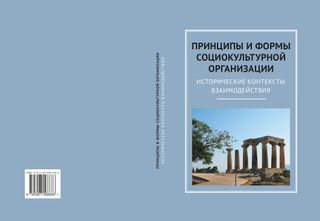
Принципы и формы социокультурной организации: исторические контексты взаимодействия
Aleksandrov G., Александрова А. К., Бовыкин Д. Ю., Bondarenko D. M., Burkova V., Butovskaya M., Вдовченков Е. В., Костелянец С. В., Ladynin I. A., Marey A. V., Туторский А. В., Федонников Н. А., Щавелев А. С. М.: Издательский дом ЯСК, 2024.
Similar publications
Ancient Greek Polis: From Homoarchy to Heterarchy and Back Again
Ivan A. Ladynin, , in: Principles and Forms of Sociocultural Organization: Historical Contexts of Interaction.: L., NY: Anthem Press, 2026. Ch. 2 P. 33–52.
The chapter considers the historical development of the Ancient Greek city-state (polis) viewed through the categories of homoarchy and heterarchy basic for the present monography. The author traces its formation on the base of the homoarchical society of the Dark Ages, the peculiarities of its heterarchical structure, the background of its crise in the 4th ...
Added: May 5, 2026
Древнегреческий полис: от гомоархии к гетерархии и обратно
Ladynin I. A., В кн.: Принципы и формы социокультурной организации: исторические контексты взаимодействия.: М.: Издательский дом ЯСК, 2024. Гл. 1 С. 51–79.
The chapter considers the historical development of the Ancient Greek city-state (polis) viewed through the categories of homoarchy and heterarchy basic for the present monography. The author traces its formation on the base of the homoarchical society of the Dark Ages, the peculiarities of its heterarchical structure, the background of its crise in the 4th ...
Added: May 5, 2026
"Коллективное безответственное": о попытках создать "общество" в городской коммуне
Котельников А. В., Этнографическое обозрение 2025 № 6 С. 212–233
The article presents research of one of about two dozen (known to the author) St. Petersburg communes based on living together in large apartments. The commune is considered by the concepts of scale by Marilyn Strathern and the concept of nonscalability by Anna Tsing. Scaling refers to the homogenization of practices and actors by integrating ...
Added: April 22, 2026
Conclusion
Gleb V. Aleksandrov, Bondarenko D. M., , in: Principles and Forms of Sociocultural Organization: Historical Contexts of Interaction.: L., NY: Anthem Press, 2026. Ch. 13 P. 251–259.
The brief concluding chapter reiterates the theoretical framework of the book and presents a brief overview of every chapter, highlighting the way chronologically and geographically diverse research subjects tie into the general approach the work utilizes. The author stresses the importance of the overarching goal of this collective work, to showcase the applicability of the ...
Added: January 22, 2026
Principles and Forms of Organization of Societies as Systems of Institutions (The “Conceptual Frame” of This Book)
Bondarenko D. M., , in: Principles and Forms of Sociocultural Organization: Historical Contexts of Interaction.: L., NY: Anthem Press, 2026. Ch. 1 P. 1–29.
Societies are systems composed of a great number of various social institutions. Societies are changing as a result of institutions appearance, transformation, and interaction. As systems of social institutions, societies have a fundamental characteristic that can be called a “basic principle of societal organization.” The principle of organization a society embodies depends on the way ...
Added: January 22, 2026
Principles and Forms of Sociocultural Organization: Historical Contexts of Interaction
Gleb V. Aleksandrov, Bondarenko D. M., Anna K. Aleksandrova et al., L., NY: Anthem Press, 2026.
Edited research collection One paragraph description of the project’s scope and content Societies are systems composed of a great number of various social institutions. Societies change as a result of emergence, transformation, and interaction of institutions. As systems of social institutions, societies have a fundamental characteristic that can be called a “basic principle of societal organization.” The ...
Added: January 22, 2026
  • About
  • About
  • Key Figures & Facts
  • Sustainability at HSE University
  • Faculties & Departments
  • International Partnerships
  • Faculty & Staff
  • HSE Buildings
  • HSE University for Persons with Disabilities
  • Public Enquiries
  • Studies
  • Admissions
  • Programme Catalogue
  • Undergraduate
  • Graduate
  • Exchange Programmes
  • Summer University
  • Summer Schools
  • Semester in Moscow
  • Business Internship
  • Research
  • International Laboratories
  • Research Centres
  • Research Projects
  • Monitoring Studies
  • Conferences & Seminars
  • Academic Jobs
  • Yasin (April) International Academic Conference on Economic and Social Development
  • Media & Resources
  • Publications by staff
  • HSE Journals
  • Publishing House
  • iq.hse.ru: commentary by HSE experts
  • Library
  • Economic & Social Data Archive
  • Video
  • HSE Repository of Socio-Economic Information
  • HSE1993–2026
  • Contacts
  • Copyright
  • Privacy Policy
  • Site Map
Edit