• A
  • A
  • A
  • АБВ
  • АБВ
  • АБВ
  • A
  • A
  • A
  • A
  • A
Обычная версия сайта
  • RU
  • EN
  • HSE University
  • Publications
  • Book chapter
  • Заключение
  • RU
  • EN
Расширенный поиск
Высшая школа экономики
Национальный исследовательский университет
Priority areas
  • business informatics
  • economics
  • engineering science
  • humanitarian
  • IT and mathematics
  • law
  • management
  • mathematics
  • sociology
  • state and public administration
by year
  • 2028
  • 2027
  • 2026
  • 2025
  • 2024
  • 2023
  • 2022
  • 2021
  • 2020
  • 2019
  • 2018
  • 2017
  • 2016
  • 2015
  • 2014
  • 2013
  • 2012
  • 2011
  • 2010
  • 2009
  • 2008
  • 2007
  • 2006
  • 2005
  • 2004
  • 2003
  • 2002
  • 2001
  • 2000
  • 1999
  • 1998
  • 1997
  • 1996
  • 1995
  • 1994
  • 1993
  • 1992
  • 1991
  • 1990
  • 1989
  • 1988
  • 1987
  • 1986
  • 1985
  • 1984
  • 1983
  • 1982
  • 1981
  • 1980
  • 1979
  • 1978
  • 1977
  • 1976
  • 1975
  • 1974
  • 1973
  • 1972
  • 1971
  • 1970
  • 1969
  • 1968
  • 1967
  • 1966
  • 1965
  • 1964
  • 1963
  • 1958
  • More
Subject
News
September 11, 2026
How to Assess Students Knowledge in the Age of AI
A researcher at HSE University has proposed a flowchart to help lecturers decide how to assess students who use artificial intelligence. It shows where the use of AI should be restricted and where it can be incorporated into the learning process. The article has been published in IT Professional.
September 9, 2026
‘Balkan Hospitality Opens Doors: Studying Dialects on the Verge of Extinction
You cannot study spoken dialects from books. Instead, you need to go to a village, seek out its elders, and earn the trust of local residents before you can record hours of spontaneous stories. This is how Natalia Muravleva, Associate Professor at the Faculty of Humanities, conducts her research. Her internship in Serbia continued her long-standing study of dialects spoken by Macedonian settlers. In this interview, she discusses how diaspora cultural centres help researchers reach informants, why native speakers need to be interviewed only in their own language (otherwise, as she puts it, they may 'break'), and how a single field season helped her finalise her monograph. She also shares warm memories of autumn in Belgrade and of colleagues with whom grammar can be discussed in three languages at once.
September 9, 2026
Scientists Train Neural Network to Generate Process Plans from 3D Models
Researchers at the HSE FCS AI and Digital Science Institute have developed CAD2TechSpec, a framework that converts 3D models of mechanical parts into machining process plans—step-by-step instructions for machine tools. The solution aims to reduce the time required for the design and preparation of technical process documentation in mechanical engineering, aircraft manufacturing, and other high-tech industries. The study findings have been published in PeerJ Computer Science.


Have you spotted a typo?
Highlight it, click Ctrl+Enter and send us a message. Thank you for your help!

Publications
  • Books
  • Articles
  • Chapters of books
  • Working papers
  • Report a publication
  • Research at HSE

?

Заключение

С. 343–357.
Aleksandrov G., Bondarenko D. M.

The concluding chapter reiterates the theoretical framework of the book and presents a brief overview of every chapter, highlighting the way chronologically and geographically diverse research subjects tie into the general approach the work utilizes. The author stresses the importance of the overarching goal of this collective work, to showcase the applicability of the concept of foundational principles of social organization in a wide range of historical contexts, from what can be called “traditionally ethnographic” societies to contemporary Western states. Special attention is given to the methodological range of the works presented in this volume, showing that the core concept combines effectively with a wide range of methodologies, from classic anthropological participatory observation to historical analysis and statistical methods. This highlights the inherently transdisciplinary nature of the theoretical concept initially established through borrowing the key notion of heterarchy from natural sciences, and expanded with significant influences from history, since the connection between anthropology and history was always prominent in the Russian anthropological tradition. Summarizing the results of the collective work, the author concludes that the theoretical framework used in the book has proven to be a useful tool for the study of social evolution from an institutionary perspective, which avoids strict categorization prevalent in other evolutionist approaches and allows the study of social complexity to be grounded in the actual empirical historic evidence rather than in preexisting notions of what forms of social organization should emerge in particular conditions. This establishes the concept of foundational principles of social organization one of the few existing theoretical frameworks to take into account the full diversity of social forms and social experiences which existed throughout history and exist today, studying or even acknowledging which has become an increasingly obvious challenge for anthropology and other related disciplines in recent years.

Language: Russian
Full text
Keywords: социальная теорияheterarchyгетерархиясоциальная эволюцияsocial theoryhomoarchysocial evolutionгомоархиясоциокультурная организацияsociocultural organization
Publication based on the results of:
Interactions between homoarchical and heterarchical cultures in varying historical contexts (2024)

In book

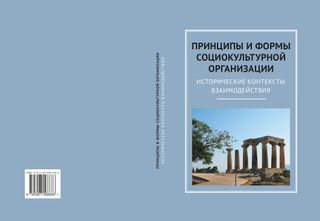
Принципы и формы социокультурной организации: исторические контексты взаимодействия
Aleksandrov G., Александрова А. К., Бовыкин Д. Ю., Bondarenko D. M., Burkova V., Butovskaya M., Вдовченков Е. В., Костелянец С. В., Ladynin I. A., Marey A. V., Туторский А. В., Fedonnikov N., Щавелев А. С. М.: Издательский дом ЯСК, 2024.
Similar publications
A Big History Perspective on Complexity in Universal Evolution: Conclusions
David J. L., Leonid Grinin, Korotayev A., , in: Complexity in Universal Evolution. A Big History Perspective.: Springer, 2026. Ch. 22 P. 585–608.
This collective monograph explores focus on complexity aspects in Big History against the background of complexity growth in the Universe, on our planet, and in biological, social, and cultural systems. Complexity growth is regarded as the connecting thread of evolutionary development and as a leading trend of Big History. The cosmic development chapters examine symmetries ...
Added: August 10, 2026
Human Evolution in the Complexity Growth Perspective: Toward Periodization of the Big History Biosocial Era
Korotayev A., , in: Complexity in Universal Evolution. A Big History Perspective.: Springer, 2026. Ch. 13 P. 359–409.
We have undertaken an attempt to propose a periodization of the Big History Biosocial (Anthropogenesis) Era on the basis of the most recent scientific data. This periodization is complexity-based, that is, the boundaries of the identified epochs are marked with complexity jumps, that is, in our case, such phase transitions that result in significant increases ...
Added: August 10, 2026
Biological and Social Phases of Big History and Complexity Growth
Leonid Grinin, Alexander M., Korotayev A., , in: Complexity in Universal Evolution. A Big History Perspective.: Springer, 2026. Ch. 12 P. 283–355.
In the first half of this chapter, Grinin et al. survey general similarities and differences between biological and social macroevolution. They undertake a systematic comparison between biological and social evolution at different levels of analysis and in various aspects, formulating a considerable number of general principles and rules of evolution, and working to develop a ...
Added: August 10, 2026
Complexity in Universal Evolution. A Big History Perspective
David J. L., Leonid Grinin, Korotayev A., Springer, 2026.
Complexity is widely acknowledged as a foundational and pivotal concept in Big History, offering a unifying lens through which to examine the emergence and development of systems—from particles and galaxies to life, civilizations, and beyond. Yet, despite its centrality, major gaps remain in how we define, measure, and interpret complexity across different phases and scales. ...
Added: August 7, 2026
Ancient Greek Polis: From Homoarchy to Heterarchy and Back Again
Ivan A. Ladynin, , in: Principles and Forms of Sociocultural Organization: Historical Contexts of Interaction.: L., NY: Anthem Press, 2026. Ch. 2 P. 33–52.
The chapter considers the historical development of the Ancient Greek city-state (polis) viewed through the categories of homoarchy and heterarchy basic for the present monography. The author traces its formation on the base of the homoarchical society of the Dark Ages, the peculiarities of its heterarchical structure, the background of its crise in the 4th ...
Added: May 5, 2026
Древнегреческий полис: от гомоархии к гетерархии и обратно
Ladynin I. A., В кн.: Принципы и формы социокультурной организации: исторические контексты взаимодействия.: М.: Издательский дом ЯСК, 2024. Гл. 1 С. 51–79.
The chapter considers the historical development of the Ancient Greek city-state (polis) viewed through the categories of homoarchy and heterarchy basic for the present monography. The author traces its formation on the base of the homoarchical society of the Dark Ages, the peculiarities of its heterarchical structure, the background of its crise in the 4th ...
Added: May 5, 2026
"Коллективное безответственное": о попытках создать "общество" в городской коммуне
Котельников А. В., Этнографическое обозрение 2025 № 6 С. 212–233
The article presents research of one of about two dozen (known to the author) St. Petersburg communes based on living together in large apartments. The commune is considered by the concepts of scale by Marilyn Strathern and the concept of nonscalability by Anna Tsing. Scaling refers to the homogenization of practices and actors by integrating ...
Added: April 22, 2026
Механизм формирования отношения молодежи к труду: сетевые связи и восприятие институтов
Poplavskaya A., Социологическое обозрение 2026 № 1 С. 85–111
One of the acute issues of contemporary Russian reality is understanding the youth and their ambivalent attitude to work. Based on a series of empirical studies examining Russian university students` work values, the author concludes that the main dilemma of future professionals lies in the choice between personally beneficial (presumably highly paid and prestigious) and ...
Added: March 24, 2026
Conclusion
Gleb V. Aleksandrov, Bondarenko D. M., , in: Principles and Forms of Sociocultural Organization: Historical Contexts of Interaction.: L., NY: Anthem Press, 2026. Ch. 13 P. 251–259.
The brief concluding chapter reiterates the theoretical framework of the book and presents a brief overview of every chapter, highlighting the way chronologically and geographically diverse research subjects tie into the general approach the work utilizes. The author stresses the importance of the overarching goal of this collective work, to showcase the applicability of the ...
Added: January 22, 2026
  • About
  • About
  • Key Figures & Facts
  • Sustainability at HSE University
  • Faculties & Departments
  • International Partnerships
  • Faculty & Staff
  • HSE Buildings
  • HSE University for Persons with Disabilities
  • Public Enquiries
  • Studies
  • Admissions
  • Programme Catalogue
  • Undergraduate
  • Graduate
  • Exchange Programmes
  • Summer University
  • Summer Schools
  • Semester in Moscow
  • Business Internship
  • Research
  • International Laboratories
  • Research Centres
  • Research Projects
  • Monitoring Studies
  • Conferences & Seminars
  • Academic Jobs
  • Yasin (April) International Academic Conference on Economic and Social Development
  • Media & Resources
  • Publications by staff
  • HSE Journals
  • Publishing House
  • iq.hse.ru: commentary by HSE experts
  • Library
  • Economic & Social Data Archive
  • Video
  • HSE Repository of Socio-Economic Information
  • HSE1993–2026
  • Contacts
  • Copyright
  • Privacy Policy
  • Site Map
Edit