• A
  • A
  • A
  • АБВ
  • АБВ
  • АБВ
  • A
  • A
  • A
  • A
  • A
Обычная версия сайта
  • RU
  • EN
  • HSE University
  • Publications
  • Book chapter
  • Russian Germans as an ethno-linguistic community: Historical development and current state of the youth age group in Moscow
  • RU
  • EN
Расширенный поиск
Высшая школа экономики
Национальный исследовательский университет
Priority areas
  • business informatics
  • economics
  • engineering science
  • humanitarian
  • IT and mathematics
  • law
  • management
  • mathematics
  • sociology
  • state and public administration
by year
  • 2028
  • 2027
  • 2026
  • 2025
  • 2024
  • 2023
  • 2022
  • 2021
  • 2020
  • 2019
  • 2018
  • 2017
  • 2016
  • 2015
  • 2014
  • 2013
  • 2012
  • 2011
  • 2010
  • 2009
  • 2008
  • 2007
  • 2006
  • 2005
  • 2004
  • 2003
  • 2002
  • 2001
  • 2000
  • 1999
  • 1998
  • 1997
  • 1996
  • 1995
  • 1994
  • 1993
  • 1992
  • 1991
  • 1990
  • 1989
  • 1988
  • 1987
  • 1986
  • 1985
  • 1984
  • 1983
  • 1982
  • 1981
  • 1980
  • 1979
  • 1978
  • 1977
  • 1976
  • 1975
  • 1974
  • 1973
  • 1972
  • 1971
  • 1970
  • 1969
  • 1968
  • 1967
  • 1966
  • 1965
  • 1964
  • 1963
  • 1958
  • More
Subject
News
September 15, 2026
Immunity to Chaos: How Personal Resources Help Us Cope with the Challenges of a Turbulent World
International conflicts, crises and digital overload—the modern world puts our minds to the test every day. Traditional psychology often focuses on the consequences: anxiety, depression, and psychosomatic disorders. But what if we looked at the problem differently—through the lens of the resources that prevent us from breaking down? Psychological immunity is precisely this set of resources. Alena Zolotareva and her group, Psychological Immunity as a Resource for Positive Functioning, are developing an integrative model of this phenomenon, adapting diagnostic tools and preparing for large-scale empirical research. Why do psychologists need to collaborate with medical professionals, and how could their research transform preventive care in clinics and corporations?
September 11, 2026
How to Assess Students Knowledge in the Age of AI
A researcher at HSE University has proposed a flowchart to help lecturers decide how to assess students who use artificial intelligence. It shows where the use of AI should be restricted and where it can be incorporated into the learning process. The article has been published in IT Professional.
September 9, 2026
‘Balkan Hospitality Opens Doors: Studying Dialects on the Verge of Extinction
You cannot study spoken dialects from books. Instead, you need to go to a village, seek out its elders, and earn the trust of local residents before you can record hours of spontaneous stories. This is how Natalia Muravleva, Associate Professor at the Faculty of Humanities, conducts her research. Her internship in Serbia continued her long-standing study of dialects spoken by Macedonian settlers. In this interview, she discusses how diaspora cultural centres help researchers reach informants, why native speakers need to be interviewed only in their own language (otherwise, as she puts it, they may 'break'), and how a single field season helped her finalise her monograph. She also shares warm memories of autumn in Belgrade and of colleagues with whom grammar can be discussed in three languages at once.


Have you spotted a typo?
Highlight it, click Ctrl+Enter and send us a message. Thank you for your help!

Publications
  • Books
  • Articles
  • Chapters of books
  • Working papers
  • Report a publication
  • Research at HSE

?

Russian Germans as an ethno-linguistic community: Historical development and current state of the youth age group in Moscow

Ch. 8. P. 155–171.
Bergelson M., Daria Ryazantseva

From the end of September 2020 to November 2021, the Year of Germany was held in the Russian Federation. At present, while summing up its results, it seems appropriate to focus this paper on the study of the multifaceted, ethnolinguistic community of Russian Germans, especially its Moscow diaspora. In this study, two key points are considered: a brief survey of the history of representatives of the community to the present day and the empirical part of the study, which includes an analysis of in-depth interviews with respondents who are young Russian Germans under 35 living in Moscow. The main purpose of the work was to determine the state of this ethno-linguistic community today: to consider the problem of self-identification of its members, to trace the level of knowledge of the language of the ancestral homeland and the interest in studying and preserving the cultural heritage of their ancestors. In the course of the study, the analysis of various sources revealed that throughout the history of German presence on the territory of this country, the attitude towards them has repeatedly changed: from positive to hostile, then to more neutral; from praising this community as competent specialists and innovators in many fields of science and art, to persecution and repression during the first half of the twentieth century and refusal to be recognised as a full-fledged community. As a result of these actions on the part of the state, the community of Russian Germans found themselves in a state of identity crisis with the problem of the gradual disappearance of their linguistic and cultural landscape. In turn, interviews compiled on the basis of a form created within the framework of the “Languages of Moscow” project demonstrated that even in Moscow, historically, one of the most important centres of Russian Germans settlement, the state of the community is not quite established, due to the low level of presence of native Moscow Germans. At the same time, there is an opportunity for its development, as many respondents consider it important to pass on their cultural and linguistic heritage to their descendants and develop it on the territory of Russia. So, current work has the potential for further, deeper research of the ethno-linguistic community, in particular with a focus on the diaspora of Russian Germans who emigrated to Germany.

Language: English
DOI
Keywords: ethnolinguistic group
Publication based on the results of:
Discourse Practices across Professional, Cultural, and Social Groups (2022)

In book

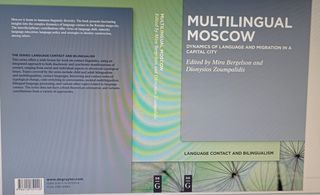
Multilingual Moscow. Dynamics of Language and Migration in a Capital City
Berlin: De Gruyter Mouton, 2024.
Similar publications
Язык и идентичность польской этноязыковой группы в Нижнем Новгороде
Balakina Y. V., Gronskaya N. E., Региональные исследования 2018 Т. 62 № 4 С. 28–35
The following research article is devoted to the problem of self-identification of ethnolinguistic groups in the context of a modern city. The relevance of the present study is determined by the need to identify alternative factors that affect the preservation of the language and identity of small minority groups in modern urbanized environment. Polish ethnolinguistic ...
Added: October 1, 2017
  • About
  • About
  • Key Figures & Facts
  • Sustainability at HSE University
  • Faculties & Departments
  • International Partnerships
  • Faculty & Staff
  • HSE Buildings
  • HSE University for Persons with Disabilities
  • Public Enquiries
  • Studies
  • Admissions
  • Programme Catalogue
  • Undergraduate
  • Graduate
  • Exchange Programmes
  • Summer University
  • Summer Schools
  • Semester in Moscow
  • Business Internship
  • Research
  • International Laboratories
  • Research Centres
  • Research Projects
  • Monitoring Studies
  • Conferences & Seminars
  • Academic Jobs
  • Yasin (April) International Academic Conference on Economic and Social Development
  • Media & Resources
  • Publications by staff
  • HSE Journals
  • Publishing House
  • iq.hse.ru: commentary by HSE experts
  • Library
  • Economic & Social Data Archive
  • Video
  • HSE Repository of Socio-Economic Information
  • HSE1993–2026
  • Contacts
  • Copyright
  • Privacy Policy
  • Site Map
Edit